The Ghost Trees: Are Spiders Weaving a Warning to the World?
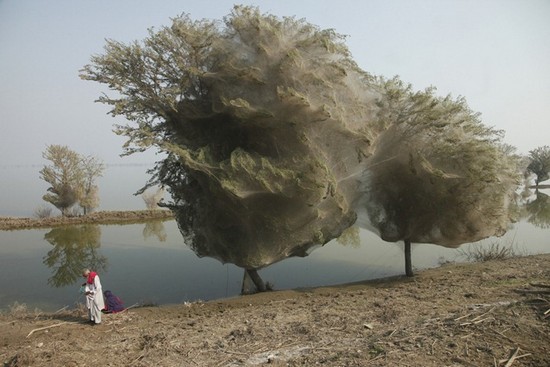
Look at that picture. Really look at it.
It’s something ripped from a nightmare. A landscape sculpted by H.R. Giger. Trees, once bursting with life, now stand as silent, shrouded monoliths. They are entombed in silk. Mummified.
What ancient, alien force could be responsible for such a spectacle?
The answer is almost more terrifying than the fiction.
Spiders. Millions of them.
This isn’t a Hollywood special effect. This is Pakistan, 2010. And it’s not the only place on Earth where our eight-legged neighbors have started behaving in ways that defy everything we thought we knew about them. The official story is simple. The reality? The reality is far, far stranger. It hints at a global shift, a silent revolution happening right under our noses, and these ghost trees might just be the first warning sign.

Cataclysm in Pakistan: The Birth of the Cocoon Trees
Let’s set the scene. The year is 2010. Pakistan is drowning. The monsoon season unleashes a fury unlike any seen in living memory. The floods are biblical. A fifth of the country is submerged. Homes, farms, lives—all washed away in a torrent of muddy water. It’s a tragedy on an unimaginable scale.
And in the midst of this human catastrophe, something else was happening. Something unnoticed at first.
As the waters rose, the creatures of the ground had to flee. Snakes, rodents, insects… and spiders. Trillions of them. With the ground gone, their only option was up. They scrambled into the trees, seeking refuge from the relentless deluge.
But they didn’t just wait.
They built. And they never stopped.
The result was this horrifying, ethereal spectacle in the Sindh province. Tree after tree was wrapped in a thick, silvery shroud of webbing. It was an unexpected side-effect of the flood, a bizarre footnote to a national disaster. Scientists said it was simple: millions of spiders, trapped in close quarters, each spinning their own web, which eventually merged into a single, massive cocoon.
Case closed, right? Just a weird weather event.
Not even close. That’s just where the questions begin.
A Deep Dive: The Mosquito Miracle
There was a strange silver lining to this arachnid apocalypse. The local people of Sindh, while initially terrified by the spectral trees, began to notice something remarkable. The mosquitos were gone.
In a region where malaria is a constant, deadly threat, the swarms of disease-carrying insects simply vanished. These colossal webs, it turned out, were the most effective mosquito nets in history. They were catching insects by the billion. The UN Department for International Development even noted a significant drop in malaria cases in the area. A beautiful, deadly trap. A natural solution born from a natural disaster.
But this “miracle” only deepens the mystery. Spiders are typically hyper-territorial. They are cannibals. They don’t cooperate. So how did millions of them live together in these trees for months without slaughtering each other? Why did they create a unified structure instead of a chaotic mess of competing webs? The “simple survival” explanation starts to feel a little too neat, a little too clean.
The Texas Web of Terror: A Different Kind of Monster
Let’s rewind three years. 2007. Lake Tawakoni State Park, Texas. Thousands of miles from the floods of Pakistan, another arachnid enigma was unfolding. Park-goers began reporting something unbelievable.
A web. A single, enormous, sprawling web.
It wasn’t just in one tree. It blanketed dozens of trees, shrubs, and the ground between them. It stretched for 200 yards. Two. Hundred. Yards. That’s the length of two football fields. It drooped from branches like grotesque Spanish moss and glowed an eerie white in the sunlight. It was a scene so outlandish that the park superintendent initially dismissed the reports as a prank.
Then he saw it for himself.
Entomologists swarmed the site, their minds blown. This wasn’t supposed to happen. Spiders, with very few exceptions, are solitary killers. Their webs are their personal hunting grounds. The idea of them collaborating on a single, massive construction project was, to put it mildly, against the rules.

This was different from Pakistan. There was no flood. This was a deliberate, cooperative effort. It was a mega-colony. A city of silk.
Specialists took samples. They studied over 240 specimens from the monstrous web. What they found only made things weirder. It wasn’t one type of social spider. They identified twelve distinct families of spiders, many of them species that are normally viciously solitary. It was as if wolves, bears, lions, and house cats had all decided to put aside their differences and build a city together.
There was no consensus. No easy answer. Some experts theorized it was a unique convergence of conditions—a boom in the insect population providing unlimited food, perfect weather—that temporarily suppressed the spiders’ aggressive instincts. A “once-in-a-lifetime phenomenon.”
But what if it wasn’t?
What if Texas wasn’t a freak event, but a field test? What if Pakistan wasn’t just a reaction, but an adaptation?
Are Spiders Evolving Before Our Eyes?
This is where we leave the comfortable world of mainstream science and venture into the shadows. The two events, Pakistan and Texas, seem unrelated on the surface. One caused by a flood, the other appearing out of the blue. But they share one deeply unsettling commonality: massive, unprecedented cooperation among creatures that should be tearing each other apart.
Could we be witnessing a fundamental change in spider behavior? Is environmental pressure—from climate change-fueled disasters like the Pakistan floods to more subtle shifts in food supply like the one in Texas—forcing a rapid, shocking evolutionary leap?
What if… They’re Becoming a Hive Mind?
Let’s explore a radical idea. On the internet, forums and message boards buzz with a wild theory. The “Arachnid Hive Mind” hypothesis. It suggests that spiders, through some unknown mechanism, are developing a form of collective intelligence.
Think about it. Ants and bees operate as superorganisms, where the colony is the individual. What if spiders are developing a similar capability, but in a decentralized way? Perhaps they’re communicating through vibrations in their webs on a scale we can’t comprehend. Maybe they’re responding to chemical signals or atmospheric changes that we are completely oblivious to.
The Texas web wasn’t just a bunch of webs next to each other; it was a cohesive structure. The Pakistan webs, while born of chaos, showed a strange uniformity. In both cases, millions of individual survival instincts were seemingly overridden by a larger, collective purpose: build. Expand. Dominate.
The Chemical Connection: Are We a Part of the Problem?
Another popular theory points the finger directly at us. What have we been pumping into our environment for the last century? Pesticides, herbicides, industrial chemicals, agricultural runoff, pharmaceuticals in our water supply. The list is endless.
We know these chemicals have bizarre effects on wildlife. They can alter hormonal balances, reproductive cycles, and neurological function. Is it so crazy to think that some chemical cocktail in the water at Lake Tawakoni, or in the floodwaters of the Indus River, could have flipped a switch in the spider brain?
Perhaps a specific pollutant is short-circuiting their territorial aggression. Maybe it’s enhancing their silk production. We’re running a massive, uncontrolled chemical experiment on a global scale, and these ghost trees and mega-webs could be one of the terrifying results. We intended to control pests, but we may have accidentally created a new kind of monster: the social spider.
A Pattern Emerges: Whispers from Around the World
Once you start looking, you see it everywhere. These aren’t just two isolated events. They are the most famous, the most photogenic, but they are not alone.
- Madagascar (2015): Reports surface of the Darwin’s bark spider, a species already known for making huge webs, creating structures that span entire rivers, far larger and more complex than previously documented.
- Australia (2012): After floods in Wagga Wagga, a similar phenomenon to Pakistan occurs. Entire fields are blanketed in a ghostly layer of silk as spiders flee the rising water, an event locals called “spider frost.”
- Brazil: Deep in the Amazon, scientists have noted certain species of social spiders expanding their territories and building colonies of a size and complexity that are startling researchers.
Individually, each of these is a curiosity. An oddity for a nature journal. But when you connect the dots, a disturbing pattern emerges. All over the world, spiders are breaking their own rules. They are working together, building bigger, and acting stranger.
The Final Question: Is This a Warning?
Let’s step back. Forget the science for a moment and just feel it. What does a world being draped in spider webs feel like?
It feels like a conquest. It feels like reclamation.
Maybe the wildest theory of all is the most simple. Maybe the Earth is sick. Maybe it has a fever. And we are the virus. In this “Gaia hypothesis” view, the planet is a single, living organism. And when an organism is attacked, its immune system kicks in.
What if the spiders are part of that immune system? What if their strange new behavior is a response, not just to a flood or an abundance of crickets, but to us? A planet-wide signal is going out, and the spiders are answering the call. The webs are a symptom. A visible sign of the planet trying to fight back, using its oldest and most numerous creatures to literally bind up the world.
The official story will always be there. It’s neat. It’s tidy. It’s just spiders escaping a flood. It’s just a weird season in Texas. Pay no attention to the ghostly trees. Don’t worry about the web that’s bigger than your house.
But those of us who look closer see something else. We see an anomaly that defies easy explanation. We see a fundamental law of nature being rewritten in real-time. The question is no longer “What caused this?”
The real question is, “What happens next?”
Because the next time you see a web that seems a little too big, or two spiders working a little too closely together, stop and watch. You might be looking at a simple fluke of nature. Or you might be witnessing the front line of a silent, silken invasion that has already begun.
Originally posted 2016-04-11 12:28:18. Republished by Blog Post Promoter