Friday, September 11, 2026
HomeAncient & Lost CivilizationsHistorical MysteriesRobotic 'mermaid' retrieves deep sea treasure

Robotic ‘mermaid’ retrieves deep sea treasure

The Mer-Bot and the Sun King’s Ghost: Cracking a 350-Year-Old Mystery With a Robot You Can Feel

The abyss is silent. It’s a place of crushing pressure and eternal darkness, a domain that has swallowed empires whole and kept their secrets locked away for centuries. Down there, history isn’t written in books. It’s scattered across the seafloor, guarded by the immense, unforgiving weight of the ocean.

For most of human history, these lost worlds were beyond our reach. To go that deep was to die. Simple as that. Divers, even in the most advanced suits, were just fragile bags of bone and blood, seconds away from being crushed into nothing. The treasures of the deep remained the stuff of legend.

Until now.

Because something new has entered the water. It isn’t human. But it has hands. It has eyes. And for the person controlling it, miles away on the deck of a ship, it even has a sense of touch.

Enter OceanOne: The Humanoid for the Abyss

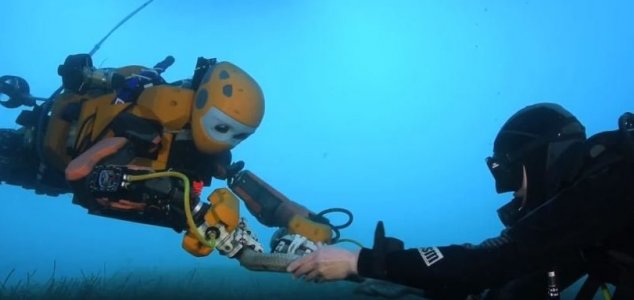
Forget what you think you know about underwater drones. Those are clumsy, remote-controlled boxes with pincers. This is different. This is a game-changer. Scientists at Stanford University, led by computer science professor Oussama Khatib, created something that blurs the line between man and machine.

They call it OceanOne.

It looks vaguely human, and that’s on purpose. It has a “head” packed with cameras that act as its eyes, providing a crystal-clear, 3D view of the underwater world to its pilot. It has two fully articulated arms, complete with dexterous hands that can manipulate delicate objects with astonishing precision. It even has its own thrusters to move and hover in the water like a diver.

But here’s the part that will bend your mind. The pilot doesn’t just *see* what the robot sees. Thanks to an incredible technology called haptic force feedback, the pilot *feels* what the robot feels.

Imagine this. You’re sitting in a control chair on a boat, the sun on your face. You slip your hands into a set of controls. A thousand feet below, OceanOne mirrors your every move. When its robotic fingers touch the smooth, cold curve of a sunken vase, you feel that smoothness. You feel the cold. When it lifts a heavy object, you feel the resistance, the weight. The system is so advanced, the feedback so instantaneous, it’s like your consciousness has been teleported into a machine body.

“OceanOne will be your avatar,” Professor Khatib explained. “The intent here is to have a human diving virtually, to put the human out of harm’s way.” He’s not exaggerating. “You can feel exactly what the robot is doing,” he said. “It’s almost like you are there; with the sense of touch you create a new dimension of perception.”


An amazing tool for science? Absolutely. But to test its true power, you need a legendary challenge. You need a ghost.

Deep Dive: The Ghost Ship of the Sun King

The year is 1664. King Louis XIV, the extravagant and all-powerful “Sun King,” rules France. His ambition is limitless, his navy a symbol of his global might. At the heart of that navy is his flagship, *La Lune* (The Moon).

She was more than a ship. She was a statement. A floating fortress, a vessel of conquest. But pride, as they say, comes before a fall.

A King’s Pride, A Watery Grave

Returning from a military campaign in North Africa, *La Lune* was battered and leaking, carrying hundreds of soldiers, many of them sick or wounded. The ship’s commander, desperate to make port in Toulon, France, ignored warnings from port authorities about the ship’s poor condition and an impending storm. He was ordered to quarantine offshore.

It was a death sentence.

The storm hit. The damaged ship, overloaded with men and cannons, stood no chance. In the raging winds and mountainous waves, *La Lune* broke apart and sank like a stone. Of the nearly 1,000 souls on board, fewer than 100 survived. The Sun King’s pride was gone, swallowed by the Mediterranean.

For 350 years, *La Lune* became a phantom. Everyone knew the story, but the wreck’s location remained a mystery. It lay in water over 300 feet deep—too deep and dangerous for divers of the past. The immense pressure and darkness kept its secrets safe. It was an untouchable tomb, a time capsule from the 17th century that no one could open.

The Mission: Touching the 17th Century

This was the challenge chosen for OceanOne. Could this new-age avatar succeed where centuries of human effort had failed? Could it reach into the past and bring back a piece of the Sun King’s lost world?

The team positioned their research vessel over the wreck site. The air was thick with anticipation. This wasn’t just another test run in a controlled pool. This was real. A real shipwreck. A real piece of history hanging in the balance.

The humanoid robot was lowered into the blue depths. On the screen, the pilot saw the world through the robot’s eyes. The light faded, the water turned from blue to black, and the ghostly outline of a massive shipwreck emerged from the gloom.

It was *La Lune*.

The operator, Oussama Khatib himself, guided the robot through the debris field. Wooden beams, cannons, the remnants of a once-mighty warship lay scattered across the seabed. Using the robot’s hands, he gently brushed away centuries of silt. And then he saw it.

A small, beautifully preserved vase. It was perfectly intact. A fragile piece of pottery that had survived the violent sinking and rested in total darkness for three and a half centuries.

The Haptic Sensation: A Handshake Across Time

This was the moment of truth. Reaching out with the robot’s arm, the pilot’s own hands mimicked the motion. The robot’s fingers closed around the vase. On the ship, Khatib felt it. He felt the delicate curve of the pottery. He felt its texture, its weight. He was, in a very real sense, touching an object that had last been held by a French sailor in 1664.

Gently, carefully, he lifted the vase. He could feel its balance, ensuring he didn’t apply too much pressure and shatter this priceless link to the past. He maneuvered it into a specially designed recovery basket. The mission was a success. History had been made.

“Having a machine that has human characteristics that can project the human diver’s embodiment at depth is going to be amazing,” Khatib beamed. He was right. They had proven the concept. The impossible was now possible.

What They Aren’t Telling Us: The Real Purpose of the Deep-Sea Avatar?

This is where the official story ends. A brilliant robot, a historic shipwreck, a happy ending for science. But we have to ask the questions nobody else is asking. Do you really think this billion-dollar technology was created just to pick up old pottery?

The recovery of the vase from *La Lune* was a fantastic proof-of-concept. A public demonstration. But what is the *real* application for a remote-operated, human-like robot that can go to depths humans can’t and perform delicate tasks?

The possibilities are staggering. And a little terrifying.

Corporate Gold Rush on the Seafloor

Think about deep-sea mining. The ocean floor is littered with rare-earth metals, gold, cobalt—the building blocks of our modern technological world. The problem has always been getting to them. Human divers can’t do it. Clumsy ROVs are inefficient. But a fleet of OceanOnes? Controlled by operators working 8-hour shifts in a comfortable office? They could strip-mine the ocean floor 24/7, with no risk to human life. Corporations are drooling over this. It’s a license to print money, and the environmental consequences are someone else’s problem.

The Military Connection

Now, let’s think darker. Every major technological leap has military applications. Every single one. A robot that can operate undetected in the crushing depths of the ocean? A robot that can manipulate objects with human-like dexterity?

What about retrieving downed spy satellites or stealth drones before your enemy does? What about tapping into or cutting undersea fiber optic cables, the very backbone of the internet and global communications? Or how about covertly salvaging technology from sunken enemy submarines? An OceanOne avatar could perform repairs on a nuclear sub, or even sabotage one, all while the human pilot sits safely thousands of miles away.

The South China Sea. The North Atlantic. Tense, strategic waterways where submarines play a constant game of cat and mouse. Whispers on deep-web forums are already speculating that second and third-generation versions of this tech are being secretly tested by DARPA. They say the *La Lune* mission wasn’t a scientific expedition; it was a public relations cover for a military-industrial project of immense importance.

Internet Theories and The USO Connection

Go deeper down the rabbit hole. For decades, sailors and military personnel have reported strange sightings of Unidentified Submerged Objects, or USOs. Craft that move at impossible speeds underwater, defying our known laws of physics. The official explanation is always swamp gas, weather balloons, or mass delusion. Funny how that works.

But what if something was recovered? What if, decades ago, a non-human craft was secretly salvaged from the depths of the Puerto Rico Trench? The popular online theory is that much of our “modern” leap-forward technology—fiber optics, microprocessors, stealth tech—is the result of reverse-engineering such a find.

Is it such a stretch to think that a haptic-feedback avatar, a way for a human to “virtually” enter a hostile environment, was a technology they desperately needed to study or repair a recovered craft? Maybe OceanOne isn’t a new invention. Maybe it’s just the first version they’re willing to show us.

A Future Without Us in the Water?

The creation of OceanOne marks a profound shift. We are on the verge of taking the human body out of the equation for exploration. It’s safer. It’s more efficient. We can stay down longer, go deeper, and do more than any human diver ever could.

But are we losing something? The raw, unfiltered experience of being there. The primal thrill and terror of descending into the black. We are becoming spectators, piloting a machine body from a sterile control room. We gain access, but we lose the direct connection. It’s the ultimate outsourcing of adventure.

The story of OceanOne and *La Lune* is more than just a cool tech demo. It’s a crossroads. It’s the moment we created a ghost in the machine capable of touching the ghosts of our past. But it also opened a door to a future where fleets of these cybernetic divers are deployed for reasons far beyond archaeology. They could be mapping the seafloor for oil, fighting silent wars in the deep, or recovering things that the powers-that-be insist don’t exist.

The next time you see a story about a remarkable robot exploring a shipwreck, remember OceanOne. Remember the Sun King’s ghost ship. And ask yourself: what are they *really* looking for down there in the dark?

Arindam Mukherjee
Arindam Mukherjee
Arindam loves aliens, mysteries and pursing his interest in the area of hacking as a technical writer at 'Planet wank'. You can catch him at his social profiles anytime.
RELATED ARTICLES
- Advertisment -

Most Popular

Recent Comments

Warren Pan Abbott on The legend of the Devil Monkey !
chris davies on The McPherson Tape Mystery
Reed Reedly on ET has Internet!
Bea Houseoffashion on Proof Of Time Travellers – Gallery
Marcus2012 on ET has Internet!
Reed Reedly on ET has Internet!
LaughsAtConspiracyNuts on The 9/11 Conspiracy – Myths and Facts
Alex Sliverman on Did the ancients fly?
Doctor Wholigan on Time Traveler in 1938 film
chris davies on The McPherson Tape Mystery
Archie1954 on 10 secret UFO hideouts
chris davies on Ghosts of flight 401
Marcus2012 on ET has Internet!
jason Macdonald on Proof of Time Travel? – China
chris davies on Long-Lost Pyramids Found?
Reed Reedly on ET has Internet!
Milkman on Connected Universe
Tenmiles on Baigong Pipes Mystery
Simon Foster on Sirius – The Documentary
From the 1st April on 2013 – Alien Contact date ?
SkyWatcher on Is ET ignoring us?
I Come From The Future on Obama to make UFO Alien disclouser soon ?
Just another person on 2013 – Alien Contact date ?
Malcolm Windowcleaner on The strange case of Rudolph Fentz
Mason Servio on Strange Things on Mars
Marke Wisdom Seeker on What will we find as arctic melts?
Andrea A Elisabeth Levyne on Aliens Captured in Varginha, Brazil
Mitch Grouyeki on Amazing Space Shuttle pictures