The Billion-Dollar Ghost: Unraveling Saddam Hussein’s Final Heist
The air in Baghdad was thick. Heavy. Not just with sand, but with a palpable dread. It was March 18th, 2003. The world was holding its breath, and the people of Iraq were waiting for the sky to fall. They knew it was coming. An invasion. A war broadcast on live television. But in the pre-dawn stillness, under the cloak of that final, fragile peace, a crime of unimaginable scale was quietly unfolding. A crime that would become one of history’s greatest and most enduring mysteries.
This wasn’t a smash-and-grab. No ski masks. No getaway cars with screeching tires. This was something else entirely. This was a state-sanctioned disappearance. The dictator of a nation, on the very eve of his destruction, decided to empty the national piggy bank.
We’re talking about the biggest bank job of all time. And the man holding the gun was the one who owned the bank.
A Note in the Dark
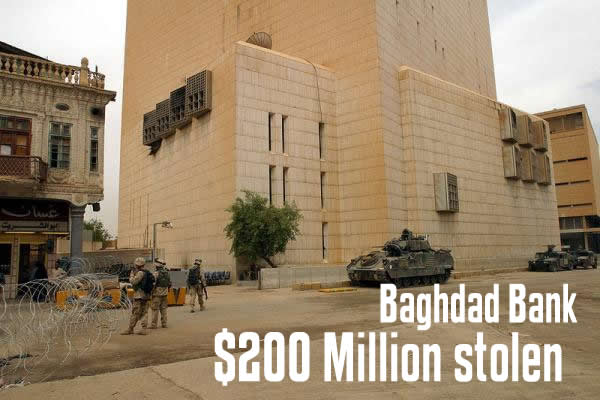
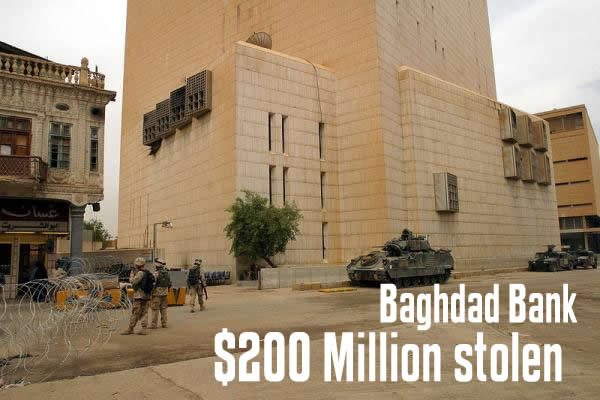
Imagine being the governor of Iraq’s Central Bank. The phone rings at 4 a.m. You’re ordered to come in. Immediately. The streets are unnervingly quiet, patrolled by the shadows of soldiers loyal to a doomed regime. You arrive at the grand, imposing building that holds the nation’s wealth, only to be met not by accountants, but by one of the most feared men in the country: Qusay Hussein, Saddam’s youngest son and heir apparent.
He isn’t there to make a polite request. He carries with him a simple, handwritten note.
The note is from his father. It’s an order. A command to move a staggering sum of money for reasons of “national security,” to protect it from foreign hands. The amount? Nearly one billion American dollars. Plus a hoard of Euros.
What do you do? Do you argue? Do you ask for a more official-looking document? Do you quote banking regulations to the son of a man who ruled with absolute, brutal authority for decades? Of course not. You do exactly what you’re told. You open the vaults.
Three Trucks, Ten Tons of Secrets
The logistics alone are mind-bending. One billion dollars. Think about that. Even in crisp, clean $100 bills, the largest denomination in wide circulation, a billion dollars is a physical object of immense proportions. It weighs roughly 10 metric tons. That’s the weight of two large elephants. It would fill hundreds of boxes. This wasn’t a briefcase full of cash; this was a logistical operation.
For five long, tense hours, bank workers, under the watchful eyes of Qusay and his personal guard, hauled box after box of bundled American currency. They loaded three massive tractor-trailers. Pallet after pallet of a nation’s future, stacked and bound for an unknown destination.
As the sun began to rise over Baghdad, casting long shadows that would soon be erased by bomb flashes, those three trucks rumbled out of the bank’s loading docks and simply… vanished. They drove off into the annals of history, carrying a treasure that would fuel speculation, conspiracy, and conflict for years to come.

The World’s Strangest Treasure Hunt
Just over 24 hours later, the bombing began. “Shock and Awe.” The invasion was swift. The regime crumbled. Statues of Saddam were pulled from their pedestals and beaten with shoes in the streets. But as Coalition forces secured the capital, they began hearing whispers. Rumors. A story so outlandish it had to be true.
The story of the missing billion.
Suddenly, American soldiers weren’t just fighting a war; they were on the biggest treasure hunt in modern history. The hunt for Saddam’s loot became a bizarre, unofficial side-mission of the entire occupation.
The Palace Walls Speak
The palaces were the first place to look. Saddam Hussein’s network of opulent, gaudy, and sprawling compounds were monuments to his ego. And it was within one of these palaces that investigators got their first big break.
It was almost laughably simple. Acting on a tip, soldiers from the 1st Battalion, 22nd Infantry Regiment, began inspecting a nondescript outbuilding in one of Saddam’s many presidential estates. Behind a false wall, they found it. Metal boxes. Aluminum cases sealed with green tape. Stacks and stacks of them.
Inside? A fortune. Bundles of pristine, sequentially numbered $100 bills. When they finished counting, the total came to an unbelievable $650 million.
It was a stunning discovery. The photos went viral before “going viral” was even a common phrase. Soldiers, barely out of their teens, posing with literal mountains of money. It was the ultimate pirate booty, found in the heart of a dictator’s lair. For a moment, it seemed the mystery was solved. The money was found. The case was closed.
But it wasn’t. Because if they found $650 million… where was the rest?
The $350 Million Question
This is where the story gets really interesting. This is where it leaves the world of known facts and enters the realm of shadow and rumor. Three hundred and fifty million dollars doesn’t just evaporate. It had to go somewhere. And with Saddam and his sons Qusay and Uday all dead by the end of 2003, the men who knew the secret took it to their graves. All we are left with are the theories. Chilling, plausible, and utterly unprovable.
Theory 1: The Insurgency Super-Fund
This is the theory favored by military intelligence and analysts. Saddam wasn’t stupid. He knew his conventional army stood no chance against the American military machine. He had seen the first Gulf War. He knew his only chance was a long, bloody, asymmetrical fight—an insurgency.
What does an insurgency need to survive and thrive? Money. Lots of it. Money to buy weapons on the black market. Money to pay fighters and suicide bombers. Money to bribe officials and fund propaganda. Money to keep the fight going for years.
$350 million would be the perfect seed capital for a decade of chaos. It’s a war chest of almost unlimited potential.
Could this cash, siphoned off in the final hours, have been the very fuel for the fire that U.S. forces would spend the next eight years trying to extinguish? Was every roadside bomb, every ambush, every attack indirectly funded by this audacious last-minute withdrawal? It’s a chilling thought. The idea that the architects of the invasion were, in a way, chasing money that was actively being used to kill them.
Theory 2: The Golden Parachute
What if it wasn’t about fighting? What if it was about fleeing?
Saddam’s inner circle was vast. He had family, loyal generals, Ba’ath party officials, and cronies who had everything to lose. While Saddam himself might have planned to go down with the ship, he may have arranged an escape plan for others. A golden parachute to ensure his legacy—or at least his loyalists—survived.
The borders in the early days of the war were porous. A fortune could easily be smuggled across into Syria or Jordan, then wired anywhere in the world. This money could have been used to set up dozens, if not hundreds, of his followers with new lives, new identities, and extreme wealth in foreign countries. Are there former Iraqi officials living quiet lives of luxury in Europe, Asia, or South America, their fortunes built on a foundation of stolen American dollars? It’s entirely possible. The money was a ticket to a new life, a reward for loyalty to the very end.
Theory 3: Lost in the Chaos (Or Stolen by Someone Else)
This theory is perhaps the most tantalizing. War is chaos. Baghdad in 2003 was the definition of chaos. Records were destroyed. People disappeared. Power structures collapsed overnight.
What if the money never reached its intended destination? What if the men driving one of those three trucks simply… kept driving? Faced with the choice of delivering a fortune to a doomed cause or setting themselves and their families up for generations, what would you choose?
Or what about a more conspiratorial angle? Could another intelligence agency—perhaps from a neighboring country with a vested interest in post-war Iraq—have intercepted the shipment? It would have been the intelligence coup of a lifetime, crippling the nascent insurgency before it even began and providing a massive undeclared slush fund.
There is no evidence. There are no witnesses. There is only the gaping hole where $350 million used to be.
Modern Internet Sleuths Weigh In
In the age of the internet, no mystery is ever truly cold. On forums like Reddit and in deep-dive YouTube videos, a new generation of investigators continues to pick apart the case. They track the serial numbers of the recovered bills, looking for sister notes that might pop up in global circulation. They scour veterans’ forums for deathbed confessions or long-forgotten stories from soldiers who were there.
Are The Digital Breadcrumbs Real?
Some theories posted online get wild. One popular idea is that the money was used to purchase a massive amount of gold bullion, which is untraceable and easier to transport. This gold was then supposedly smuggled out of the country piece by piece. Others claim to have found strange financial patterns, massive buy-ins at foreign real estate markets in the mid-2000s that could, if you squint, be linked back to shell corporations with Iraqi ties.
Is any of it true? Probably not. But it speaks to the power of this mystery. The sheer audacity of the crime invites us to fill in the blanks with our own imagination.
A Heist Bigger Than Fiction
History is filled with spectacular robberies. The Irish Republican Army (IRA) was notorious for funding its operations through bank heists. In 1976, the PLO is said to have blasted its way into a British bank in Lebanon during the civil war and made off with a fortune. But Saddam’s withdrawal was different.
This wasn’t a robbery *against* the state. It was a robbery *by* the state. It was a king emptying his own treasury before abandoning the castle. He didn’t break into the vault; he used his own key. This unique fact makes it less of a common crime and more of a final, defiant act of a ruler on the brink. A final exertion of absolute power.
The Lingering Shadow
The men who knew the truth are dead. The paper trail, a single handwritten note, likely turned to ash long ago. But the money, the $350 million ghost, is still out there. Its influence is a specter that hangs over modern Iraqi history.
Did it give the insurgency the head start it needed to plunge the country into years of bloodshed? Did it allow the worst remnants of a brutal regime to escape justice and live out their days in comfort? Or is it buried in a box somewhere in the Iraqi desert, waiting for a lucky goatherd to stumble upon it?
We will likely never know. The billion-dollar heist remains a perfect crime, a final, mysterious chapter in the story of a brutal dictator, and a secret that is now buried forever in the sands of time.