The 30-Year Ghost: Has the World’s Rarest Animal Just Returned From Extinction?
Deep in the abyss, where sunlight dies and the pressure is a crushing fist, something ancient stirs. Something that shouldn’t exist. A creature that haunted the dreams of one scientist for over three decades, a phantom of the deep that vanished without a trace. They called it a ghost. A one-time fluke. Maybe even a mistake.
But it’s back.
This isn’t just a story about a rare animal. This is a story about a living fossil, a time-traveler from an era before the dinosaurs, that blinked out of existence for a generation and has now reappeared. A creature so bizarre, so otherworldly, it defies our understanding of life on this planet. It asks a terrifying question: what else is lurking down there, in the dark we cannot see?
A Flicker on the Screen, A Ghost From 1984
Let’s rewind the tape. The year is 1984. The world is a different place. But deep in the waters off Papua New Guinea, biologist Peter Ward was about to have an encounter that would change his life. He and a colleague were studying one of Earth’s most ancient residents: the nautilus. These creatures are true survivors, swimming calculators of the deep, their beautiful, spiraled shells a testament to a design that has worked for 500 million years.
They thought they knew what to expect.
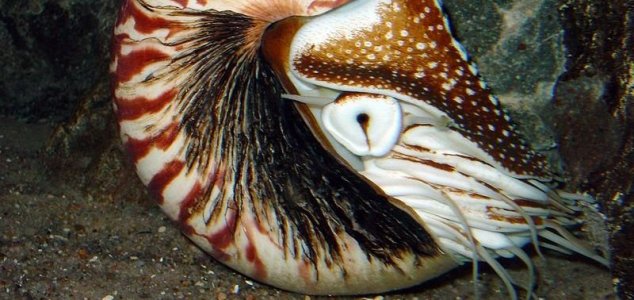
Then, something impossible drifted into view. It was a nautilus, yes, but… different. Wrong. It was covered in a strange, slimy, almost hairy-looking coat. A fuzzy nautilus. It was so distinct, so profoundly strange, that it couldn’t be just a variation. It had to be something new. They named it Allonautilus scrobiculatus.
And then, it was gone.
For more than thirty years, it was a ghost story whispered among marine biologists. A single sighting. A few photographs. Was it a real species? A genetic mutant? Had it gone extinct moments after humanity first laid eyes on it? The mystery deepened with every passing year. Searches turned up nothing. The fuzzy nautilus had become the stuff of legend.
Deep Dive: The Time-Traveling Submarine of the Seas
Before we go further, you need to understand why this is so mind-blowing. What exactly *is* a nautilus?
Forget sharks. Forget whales. The nautilus family is the true old guard of the ocean. Their ancestors, the ammonites, dominated the seas for hundreds of millions of years, their fossilized shells found on mountaintops across the globe. They were everywhere. Then came the asteroid. The one that wiped out the dinosaurs 66 million years ago. The sky burned, the oceans acidified, and the mighty ammonites were erased from existence.
But not the nautilus. Somehow, this little group of cephalopods clung to life.
How?
They are living, breathing time capsules. They move through the water using jet propulsion, shooting water from a siphon to glide through the abyss. They have more than 90 tentacles, but unlike an octopus or squid, they have no suckers. And their eyes are primitive, almost like pinhole cameras, unable to form sharp images. They literally see the world as a blurry, ancient place.
Their real secret, though, is the shell. That iconic, spiraled shell isn’t just armor. It’s a marvel of natural engineering. Inside, it’s divided into a series of gas-filled chambers. The nautilus can precisely control the amount of gas and liquid in these chambers, allowing it to change its buoyancy. It can rise and fall through the water column with minimal effort. It is a natural submarine. This incredible biological machine allowed it to retreat into the deep, stable waters of the ocean, riding out the apocalypse that consumed the dinosaurs above.

The creature in that picture? That’s the *Nautilus pompilius*, the common, well-known cousin. Smooth, elegant, and familiar. The animal Peter Ward saw was something else entirely. A renegade from the family tree.
The Hunt for the Holy Grail
Fast forward to 2015. Peter Ward, now a professor at the University of Washington, couldn’t let the ghost go. The memory of that fuzzy nautilus from 1984 haunted him. He had to know. So he assembled a team and returned to the same dark waters off Papua New Guinea, a place of deep trenches and undersea volcanoes.
This wasn’t easy. The target lives in a crushingly deep twilight zone, between 500 and 1,300 feet below the surface. You can’t just send divers down there. The pressure would turn a human body to pulp. So they relied on a simple, almost primitive method, updated with modern tech.
Every night, they lowered a “bait on a stick” system. A tempting morsel of fish and chicken meat suspended in front of a camera and lights, sent down into the blackness. They would wait for hours, watching the video feed, hoping for a sign. For days, they saw other nautiluses, sharks, and deep-sea fish drawn to the bait. But not the one.
The frustration must have been immense. Imagine searching for a ghost you saw once, thirty years ago, in an ocean that covers 70% of the planet. The odds were astronomical. The search was a shot in the dark. A literal shot, into the deepest, darkest parts of our world.
And then it happened.
A shape emerged from the gloom. It was a nautilus. But it was shaggy. Covered in that strange, slimy, hairy layer. It was him. *Allonautilus scrobiculatus*. The ghost had returned. Ward described it as a “holy grail.” And for good reason. He wasn’t just rediscovering a species; he was confirming a legend was real.
The team managed to trap a few specimens, bringing them to the surface in chilled water to study them. They attached trackers, trying to understand their movements, their depths, their secrets. Then, they released them back into the crushing blackness they call home.
What is That Fuzz? The Mystery of the Hairy Coat
So what is that bizarre, hairy coating? It’s not hair, not really. It’s a unique, thick, and slimy covering called a periostracum. While other nautiluses have a thin version of this layer when they’re young, *Allonautilus* keeps it its entire life, and it’s unlike anything else seen in the family.
But why? The deep sea is a world of brutal efficiency. Nothing is wasted. Every single feature on an animal has a purpose. So what’s the purpose of the fuzz?
The theories are wild.
- A Cloaking Device? Could this slimy coat be a form of camouflage? Perhaps it makes the shell less reflective, helping it blend into the murky darkness and avoid predators. Or maybe it collects silt and detritus from the seafloor, creating a natural ghillie suit.
- A Chemical Defense? Some speculate the slime could be noxious or foul-tasting, acting as a deterrent to any deep-sea hunter that might try to crack its shell. A living suit of chemical armor.
- A Sensory Organ? What if the “hairs” act like a massive network of feelers? In a world of near-total darkness where vision is almost useless, perhaps this coat allows the *Allonautilus* to “feel” its way through the water, detecting minute pressure changes or the vibrations of approaching prey or predators.
The truth is, nobody knows. It’s a question that scientists are desperately trying to answer. The biology of this animal is so alien it might as well be from another planet. It’s one of the newest animals known to science, yet it’s one of the oldest lineages on Earth. A walking, swimming contradiction.
The Race Against Oblivion
The rediscovery of the fuzzy nautilus is a moment of triumph. A beacon of hope. It shows us that the ocean still holds profound secrets, that creatures we think are lost can endure. But this story is also a warning.
A chilling one.
This creature, this survivor of mass extinctions, now faces its greatest threat: us. The very deep-sea environments where it hides are being targeted. Illegal fishing and the looming threat of deep-sea mining operations could destroy its habitat before we even begin to understand it. The nautilus shell is also prized by collectors, leading to overfishing that has decimated populations of the more common species.
Think about that. An animal that survived the asteroid that killed the dinosaurs might not survive the 21st century. We have just rediscovered a ghost, only to find we might be the ones to exorcise it for good. Ward himself said this could be “the rarest animal in the world.” We don’t know if its small population off Papua New Guinea is the only one. It might be the last pocket of survivors on the entire planet.
We are in a race against time. A race to explore, a race to understand, and a race to protect. The fuzzy nautilus is more than just a biological curiosity. It’s a messenger from a lost world. It’s a living testament to the sheer resilience of life, a puzzle box of evolutionary secrets that could tell us more about our own planet’s history than we can imagine.
The abyss is the last true frontier on Earth. We know more about the surface of Mars than we do about the bottom of our own oceans. Down there, in the cold, silent dark, things are hiding. Things are waiting. The fuzzy nautilus is proof. What other ghosts are swimming in the deep, waiting for their flicker on a scientist’s screen? And will we find them before it’s too late?