The Quimbaya Jets: Solid Gold Proof of Ancient High-Tech Flight?
Deep in the jungles of Colombia, buried for centuries, a treasure was unearthed. Not just any treasure. Not chests of coins or royal jewels. Something far more unsettling. Something that defies history as we know it.
Tiny, solid gold objects, crafted with breathtaking skill by a people lost to time. The Quimbaya civilization.
Mainstream history tells us they were a remarkable pre-Columbian culture, masters of metal, who thrived between 300 and 1550 CE. They left behind a legacy of goldwork that can make you weep. But among the pendants and figurines, a handful of artifacts stand apart. They are bizarre. They are controversial. And to a growing number of people, they are proof.
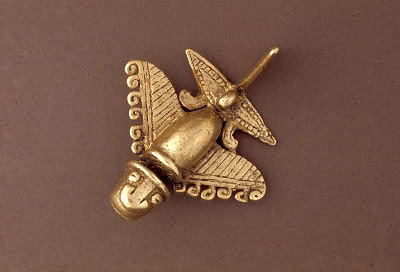
Proof that someone, long before the Wright Brothers, understood the laws of aerodynamics. Proof that high-tech flying machines ripped through ancient skies. Because when you look at these golden artifacts, you’re not seeing birds or insects.
You’re seeing jets.
The Goldsmiths of a Lost World
Before we get to the conspiracy, let’s get the official story straight. The Quimbaya were brilliant. Living in the mountainous regions of what is now modern Colombia, they were surrounded by natural wealth. They developed a society rich in culture and tradition. But their true genius? It was in metallurgy.
They weren’t just melting gold and pouring it into molds. They were alchemists. They perfected a beautiful and durable alloy called tumbaga—a blend of gold and copper. This wasn’t just about saving precious gold; it lowered the melting point, made the metal harder, and created a stunning reddish hue. It was advanced stuff.
And here’s our first little detour down the rabbit hole. Plato, in his famous dialogues about the lost city of Atlantis, speaks of a mysterious, gleaming red metal called “orichalcum,” second only to gold in value. Could tumbaga, this reddish-gold alloy from a culture mysteriously advanced in its craft, be the same legendary metal? It’s a stretch. A big one. But when you’re dealing with artifacts that look like they belong on an aircraft carrier, you start to connect dots others are afraid to touch.
A Discovery That Rewrote the Rules
For decades, these strange little gold objects sat quietly in the Gold Museum (Museo del Oro) in Bogotá, Colombia. They were cataloged as “zoomorphic,” a fancy word for “shaped like an animal.” Archaeologists nodded sagely and labeled them as stylized representations of birds, fish, or insects from the region. Case closed.
Nobody looked twice. After all, ancient cultures made animal figures all the time.
But then… people started looking closer. Much closer. And the official explanation started to fall apart. These didn’t look like any known animal. The proportions were all wrong. The features were… mechanical.

The whispers began in the fringes of archaeology, in the forums of ancient astronaut theorists and alternative historians. What if the experts were wrong? What if they were so locked into their dogma that they couldn’t see what was right in front of their faces? A blueprint.
Anatomy of an “Impossible” Machine
Let’s put one of these so-called “insects” under a microscope. When you strip away your preconceptions, the mechanical nature is simply staggering. It’s not just a vague resemblance. The design incorporates specific, complex aerodynamic features that shouldn’t exist in a piece of ancient art.
The Wings: A Lesson in Aerodynamics
Look at the wings. In almost every bird, bat, or insect on Earth, the wings are located on the top or middle of the body. It’s biomechanically efficient. But on the Quimbaya flyer, the wings are mounted at the bottom of the fuselage. This is a classic “low-wing” configuration, a design choice seen in countless modern fighter jets and transport planes. Why? It provides greater maneuverability and stability at high speeds.
Furthermore, the shape is not the gentle curve of a bird’s wing. It’s a distinct, triangular delta-wing design. Perfectly straight leading edges, a sharp sweep-back. This is the exact design used for supersonic aircraft like the Concorde and the F-106 Delta Dart. It’s a shape built for one thing: speed. It’s a terrible design for a low-speed animal, but a perfect one for a high-performance aircraft.
The Tail: Nature Doesn’t Build Them Like This
Here’s the absolute smoking gun for many investigators. The tail.
Think about every flying or swimming creature you know. Birds, bats, fish, insects. Their tails, their horizontal stabilizers, are always horizontal. They move up and down to control pitch. It is the universal design of nature.
But the Quimbaya artifact has an unmistakable, perfectly upright, vertical stabilizer tail fin. Just like a modern airplane. This feature is critical for preventing yaw—the side-to-side fishtailing motion—during flight. There is no known animal on this planet, living or extinct, that has a single, large, upright vertical tail fin. It is a purely man-made, technological solution to a problem of high-speed flight.
To dismiss this as “artistic license” is an insult to the intelligence of the Quimbaya and to our own eyes. It’s not an artistic choice; it’s an engineering one.
The Fuselage and Cockpit: More Than Just a Body?
The body itself is streamlined, a perfect tube that tapers at both ends. It’s a fuselage. And right at the front, where the pilot would sit, there’s a distinct bump or enclosure. Archaeologists call it the head. Believers call it the cockpit. Look closely at some of the artifacts, and you can even see markings that seem to delineate a windshield or canopy.
Is it just an eye? Maybe. But it’s placed in the exact right spot for a pilot to command the vehicle. The coincidences are just piling up too high.
From Ancient Gold to Modern Skies: The Test Flight
For years, this was all just heated debate. Speculation. But then, a few brave researchers decided to put their money where their mouth was. If this was an airplane, it should fly, right?
In 1997, two German aviation experts, Peter Belting and Conrad Lübbers, took on the challenge. They weren’t just hobbyists; they were serious model aircraft builders and flight theorists. They built exact, scaled-up radio-controlled replicas of the most famous Quimbaya “jet.” One was fitted with a simple propeller engine, the other with a true miniature jet turbine.
They made no “improvements” to the aerodynamic design. They copied the delta wings, the low-wing placement, the vertical tail fin—everything. The only modern additions were the engine and the control surfaces (ailerons and elevators) implied by the design.
The results were stunning. The models didn’t just fly. They flew perfectly.
They took off with ease, performed complex aerobatic maneuvers like rolls and loops, and landed smoothly even with the engines cut off, proving the design was also a fantastic glider. Belting and Lübbers were shocked. They concluded, unequivocally, that the object could not possibly be a depiction of an animal. It was, in their expert opinion, a flawless model of a high-performance aircraft.
The Official Takedown: A Storm of Skepticism
You can imagine how well this went over in the halls of mainstream archaeology. The pushback was immediate and fierce. The experts fired back with a barrage of counter-arguments, determined to ground these flying theories for good.
The Pareidolia Problem
The first and most common argument is pareidolia. This is the psychological phenomenon where our brains find familiar patterns in random data. We see faces in clouds, a man in the moon, and, according to skeptics, airplanes in ancient jewelry. They argue we are so surrounded by modern technology that we are projecting our own world onto the past. We see a jet because we *want* to see a jet.
But What About the Fish?
Archaeologists also point to a specific type of armored catfish from the region, the *Hypostomus plecostomus*. These fish have rigid pectoral fins that stick out to the side, a somewhat flattened body, and an upright tail fin. Skeptics argue that a stylized version of this fish could, after being passed through the lens of Quimbaya art, end up looking something like the golden flyers. It’s a plausible, if somewhat unsatisfying, explanation that conveniently ignores the perfect delta-wing shape and other aerodynamic details.
Where Is the Rest of It?
This is perhaps the skeptics’ strongest point. If the Quimbaya, or some earlier civilization, had aircraft, where is the other evidence? Where are the hangars, the landing strips, the engine blocks, the fuel refineries? Why would a culture with the ability to build supersonic jets leave behind nothing but a few tiny, inch-long gold trinkets? It’s a fair question. An entire technological ecosystem would need to exist to support such machines, and we have found absolutely no trace of it.
What If? Exploring the Unthinkable
But the evidence of the flying models is hard to ignore. The design is just too perfect. So if they aren’t just insects, and they aren’t a figment of our imagination, what are they? We are left with some truly mind-bending possibilities.
Possibility #1: A Lost Blueprint
What if this wasn’t a model of a *real* plane, but a conceptual one? Perhaps the Quimbaya had a genius in their midst, a lost Leonardo da Vinci who, through observation and brilliance, figured out the principles of flight. He couldn’t build a full-scale version, but he created these small golden models to preserve his revolutionary idea. A blueprint for a future that never came to pass.
Possibility #2: Echoes of Atlantis
Let’s go back to the tumbaga-orichalcum connection. What if the Quimbaya were the descendants of a much older, far more advanced civilization? A global culture that was wiped out by a catastrophe, like the mythical Atlantis. The survivors were scattered, their knowledge lost. All that remained were stories, legends, and a few sacred relics. The Quimbaya may not have known what these objects were; they just knew they were powerful symbols from the “before time,” the age of the gods. They copied them in their most sacred material, gold, preserving a technological ghost without ever understanding what it truly was.
Possibility #3: The Cargo Cult
This is the theory that launched a thousand TV shows. The Ancient Astronaut theory. The argument is simple: the Quimbaya were a primitive people who witnessed something extraordinary. They saw advanced flying machines, piloted by beings they could only interpret as gods. These “sky gods” descended from the heavens in loud, fast, delta-winged craft.
Terrified and awestruck, the Quimbaya did what humans have always done when faced with the divine. They worshipped it. They built effigies of the gods’ incredible sky-chariots, recreating them in perfect detail using the most precious substance they had. They weren’t inventing; they were recording. The Quimbaya jets are not proof of ancient human technology, but of an ancient alien encounter.
The mystery of the Quimbaya artifacts remains one of the most compelling puzzles in the world of OOPArts (Out-of-Place Artifacts). Are they nothing more than stylized insects and fish, twisted into familiar shapes by our modern eyes? Or are they something more? A forgotten blueprint? A memory of a lost golden age? Or a golden idol of a visitor from the stars?
The little jets sit silently behind glass in a museum in Colombia, keeping their secrets. They challenge our neat and tidy version of history. They ask us a simple, terrifying question: What if everything we think we know about our past is wrong?
Originally posted 2016-04-21 16:28:09. Republished by Blog Post Promoter