Home Unexplained Mysteries Modern Mysteries Proof of time travel? iPhone discovered in mysterious 350 year old picture

Proof of time travel? iPhone discovered in mysterious 350 year old picture

0
59

The Amsterdam Anomaly: Is That an iPhone in a 350-Year-Old Painting?

History isn’t always what it seems. We think of it as a fixed, settled thing. A collection of dusty books and faded photographs. A story with a clear beginning, middle, and end.

But what if it isn’t?

What if history is a river, with strange currents and eddies that pull things from one time into another? What if there are glitches in the timeline, tiny rips in the fabric of reality that leave behind baffling clues? Clues that, once you see them, you can never unsee.

Clues like a smartphone in a painting from 1670.

Yes, you read that right. We’re talking about a piece of technology that shouldn’t exist for another three centuries, sitting there plain as day in a Dutch masterpiece. It’s a mystery that has stumped art historians, fascinated internet sleuths, and even caught the attention of the one man who should know an iPhone when he sees one: Apple’s CEO.

Prepare to question everything. The past is calling.

A Quiet Scene, A Shocking Detail

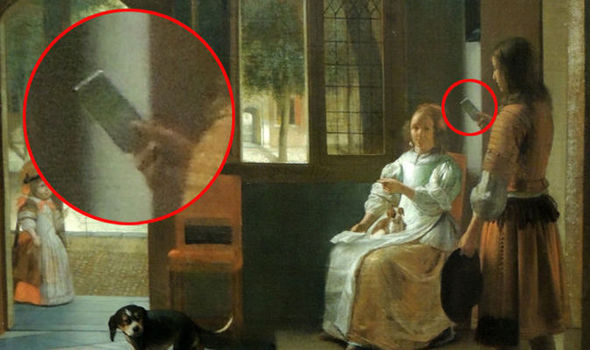
The painting at the heart of this storm is called “Man Handing a Letter to a Woman in the Entrance Hall of a House.” Not exactly a thrilling title. It was painted by Pieter de Hooch around 1670, a master of the Dutch Golden Age. He was famous for his quiet, domestic scenes, his brilliant use of light pouring through windows and doorways. Everything in its right place. Orderly. Calm.

Or so we thought.

Look at the painting. Really look.

Proof of time travel? iPhone discovered in mysterious 350 year old picture

You see a woman in a rich red dress, a loyal dog at her feet. A child plays in the background. And a man, standing in the shadows of the doorway, is handing her something. The title calls it a “letter.”

But that’s not a letter.

Look at the way he holds it. It’s a thin, black, rectangular object. He holds it at the bottom, thumb poised, almost as if he’s about to swipe up. His fingers are curled around the back. It’s the exact, unmistakable posture of someone holding a modern smartphone. He’s not presenting a piece of parchment; he’s showing her a screen. The light even seems to catch the top edge, giving it that familiar metallic sheen.

This isn’t just a fan theory cooked up in some forgotten corner of the internet. This anomaly is so jarring, so out-of-place, that it stopped the head of the world’s biggest tech company in his tracks.

When The Creator of the iPhone Was Left Speechless

The story goes like this. In 2016, Apple CEO Tim Cook was visiting Amsterdam. He was there for a tech festival, but took some time to visit the world-famous Rijksmuseum with a former European politician, Neelie Kroes.

As they strolled through the hallowed halls, surrounded by masterpieces, Kroes pointed to the de Hooch painting.

Cook froze.

Later, at a press conference, he confessed the experience left him shaken. “I always thought I knew when the iPhone was invented,” Cook told a stunned audience, “but now I’m not so sure anymore.”

He wasn’t joking. He described the moment of discovery, how he saw the strange object in the man’s hand. The reporter asked him what he thought it was. Cook’s reply? He said the “iPhone” in the painting did appear to be one of those made by his company.

Think about that. The man who inherited the legacy of Steve Jobs, who oversees the design and creation of every single iPhone on the planet, saw this 350-year-old painting and recognized his own product. When the expert’s expert admits something is impossibly strange, you have to sit up and pay attention. The mystery was no longer a fringe idea. It was mainstream.

The Skeptics Fire Back: A Case of Mistaken Identity?

Of course, not everyone is convinced. The official explanation is… boring.

Art historians and professional debunkers will tell you that the object is exactly what the title says it is: a letter. They argue that we are simply victims of our modern brains, a phenomenon known as pareidolia—where we see familiar patterns (like faces in clouds, or iPhones in paintings) in random objects.

They have their points. Let’s hear them out.

Theory 1: It’s Just a Letter

The argument is that letters in the 17th century weren’t always floppy scrolls of parchment. They were often folded into neat, compact rectangles, not unlike the size of a modern phone. Sometimes they were sealed with dark wax, which could explain the object’s black color. The “sheen” of light could just be the artist’s rendering of light hitting the wax seal or the edge of the folded paper.

Okay. Plausible.

But does it hold up? Look again at the man’s grip. It’s so specific. You hand a letter to someone differently. You present it. You don’t hold it vertically, pinched at the bottom, as if you’re protecting the screen from fingerprints. The posture is all wrong for a letter, but it’s perfect for a phone.

Theory 2: The Artist Is the Key

Who was Pieter de Hooch? Was he just an oblivious painter, or a witness to something extraordinary? De Hooch was part of a school of Dutch painters known as the “Fijnschilders,” or “fine painters.” They were obsessed with photorealistic detail. They painted textures, light, and reflections with a precision that was almost supernatural for the time.

So, here’s a thought. What if de Hooch was *so* good, so dedicated to painting exactly what he saw, that he painted the impossible object without question? Maybe a mysterious visitor appeared in that doorway, holding a strange black rectangle. De Hooch, being the master artist he was, simply painted what was there. He might not have understood it, but his job was to record reality. And in doing so, he accidentally recorded a glitch in time.

A Pattern of Glitches: More Phones Before Their Time

If this was just one isolated incident, we could maybe dismiss it. A trick of the light. An odd coincidence. But it’s not an isolated incident. Not even close.

Once you start looking for these “out-of-place artifacts,” you see them everywhere. It’s a breadcrumb trail of temporal paradoxes scattered throughout history, hiding in plain sight.

The Cell Phone in Chaplin’s Circus

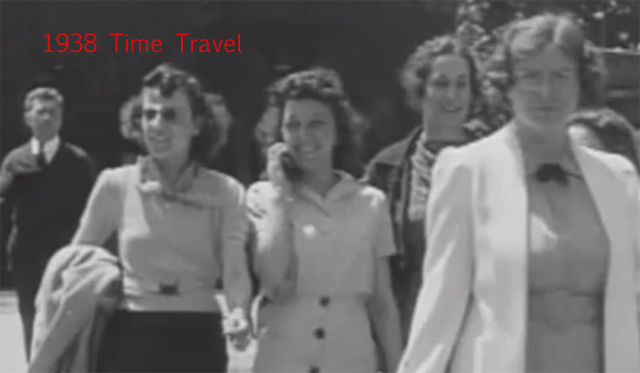
Let’s rewind to 1928. The silent film era. Charlie Chaplin releases his movie, “The Circus.” For decades, audiences watched it without noticing a thing. But with the dawn of high-definition transfers and the internet, someone did.

In the background of a scene showing the film’s premiere, a woman walks by. She is holding a black object to her ear. Her mouth is moving. She is clearly in the middle of a conversation. It looks for all the world like someone chatting on a cell phone.

In 1928.

Debunkers claim it’s a portable hearing aid, but the technology was clunky and barely existed in that form. And again, look at the posture. The casual way she holds it, the animated conversation… it’s a scene we see a hundred times a day in the 21st century.

The Laptop in Ancient Greece

Let’s go back even further. To around 100 B.C. Visit the Getty Villa in California and you’ll find a sculpture called “Grave Naiskos of an Enthroned Woman with an Attendant.” The sculpture shows a wealthy woman on a throne while a young servant holds up an object for her to inspect.

That object? It’s a thin, hinged box, roughly the size and shape of a modern laptop. The woman isn’t touching the surface; she’s touching the side of the “screen,” right where the USB ports would be. The servant holds it open at the perfect angle for viewing. Skeptics say it’s a wax tablet or a jewelry box. But a jewelry box with USB ports? The shape is too specific, too modern, to be easily dismissed.

And the list goes on. There are photos from the 1940s showing men in modern-looking hoodies and sunglasses. Murals from the Middle Ages that seem to depict space satellites. The evidence piles up, painting a picture of a past far stranger than we were ever taught in school.

Proof of time travel? iPhone discovered in mysterious 350 year old picture

The “What If?” Zone: Unpacking the Impossible

So, if these aren’t just mistakes or misinterpretations, what are they? What is the reality behind these temporal glitches? The possibilities are mind-bending.

What If… It’s Accidental Time Travel?

The most popular theory is, of course, time travel. Maybe someone from our future (or a future far beyond ours) took a trip back to 17th-century Holland. They were supposed to be a careful observer, a “temporal tourist” under strict orders not to interfere.

But they slipped up.

Maybe their phone came out of their pocket by accident. Maybe they were trying to use a translation app to communicate. For just a moment, their advanced tech was visible, and in that exact moment, a master painter was looking. It was a one-in-a-billion accident, immortalized forever in oil and canvas. This theory suggests that history is littered with the forgotten footprints and dropped gadgets of clumsy time travelers.

What If… It’s a Secret History?

Here’s a darker, more conspiratorial idea. What if advanced technology isn’t new? What if some secret group—an ancient order, an elite bloodline—has possessed technology far beyond the public’s knowledge for centuries?

In this scenario, the man in the painting isn’t a traveler from the *future*. He’s a member of a hidden society operating in the *present* of 1670. The “iPhone” isn’t a time-traveling device; it’s a piece of their hidden tech, used for secret communication. The painting isn’t a paradox; it’s a leak. A crack in the wall of secrecy, giving us a terrifying glimpse of the world as it truly is, run by shadowy forces with powers we can’t imagine.

What If… Our Reality is Changing?

This is the wildest theory of all. It connects these artifacts to the modern internet phenomenon of the Mandela Effect—the experience of large groups of people remembering history differently than it is officially recorded.

What if the timeline isn’t stable? What if it’s being subtly changed, either by accident or on purpose? Maybe in the original reality, the man in the painting *was* holding a letter. But a change made somewhere else in the timeline—someone stepping on the wrong butterfly—caused ripples to spread forward, altering small details. The letter became a phone. The memory of Nelson Mandela’s death changed. The Berenstain Bears became the Berenstein Bears.

In this view, the painting isn’t evidence of a time traveler visiting the past. It’s evidence that our *present* is an altered, edited version of what it once was.

A Letter, An iPhone, or a Clue?

So, what is the object in Pieter de Hooch’s painting? A simple letter, misunderstood by modern eyes? Or is it a key, a clue that unlocks a much bigger, more frightening picture of the world? Is it proof that time travel is real? That a secret society controls history? Or that the very fabric of our reality is unraveling?

The official story is safe. It’s comfortable. It tucks history away neatly where it belongs.

But the questions remain.

The next time you’re in a museum, or watching an old movie, or flipping through a history book, don’t just glance. Look closer. Pay attention to the details in the shadows, the objects that seem just a little too modern, a little too familiar. The past is not as dead and buried as you think. And sometimes, if you look hard enough, you can see it staring right back at you, holding a phone it shouldn’t have.

Originally posted 2016-08-25 06:27:19. Republished by Blog Post Promoter