More craters expected to form due to such eruptions as permafrost melts – and they ARE caused by global warming releasing methane gas.
Scientists from the respected Trofimuk Institute of Petroleum Geology and Geophysics insist the process by which a series of craters formed was caused by the melting of gas hydrates and the emission of methane. Picture: Vladimir Olenchenko/Trofimuk Institute of Petroleum Geology and Geophysics
A new expedition to one of the mysterious Siberian giant holes found in recent years has concluded that it is a warning sign of a deadly threat to northern regions as the climate warms.
Scientists from the respected Trofimuk Institute of Petroleum Geology and Geophysics insist the process by which a series of craters formed was caused by the melting of gas hydrates and the emission of methane.
This accumulates in a pingo – a mound of earth-covered ice – which then erupts causing the formation of the strange holes that have appeared on Russia’s Arctic fringe.
A pingo believed to be poised to explode ‘at any moment’ is now being constantly monitored by a Russian space satellite in an attempt to catch the moment when the eruption occurs.
They believe the process is similar to the Bermuda Triangle phenomenon which saw the disappearance of of ships and aircraft. This was caused by a vast eruption of methane below the Atlantic Ocean. The scientists also warn of a dire threat to both towns and cities in the extreme north, and natural gas exploration facilities and associated pipelines.
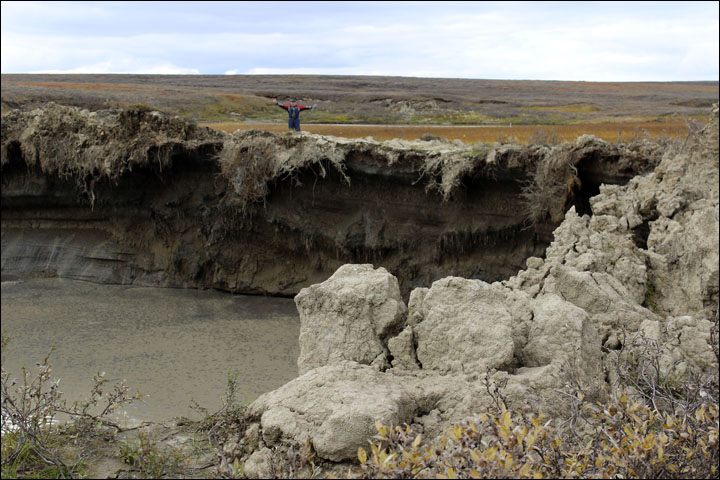
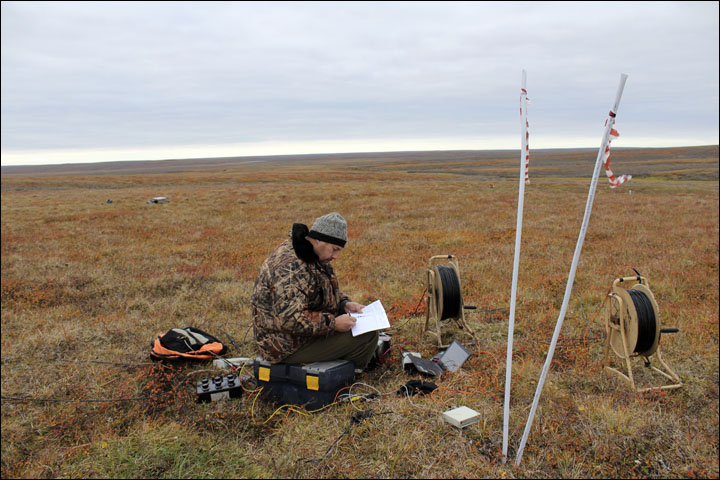
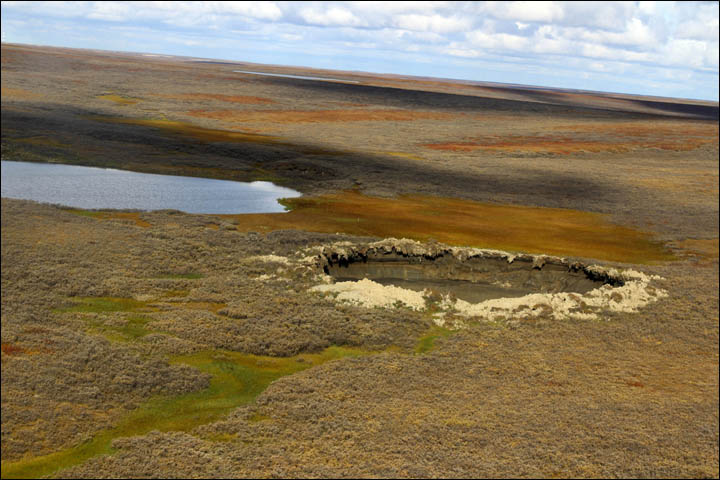
The Yamal hole is a unique object for science. We did not have any chance to study such phenomenon before. Pictures: Vladimir Olenchenko/Trofimuk Institute of Petroleum Geology and Geophysics
Dr Igor Yeltsov, deputy director of the Trofimuk Institute, said in Novosibirsk after a visit to the most famous of the newly-formed craters: ‘In the last decades, temperatures have climbed and caused the release of gas hydrates. This resembles a nuclear reaction.
‘Last year I compared it with the Bermuda Triangle, because, according to our theory, the cause of this is a mass yield of methane. The volume of methane during transition from a solid to a gaseous state increases about 150 times. The Yamal hole is a unique object for science. We did not have any chance to study such phenomenon before.
‘The importance of the study increases if we take into account that six kilometres from the crater is a main gas pipeline, and 36 kilometres away is the Bovanenkovo gas deposit.’ Such eruptions ‘can easily repeat’, he warned.
‘We need follow closely the processes with permafrost and gas hydrates on Yamal,’ he said. ‘We underestimate the danger that methane brings to us.’ The risks to coalmines of methane are well appreciated yet but it carries far wider dangers.
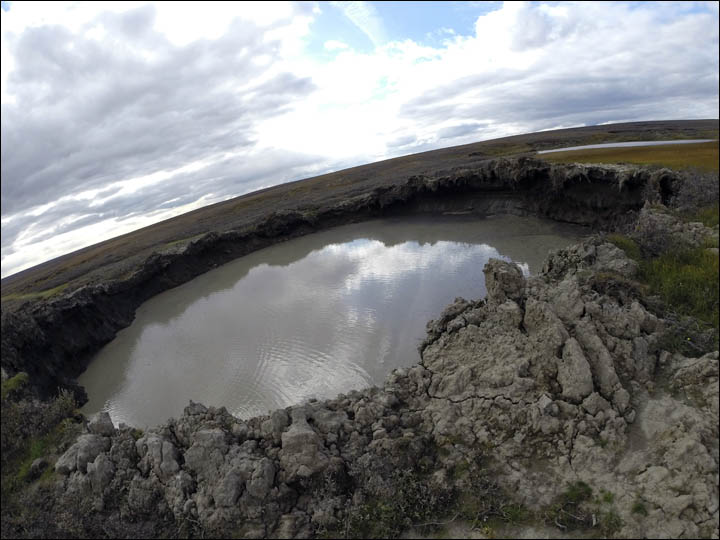
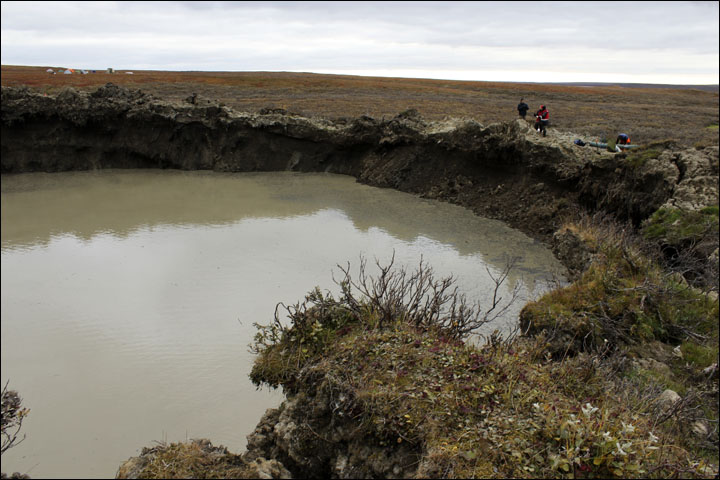
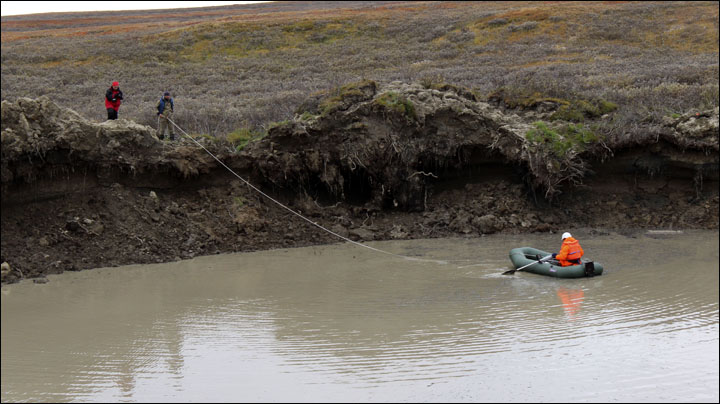
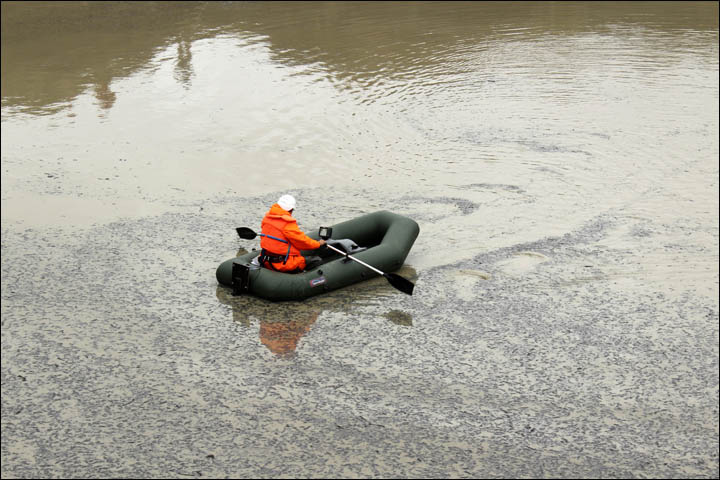
A new expedition to one of the mysterious Siberian giant holes found in recent years has concluded that it is a warning sign of a deadly threat to northern regions as the climate warms. Pictures: Vladimir Olenchenko/Trofimuk Institute of Petroleum Geology and Geophysics
‘At the moment, most gas hydrates are safely hidden, but there are territories, like Yamal, where they begin to decompose and we must closely monitor these areas. I think that now it is premature to speak about some global catastrophe, as if it is a theory of ‘methane threat’, but if the warming continues at the same pace, our northern cities, located close to Yamal – such as Salekhard, Nadym, and Novy Urengoy – are in real danger.’
He explained: ‘We propose to develop a big project aimed at monitoring the situation on Yamal. Taking into account active natural gas exploration, and ambitious projects like port Sabetta, we need to understand very well the natural processes so as to provide safe infrastructure.’
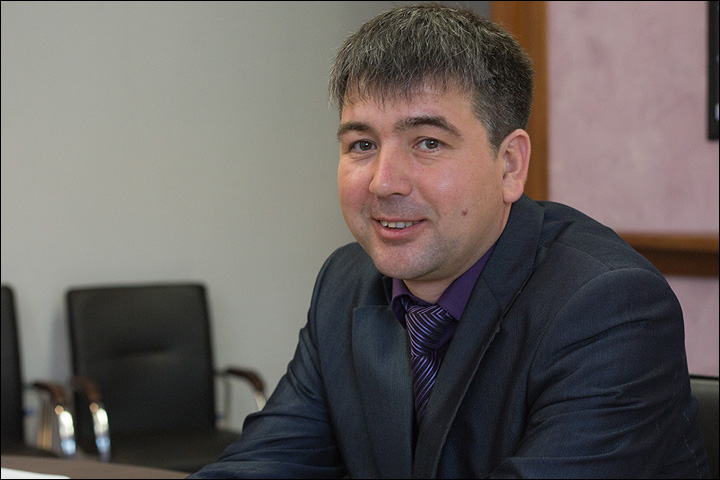
Dr Vladimir Olenchenko, senior researcher at the institute: ‘We spotted one more big pingo not far from the crater.’ Picture: Vera Salnitskaya
If exploration is to go ahead on a large scale – as is planned in such regions – then ‘we must provide proper scientific monitoring’.
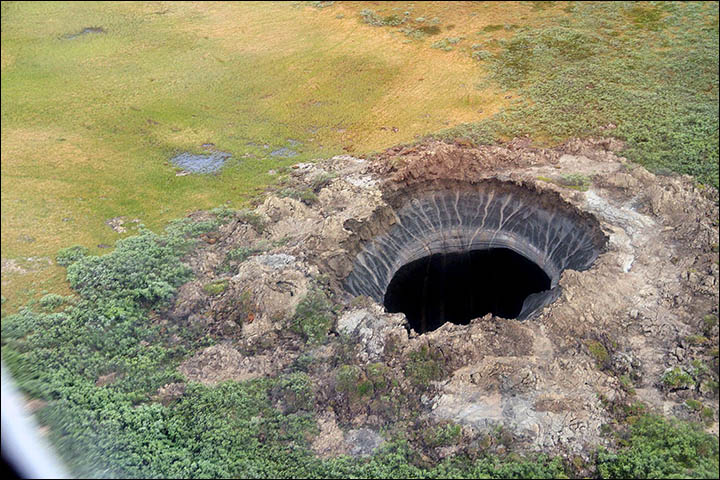
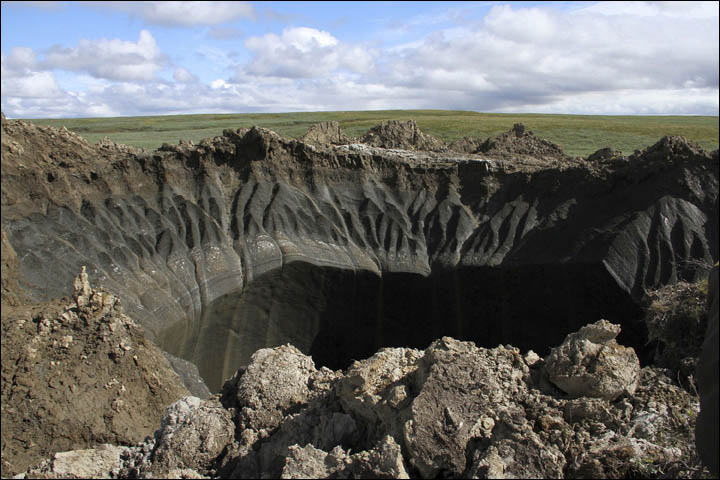
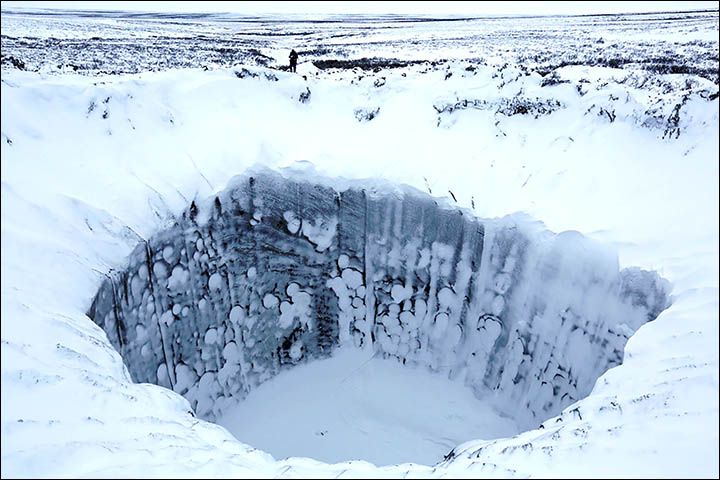
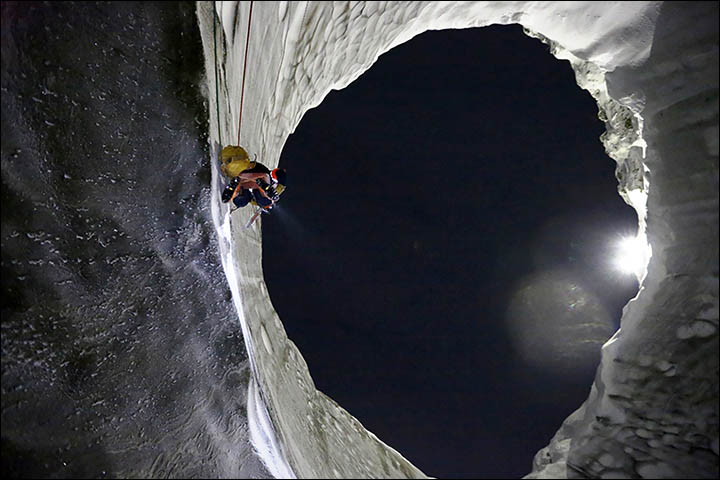
The new expedition to the crater – known as B-1 – was to enable a 3D model of its structure, and to monitor the way it rapidly turned into a lake. Dr Vladimir Olenchenko, senior researcher at the institute, said: ‘It is established now that initially at this site there was a pingo, quite a common phenomenon for this area. But this exact pingo, according to (historic) space photographs, was bigger than others and had a more regular, round shape.’
The scientists believe the methane either emerges through cracks from depths of the Earth, or that it is directly caused by ‘the decomposition of gas hydrate’.
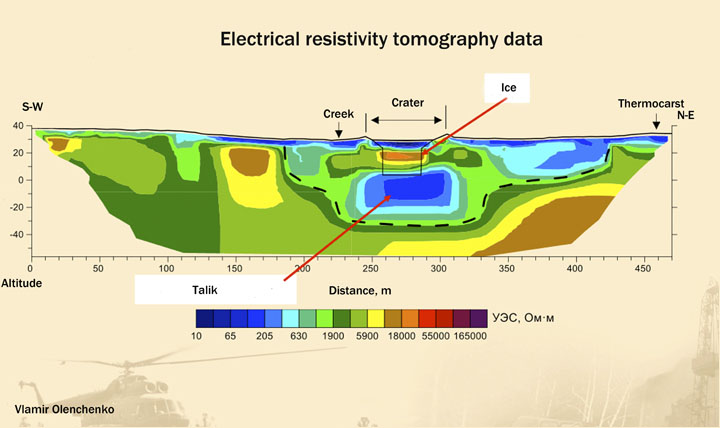
The new expedition to the crater – known as B-1 – was to enable a 3D model of its structure, and to monitor the way it rapidly turned into a lake. Picture: Vladimir Olenchenko/Trofimuk Institute of Petroleum Geology and Geophysics
‘According to our data, there is a hydrate layer 60 metres deep. We suggest that due to global warming some part of the hydrate decomposes, it accumulates in the pingo and then led to the eruption.’ They are examining the lake in detail – is it around 25 metres deep – since its form may lead them to other erupted pingos, possibly alerting to future dangers.
‘Now in the area around the crater there is active melting of the layers of ground ice, which form thaw slumps’ – Arctic landslides or sinking
This is ‘more evidence of global warming’.
‘We spotted one more big pingo not far from the crater,’ he said. ‘We will not say the exact location of the pingo, because journalists or scientists could try and go there, and it is very dangerous.
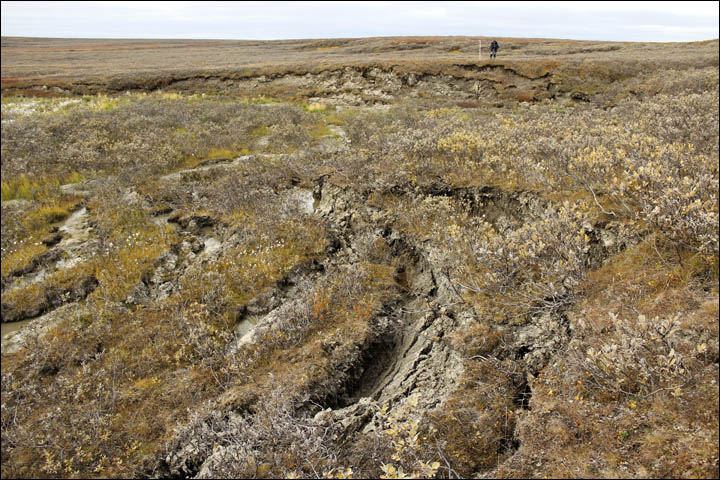
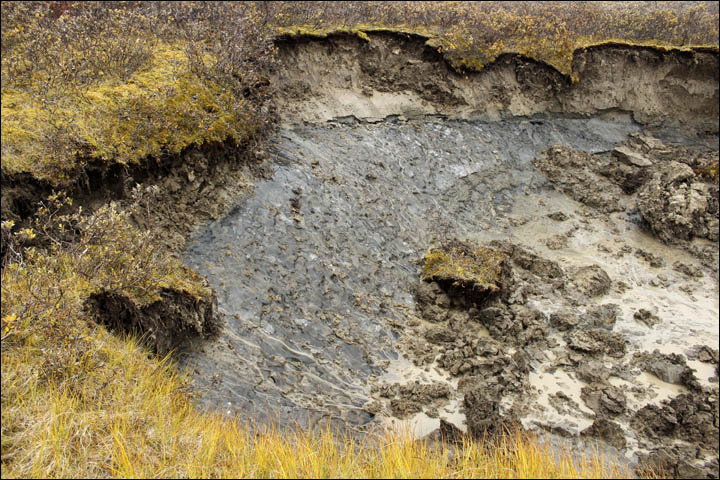
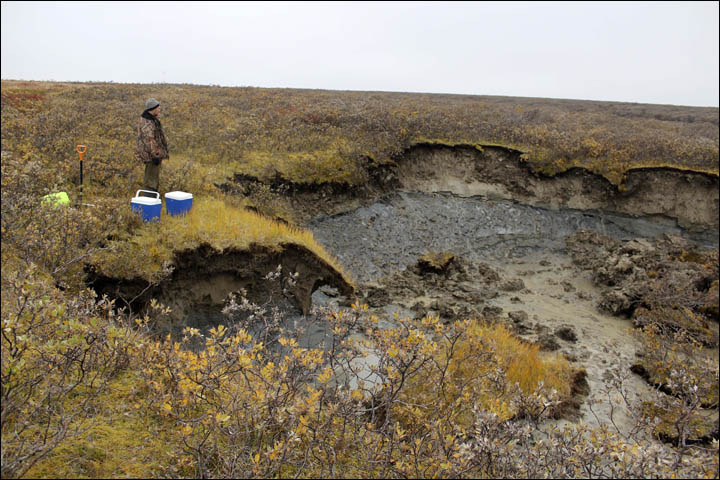
‘Now in the area around the crater there is active melting of the layers of ground ice, which form thaw slumps.’ Pictures: Vladimir Olenchenko/Trofimuk Institute of Petroleum Geology and Geophysics
‘This pingo can potentially explode at any moment. According to the preliminary estimates this pingo is bigger than the one that preceded the famous crater. We will monitor this pingo remotely from space. Now we are trying to make the list of the features to easily determine if the pingo is potentially dangerous.’
Yamal is seen as high risk, while other permafrost regions, for example Yakutia (Sakha Republic), would need a 6-7C warming to be vulnerable. Dr Yeltsov said: ‘It is not all permafrost areas that are in danger, having pingos associated with methane which can explode. There are areas where the permafrost is rather stable.’ The institute has proposed to create Yamal research centre under the Siberian Branch of the Russian Academy of Sciences. A decision is awaited.

Dr Igor Yeltsov, deputy director of the Trofimuk Institute: ‘We propose to develop a big project aimed at monitoring the situation on Yamal.’ Picture: Vera Salnitskya
Yamal – in the Yamal-Nenets autonomous district of northwest Siberia – has natural gas reserves here of around 55 trillion cubic metres.
‘We constantly try to communicate with different structures – government, Gazprom, research institutes – to develop research projects together.’ Work is underway with oil giant Total on gas hydrates on Yamal. ‘We have several joint projects with them.’ He warned: ‘Methane deposits, according to various estimates, count for about 200 trillion cubic metres. Gas hydrates hide million times more methane.
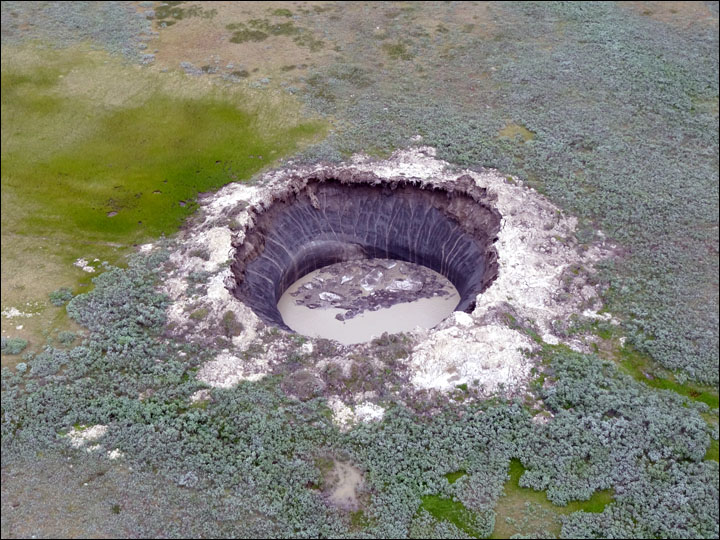
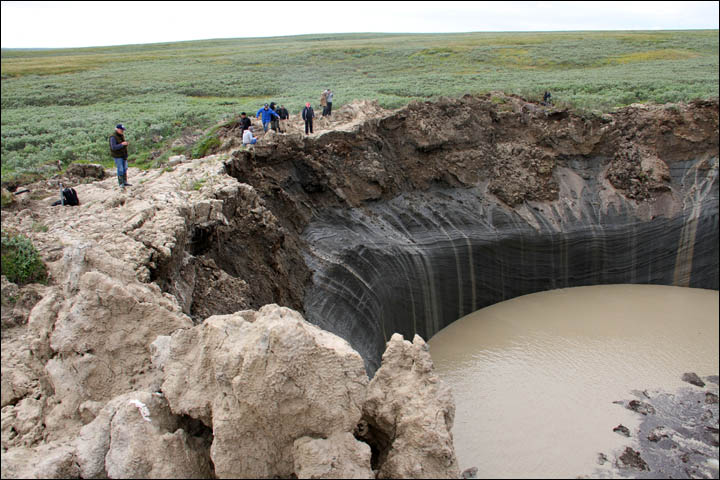
How did the crater change from July 2015 untill September 2015. Pictures: Yamalo-Nenets Autonomous region governor’s press-service, Vasily Bogoyavlensky, Vladimir Pushkarev
‘Now we face serious changes of temperature all over the Earth. Part of this large scale process, only the tip of the iceberg, we call global warming. It leads to the fact that gas hydrates lose their solid condition. One of the examples of this process is the Yamal crater. There are two main theories of its appearance, but both of them are based on methane as the main cause of the formation of the crater.’
Crater B-1 – totally some 60 metres deep – was first noticed last year. It sparked a flurry of interest around the world, and speculation on how this phenomenon was caused, ranging from meteorites, to stray missiles, to UFOs from outer space. Another crater known as B-2, some 20 km from B-1 – is ringed by 30 ‘baby’ or ‘satellite’ craters.