The Mormon Church, Time Travelers, and a 1990s CD-ROM: The Ultimate Conspiracy?
History is full of secrets. We think we know the story. We read the books. We accept the official narrative. But sometimes, hiding in plain sight, there’s a glitch. An anomaly. Something so out of place it threatens to unravel everything we thought we knew.
And it doesn’t get much more out of place than this.
We’re going back to the 1820s. Palmyra, New York. A young farm boy named Joseph Smith claims he was visited by an angel named Moroni. This angel, he says, guided him to a set of buried golden plates, which he would translate into the Book of Mormon, the foundational text for a new American religion.
It’s a story of faith, revelation, and ancient artifacts.
Or is it?
What if the story wasn’t about the ancient past, but about our recent past? What if the “angel” wasn’t a heavenly being, but a traveler from another time? And what if the “golden plates” weren’t plates of gold at all, but something far more familiar to you and me? Something from the dawn of the digital age.
Prepare yourself. We’re about to examine one of the most bizarre and compelling alternative history theories on the internet: the idea that Joseph Smith was given not ancient plates, but 1990s CD-ROMs.
The Official Story: A Prophet and His Plates
Before we jump down the rabbit hole, let’s get the mainstream story straight. According to Mormon history, Joseph Smith was told about the plates in 1823. He was directed to a nearby hill, where he found a stone box. Inside this box were the plates, described as thin sheets of gold covered in “reformed Egyptian” hieroglyphs. Along with the plates were two “seer stones” set in a silver bow, like spectacles. These were the Urim and Thummim, a divine tool meant to help with the translation.
Smith, an uneducated young man, used these stones to translate the plates, dictating the text of what would become the Book of Mormon. After the translation was complete, the Angel Moroni took the plates back. No one else was allowed to see them directly for a long time, though a few “witnesses” later signed statements claiming they had seen them.
It’s a story that requires faith. A miraculous tale of divine intervention. But what if the miracle wasn’t divine? What if it was technological?
The Anomaly in the Artwork
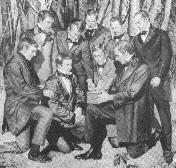
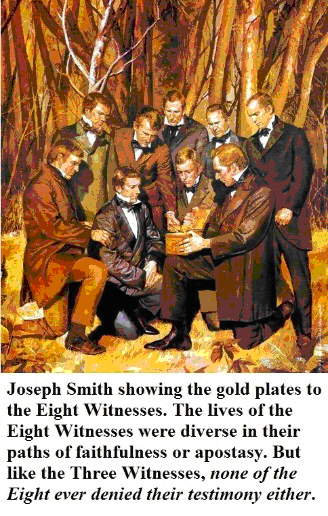
Evidence in cases like this is almost always blurry, open to interpretation. But once in a while, you find a smoking gun. Or, in this case, a smoking jewel case. Feast your eyes on this illustration, said to depict Joseph Smith with the artifacts.
Look at it. Really look.
What is he holding? They aren’t shimmering sheets of gold. They aren’t heavy metal plates. They are perfectly square. They are transparent. They have the distinct, undeniable shape of something that wouldn’t be invented for another 160 years.
They look exactly like empty plastic CD jewel cases.
Let that sink in. This isn’t a vague resemblance. The shape is precise. The transparency is obvious. One is held open, the other closed. It’s an image so jarring, so anachronistic, that it forces us to ask a terrifying question: is this picture proof of a temporal paradox sitting at the heart of one of America’s biggest religions?
A 19th-Century Description of a 20th-Century Object
The visual evidence is staggering on its own. But when you pair it with Joseph Smith’s *own descriptions* of the artifacts, the theory catches fire. He didn’t just have the “plates.” He also had the translation device, the Urim and Thummim. He described it this way:
“There were two stones in silver bows—and these stones, fastened to a breastplate, constituted what is called the Urim and Thummim.”
Now, let’s think like a 19th-century farm boy trying to describe a piece of future technology. What could he possibly be talking about?

Let’s break it down.
The “Stones”: What is a CD-ROM? It’s a disc made of polycarbonate plastic, but its data layer is a metallic film that refracts light into a rainbow of colors. To someone who had never seen plastic or lasers, it might look like a strange, flat, colorful stone. A “seer stone,” perhaps? One that, when put into the right machine, could show you visions and words?
The “Silver Bows” and “Breastplate”: This is where it gets chillingly specific. A standard CD jewel case has a removable tray, or base-plate, that the CD clips into. This “breastplate” holds the “stone” (the CD). Smith says the stones were “fastened to a breastplate.” Now, what about the “silver bows”? Some researchers believe this could refer to the hinge mechanism of the jewel case itself, which Smith later compared to a pair of spectacles—an object with two bows. Or could it be the circular depression in the tray where the disc sits?
Think about it. Smith takes the CD and its tray out of the clear plastic case. He is left with the empty jewel cases (as seen in the painting) and the “Urim and Thummim”—a “stone” (the CD) fastened to a “breastplate” (the tray).
The description is a perfect, almost technical match for a common CD-ROM and its packaging, interpreted by a man who had no words for what he was seeing.
The Researcher Who Connected the Dots
This explosive theory wasn’t born in a vacuum. It was pieced together by independent researchers, most notably a man named Ronald Pegg, who claims to have found descriptions of modern technology scattered throughout ancient and religious texts.

According to Pegg’s work, the Joseph Smith case isn’t an isolated incident. It’s part of a larger pattern of technological intervention in human history. He makes several mind-bending claims:
- A PC386 in the Old Testament: Pegg alleges that the prophetic books of the Old Testament, particularly Ezekiel and Daniel, contain detailed descriptions of not just a CD-ROM, but an entire 1990s-era computer system. The bizarre visions of wheels within wheels and flashing lights, he argues, are desperate attempts to describe a computer booting up and displaying information.
- The Ancient Setup Disks: In one of the most specific and bizarre claims, Pegg points to the Book of Ether in the Book of Mormon. The text mentions a collection of “24 plates, 8 large and 16 small.” This, Pegg claims, is a direct reference to the number of setup disks required for a PC386 computer system—the larger floppy disks and smaller compact disks needed to install the operating system and software. The numbers match. How is that possible?
- The ‘Ancients’ CD-ROM and the White Arrow: Pegg goes further. He believes the Book of Mormon describes not just any CD, but a specific one—a popular 1990s educational CD-ROM called *Ancients*. He argues that the text describes a sequence of imagery from this program, including a guiding compass and, most amazingly, the computer’s white arrow pointer—the mouse cursor. For someone in the 1820s, a disembodied arrow moving on a glowing screen would be nothing short of a divine sign, a guiding hand from God.
Pegg’s theory paints an incredible picture. A time traveler, or perhaps an “angel” using advanced technology, didn’t just drop off a disc. They brought an entire computer system, complete with installation media, and taught Joseph Smith how to use it. The “translation” of the plates was actually just Smith reading text off a computer screen, information displayed by a 1990s software program.
Deep Dive: What Was a PC386?
For anyone born after 1995, this might sound like gibberish. A “PC386”? “Floppy disks”? Let’s clarify. In the late 1980s and early 1990s, the “386” was a type of computer processor that represented a huge leap in personal computing. It was the machine that brought graphical user interfaces, like early versions of Windows, to the masses.
These computers didn’t have the internet as we know it. Software came on a series of thin, plastic squares called floppy disks. To install a big program, you had to insert a stack of these disks, one by one. It was a tedious process. Later, CD-ROMs (Compact Disc Read-Only Memory) arrived, which could hold vastly more information than a floppy disk. A complex piece of software or an entire encyclopedia could fit on a single disc.
The idea that this specific generation of technology—the clunky, beige-box era of early multimedia computing—was somehow present in 1820s New York is both absurd and fascinating. It’s not sleek future tech; it’s our own clunky, almost-forgotten past, showing up where it has no right to be.
What If It’s True? The Implications Are Staggering
Let’s suspend our disbelief for a moment and follow this thread to its logical conclusion. If Joseph Smith had a 1990s computer, who gave it to him? And why?
Scenario 1: The Benevolent Time Traveler
Perhaps a historian from our future—say, the 25th century—decided that humanity needed a nudge. Maybe they saw a coming catastrophe and believed a new, unifying religion founded on principles of community and preparation was the only way to save a portion of humanity. So, they traveled back, armed with technology that would seem miraculous, and chose a charismatic young man to be their prophet. The Book of Mormon, in this scenario, could be a document created in the future, designed to guide humanity through a dark age.
Scenario 2: “Angels” as Extradimensional or Alien Beings
Many “ancient astronaut” theorists propose that the angels and gods of old were actually extraterrestrial visitors. In this version, the “angel” Moroni was a being from another world or another dimension. Why would they use 1990s human technology? Perhaps it’s a form of communication. Maybe our level of technology is primitive to them, and they chose a format that humanity would *eventually* understand, planting a seed that would only be fully recognized once we reached a certain stage of development. The CD-ROM is a message that couldn’t be decoded until the 1990s.
Scenario 3: The Ultimate Hoax
Could this have been a non-supernatural event? Could someone in the 1820s have somehow… created these objects? This seems the least likely. The industrial processes needed to create polycarbonate plastic, stamp a CD, and build a computer were centuries away. This explanation is even more fantastical than time travel.
The Skeptic’s Corner: Pulling Apart the Theory
Now, we have to be responsible truth-seekers. It’s easy to get swept up in a good story, but we have to look at the other side. Are there simpler explanations?
Explanation 1: It’s Just a Drawing (Pareidolia)
The entire visual case rests on a single illustration. Skeptics argue that we are simply seeing what we want to see. This is a psychological phenomenon called pareidolia—our brain’s tendency to find familiar patterns in random noise. We see faces in clouds, and maybe we see jewel cases in an old, ambiguous drawing. The artist could have been trying to depict bound plates or a box in a stylized way. Our modern eyes, so accustomed to the shape of a CD case, are projecting that image onto the past.
Explanation 2: The Mysterious Origins of the Artwork
Where did this drawing even come from? This is a critical question. While it is widely circulated in conspiracy circles as a 19th-century Mormon illustration, its exact origin is notoriously difficult to pin down. Some sources claim it’s from an early edition of a book about Mormonism, while others are silent. If the artwork is actually a modern creation—a clever piece of digital art made to look old—then the entire theory collapses. Without a verified, 19th-century source for the image, the most explosive piece of evidence is suspect.
Explanation 3: The Interpretations are a Stretch
Are we twisting words to fit a narrative? “Two stones in silver bows” could mean a lot of things. It’s a vague description. For centuries, people were perfectly happy to interpret it as a mystical object. It’s only now, after the invention of the CD, that we can shoehorn this new interpretation onto the words. The same goes for the “24 plates.” It could just be a number with symbolic meaning, having nothing to do with floppy disks.
A Prophecy in Plastic or a Story for the Ages?
So where does that leave us? We have a story that is simply too strange to ignore. We have a piece of artwork that is, at best, a stunning historical anomaly and, at worst, a modern forgery. We have 19th-century descriptions that align with 20th-century technology with an eerie degree of accuracy.
Is it possible? Could the foundations of a major world religion be based on a temporal paradox? Did a time traveler with a backpack full of beige plastic and silver discs change the course of human history in the 1820s?
Or is this a case of our own modern myths—stories of time travel and advanced technology—being projected backward in time? A grand conspiracy written in the language of wishful thinking and digital artifacts.
Look again at the image. Look at the words of Joseph Smith. The official history is written. But the anomalies remain. What do you see? A prophet with a divine relic? Or a man from the past holding a message from our future?
The truth, as always, is out there. Hidden in a stone box, or maybe just on a scratched-up compact disc.