NASA’s Dark Secret: The Case for Ancient Alien Ruins on the Moon
July 20, 1969. The world held its breath. A grainy, black-and-white image flickered across television screens, and a voice crackled through the static, separated from Earth by a quarter-million miles of silent, empty space. “That’s one small step for a man, one giant leap for mankind.”
It was our species’ finest hour. A moment of pure, unadulterated triumph. We had done it. We had reached the Moon.
Or so we were told.
But what if that “giant leap” was just the public-facing story? What if the real mission, the one scrubbed from the history books and locked away in classified vaults, was something else entirely? What if the Apollo astronauts weren’t just explorers? What if they were cosmic archaeologists, sent to investigate something that was already there?
Something ancient. Something non-human.
This is the explosive theory championed for decades by one of the most controversial figures in space research, a man who once walked the hallowed halls of NASA itself.
“What NASA did not tell the American people is that it discovered the remains of an ancient lunar civilization, and to this day, that data and those artifacts have been withheld from the American people,” claims Richard C. Hoagland, founder of The Enterprise Mission.
A bold claim. A ridiculous claim, some might say. But before you dismiss it, you have to ask: who is Richard C. Hoagland? Is he just another crank shouting into the wind? Or is he a whistleblower trying to expose the biggest secret in human history?
The Insider Who Dared to Speak
Hoagland isn’t your average conspiracy theorist broadcasting from a basement. His resume is, frankly, shocking. He served as a science advisor to Walter Cronkite and CBS News during the Apollo missions. He was a consultant for NASA’s Goddard Space Flight Center. He was the curator of astronomy and space science at the Springfield Science Museum.
This is a man who was *in the room*. He had the connections. He saw the data before it was sanitized for public consumption. And he has spent the better part of his life trying to tell us what he found.
He alleges that NASA is not the civilian scientific agency it pretends to be. He claims its true purpose is to find, secure, and reverse-engineer advanced extraterrestrial technology. And the first, biggest prize was sitting right on our celestial doorstep, baking in the sun, waiting for us.
The Moon.

“Extraordinarily Advanced Technology” Hiding in Plain Sight
The proof, Hoagland insists, has been hidden in plain sight for over 50 years, buried in the official NASA photo archives. You just have to know how to look.
“The orbital photographs show us the scale of ancient ruins on the moon. And surface photography by the astronauts have shown remarkable, specific examples of anomalies that could only be explained through there being ancient remnants of some extraordinarily advanced technology,” he says.
This isn’t about fuzzy blobs or rocks that kind of look like a face. Hoagland and his team of researchers point to specific, geometric, and utterly baffling structures captured on official Apollo film. They argue these are not tricks of light and shadow. They are manufactured. They are ruins.
In his bombshell book, “Dark Mission: The Secret History of NASA,” co-written with Mike Bara, Hoagland lays out a case that is as chilling as it is compelling. He speaks of massive, crystalline structures that defy all known geology.
Think about it. Giant glass towers. Sprawling domes that glitter under the harsh, unfiltered sunlight of the lunar surface. Hoagland alleges that these structures are so vast they produce repeated prismatic, rainbow-like lens flares in the astronauts’ Hasselblad cameras—glints of color that shouldn’t exist in the monochrome lunar environment. NASA dismisses them as simple camera artifacts. Hoagland asks a different question: an artifact of what, exactly? A reflection from a multi-mile-high glass spire?
A Guided Tour of the Lunar Ghost Town
Once you start looking at the Apollo image catalog through Hoagland’s lens, the Moon transforms. It’s no longer a dead, pockmarked rock. It becomes a graveyard. A museum of a lost civilization. Let’s take a tour of the most infamous exhibits.
The Shard and The Tower
Perhaps the most famous lunar anomaly is a structure known simply as “The Shard.” Captured in the Lunar Orbiter III-84M frame, it appears as a colossal, spire-like object rising from the lunar surface, casting an impossibly long shadow across the dust. Next to it stands “The Tower,” a thicker, more robust-looking structure that some analysts at Hoagland’s Enterprise Mission have estimated could be over a mile high. A *mile*. High.
Geologists say it’s just a photographic flaw, an overexposed pixel on the original film scan. But the shape is so defined. The shadow is so consistent with the sun’s angle. Could a simple glitch create such a perfect illusion of a manufactured object? Or are we looking at the decaying skyscraper of a long-dead civilization?
The Castle: A Crystal Palace in the Dust
Floating eerily above the lunar horizon in multiple Apollo photographs is another anomaly nicknamed “The Castle.” It appears as a complex, multi-tiered structure with distinct geometric components. It seems to hang in the black sky, a testament to some forgotten architect.

Skeptics are quick to call it lens flare or an ice particle on the camera lens. But the object appears in different photos, from different angles, taken by different astronauts. It maintains its basic shape and structure. It’s almost… solid. Hoagland’s team suggests it’s a massive, partially ruined crystalline edifice, built from a material resembling glass or quartz, reflecting the sunlight in a way that makes it seem almost ethereal. A ghost structure from a forgotten age.
The Ukert Crater Anomaly
Craters are supposed to be round. They’re formed by random impacts. But the Ukert crater, located near the center of the Moon’s visible face, is anything but random. Inside the main crater are three smaller features arranged in a perfect equilateral triangle. The geometry is too precise. Too perfect. Nature likes chaos and randomness; it doesn’t typically create perfect, repeating geometric patterns on this scale. Could this be a landmark? A power station? The foundation of a massive, now-vanished triangular structure? The questions are maddening.
Deep Dive: Why the Cover-Up?
If any of this is even remotely true, it begs one gigantic, terrifying question: Why hide it?
The reasons are as complex and layered as the conspiracy itself. Hoagland and other researchers propose a few chilling possibilities.
- Mass Panic & Societal Collapse: Imagine the official announcement. “Good evening. Everything you know about your history, your religion, and your place in the universe is wrong. We are not alone, and we have found the corpse of a far superior civilization in our own backyard.” The potential for global panic, religious upheaval, and the collapse of social structures is immense. Would any government risk it?
- Technological Control: If these ruins contain functioning or even understandable technology, whoever controls it controls the future. Free energy? Anti-gravity? Advanced weaponry? This technology would be worth more than all the gold on Earth. No single nation would ever share it. It would become the ultimate national security secret, the foundation of a new, silent arms race.
- The “Threat” Narrative: What if the civilization that built these structures didn’t just die out? What if they were destroyed? Announcing the existence of alien ruins also means announcing the existence of whatever wiped them out. Is there something else out there, something powerful and hostile? Perhaps the silence is meant to keep us from ringing the dinner bell for a predator we cannot possibly comprehend.
Think about the end of the Apollo program. We went through all that trouble, spent billions of dollars, won the space race… and then we just stopped going. For over 50 years, no human has set foot on the Moon. Does that make any sense? Or were we warned off? Told that the Moon was not ours to explore? The infamous, unconfirmed “lost” radio transmission from Neil Armstrong is a cornerstone of this theory: “They’re here… they’re watching us.” While officially denied, the rumor persists. Did Armstrong and Aldrin see something they weren’t supposed to see?
Modern Sleuths and Digital Crowbars
The story doesn’t end with the Apollo archives. In the 21st century, the investigation has been crowdsourced. An army of digital archaeologists now pores over high-resolution images from probes like the Lunar Reconnaissance Orbiter (LRO). They use modern software to sharpen, de-noise, and analyze old photos, pulling out details invisible in the 1960s.
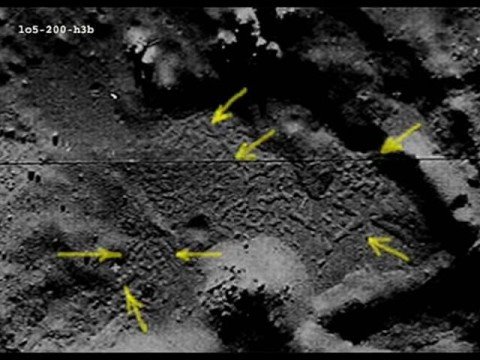
They find things. Straight lines in a world of curves. Odd, grid-like patterns on crater floors. Mounds that look suspiciously like buried, collapsed structures. Each new discovery fuels the fire, shared instantly on forums and social media.
Even official missions from other countries add to the mystery. When China’s Yutu-2 rover spotted a cube-shaped “mystery hut” on the far side of the moon, the internet exploded. It was eventually revealed to be just an oddly shaped rock. Or was that the easy, convenient explanation to shut down the speculation? As more nations point their cameras and landers at the Moon, the question becomes: how long can a secret this big be kept?
But What if It’s All in Our Heads?
It’s only fair to step back from the edge of the rabbit hole and listen to the counter-arguments. The scientific establishment has a simple, all-encompassing explanation for these lunar anomalies: Pareidolia.
Pareidolia is the psychological tendency to see patterns in random data. It’s why we see faces in clouds, animals in wood grain, and a “Man in the Moon.” The human brain is hardwired to find familiar shapes. Skeptics argue that all of Hoagland’s “structures” are just tricks of light and shadow playing on unusually shaped rocks, amplified by low-resolution, high-contrast photography.
They point to the poor quality of the original images, the compression artifacts, the film scratches, and the chemical development process as the real culprits. That “Shard,” they say, is likely just a data dropout on a scanned image. The “Castle” is a classic example of internal reflection within the camera lens elements. The geometric craters are coincidences of overlapping impacts and natural fault lines.
It’s a clean, simple explanation. It’s the sane explanation. But is it the right one?
It explains away each anomaly individually. But can it explain all of them, collectively? The sheer number and variety of strange objects on the Moon is staggering. At what point does coincidence become a pattern? At what point does Pareidolia become willful ignorance?
The Final Question: Are We Living a Lie?
We’re left standing at a fork in the road of reality. Down one path lies the comfortable, official story: the Moon is a dead, empty world, and we are the sole proprietors of intelligence in our cosmic neighborhood.
Down the other path lies a darker, more fantastic truth. A truth where our history is a lie, our sky holds the ruins of a forgotten empire, and a powerful cabal of insiders has been hiding the single greatest discovery of all time from us for more than half a century.
The evidence is there, waiting in the public NASA archives. The images are real. The anomalies are visible. The only thing in question is the interpretation.
So, the next time you look up at that bright, familiar orb in the night sky, ask yourself. Is it just a rock? Or is it a tombstone?
Originally posted 2016-02-19 20:27:59. Republished by Blog Post Promoter