The East River Monster: What Really Washed Up Under the Brooklyn Bridge?
New York City. A city of concrete, steel, and secrets. Every day, millions of people rush across its bridges, under its streets, and along its waterfronts, completely oblivious to the currents that churn below. But sometimes, those currents spit something back up. Something that doesn’t belong.
Something… wrong.
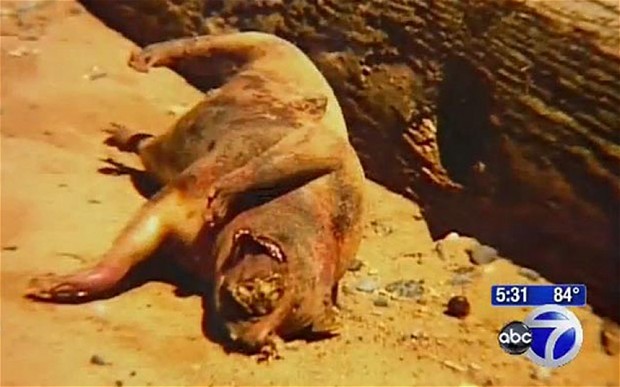
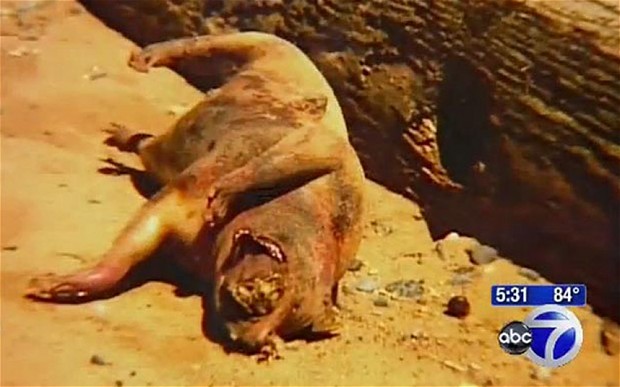
It was a Sunday. The sun was probably out. Tourists were snapping photos. But under the iconic arches of the Brooklyn Bridge, a different kind of picture was being taken. Amateur photographer Denise Ginley was out for a walk when she saw it. A grotesque form, half-buried in the sand and muck of the East River shoreline. A nightmare made real.

“We were horrified by it,” Ginley later recalled. The initial shock gave way to a morbid, undeniable curiosity. First, she used her phone. But the images weren’t enough. They didn’t capture the sheer strangeness of the thing. She had to go back. “We decided to come back with my camera and I got up the courage to climb over the fence and get closer to it.”
That decision would launch one of New York’s most enduring modern mysteries. The photos she took went viral, igniting a firestorm of speculation across the internet. Because this was no ordinary animal. This was something else entirely.
The Official Story: Just a Pig. Move Along.
Let’s get the boring part out of the way. The official explanation. The one designed to calm everyone down and put the story to bed.
The New York Parks Department took a look. They didn’t take long. Their verdict was swift and dismissive: it was a pig. Probably from a pig roast, they suggested, unceremoniously discarded into the river. Case closed. Nothing to see here, folks. Just a piece of waterlogged garbage.
A pig. Simple. Neat. Tidy.
But there was one massive, glaring problem with their story. A problem so obvious it felt like a deliberate oversight. You can see it in the photos. Look closely.
Pigs have hooves. Cloven, two-toed hooves.
This thing had paws. With five distinct, unnervingly long toes on each one.
Anatomy of a Nightmare: What the Photos Show
When you ignore the official story and just look at the evidence, the questions start piling up until they block out the sun. Let’s break down what we’re actually seeing in that infamous photograph.
The body is bloated, a common effect of decomposition in water. The skin is pale pink and almost entirely hairless, stretched taut over a swollen frame. Its head is pointed, with a long, pig-like snout that seems to terminate in an open, lipless mouth, revealing a row of small, peg-like teeth. The sockets where its eyes should be are empty, giving it a hollow, haunting appearance.
But the real mystery begins at the limbs. The front and back legs end not in hooves, but in what can only be described as paws. Five-toed appendages that look more like they belong to a dog, or a raccoon, or… something else.
This single detail—the toes—explodes the entire “pig” theory. It’s the loose thread that, when pulled, unravels the whole tidy explanation. Why would the Parks Department make such a basic anatomical error? Were they incompetent? Or were they trying to quickly bury a story they didn’t want people looking into?
The Internet’s Autopsy: A Storm of Theories
The internet, of course, was not buying the official story for a second. Digital sleuths and armchair cryptozoologists went to work, and the theories came fast and furious. The creature was quickly dubbed the “East River Monster” or the “Manhattan Monster.”
- The Raccoon Hypothesis: This is one of the more plausible theories. Raccoons have five-toed paws that look surprisingly human-like. When a raccoon carcass loses its fur and bloats in the water, it can become disturbingly unrecognizable. Could this be a giant, waterlogged raccoon? It’s possible.
- The Bloated Dog Theory: Some suggested it was the corpse of a dog, perhaps a bull terrier breed, whose short snout and powerful build could be distorted by decay into this monstrous shape. Dogs, of course, have paws, not hooves.
- The Giant Rat from the Sewers: Every New Yorker has heard the legends. Rats the size of cats, or even small dogs, thriving in the labyrinthine tunnels beneath the city. An “ROUS” – a Rodent of Unusual Size. Could one of these legendary beasts have finally surfaced?
But then the speculation took a much darker turn. People started noticing a pattern. This wasn’t the first time a bizarre, unidentifiable creature had washed up on a New York shore.
Echoes of Montauk: A Disturbing Pattern Emerges
Think back to 2008. The location was Ditch Plains Beach in Montauk, Long Island, about 120 miles east of the Brooklyn Bridge. A different beach, a different time, but a chillingly similar discovery.
A creature washed ashore that baffled everyone who saw it. It was dubbed the “Montauk Monster.”
Like the East River Monster, it was largely hairless. Its body was dog-like, but its head was completely alien, featuring a sharp, beak-like protrusion where its nose should have been. Its teeth were sharp and jagged. Its skin had the same rubbery, decayed quality. And, of course, the official explanation was mundane—a raccoon, they said. An explanation that many felt didn’t quite fit the photographic evidence.
Now, here we are, just a few years later, with another hairless, hard-to-identify beast with strange features washing up in the same state. One is an anomaly. Two is a coincidence. But what if it’s three? Or four? What if these aren’t isolated incidents?
What if they’re connected?
This thought led online investigators to one terrifying place. A place that sits right between Montauk and New York City. A place shrouded in secrecy and dark rumors for over half a century.
Plum Island.
The Shadow of Plum Island: A Government Conspiracy?
One online commentator, identified only as L13, dropped the bombshell that turned a local mystery into a full-blown conspiracy theory. “I don’t think it’s purely coincidence that these unidentifiable creatures have washed up on shores around Plum Island where the government has their Center for Animal Diseases,” they wrote. “I think these poor things are lab experiments the govt doesn’t want us to know about.”

Suddenly, all the pieces clicked into a terrifying new picture.
What *Is* Plum Island?
For those who don’t know, Plum Island is an 840-acre island in Long Island Sound. To most, it’s just a name on a map. But to others, it’s ground zero for some of the U.S. government’s most secretive and dangerous research. Since 1954, it has been home to the Plum Island Animal Disease Center (PIADC).
Officially, the PIADC is a Biosafety Level 4 facility that studies foreign animal diseases to protect American livestock. They work with things like foot-and-mouth disease and African swine fever—pathogens so dangerous they are illegal to study on the U.S. mainland.
But the facility has a dark origin. It was founded by the Department of Agriculture, but its roots trace back to the U.S. Army’s biological warfare program after World War II. The lab’s first director was a German scientist brought to the U.S. after the war, a man who had done bio-weapon research for the Nazis. From its very inception, Plum Island was a place of secrets.
Lab 257: The Horrors Behind the Curtain
For decades, rumors have swirled around Plum Island. Whispers of genetic engineering. Animal-human hybrid experiments. Pathogens escaping the lab. The 2004 book *Lab 257: The Disturbing Story of the Government’s Secret Plum Island Germ Laboratory* blew the lid off many of these stories, alleging major safety breaches, viral outbreaks, and a culture of extreme secrecy.
Is it really so far-fetched to think that in a place dedicated to studying bizarre animal diseases, they might also be… creating them? Could they be splicing genes, creating hybrid creatures for research purposes? And what happens when one of those experiments goes wrong? Or dies? Where does the body go?
Do you bury it on a small, crowded island? Or do you do what people have always done with their unwanted things in New York?
You dump it in the water.
Connecting the Dots to the East River
The Montauk Monster washed up practically in Plum Island’s backyard. The currents make that connection terrifyingly direct. But what about the East River Monster? It’s much further away.
Ocean currents are complex and powerful. A body dumped off Plum Island could easily be carried out into the Atlantic and then swept back west by tidal flows into the New York Harbor. It’s not just possible; it’s entirely plausible.
Now look at the creature again with this in mind.
Is it a pig? A dog? A raccoon? Or is it something that started as one of those things and was… changed? A failed experiment, its body grotesquely twisted by genetic manipulation, quietly disposed of in the dead of night. Its hairless, bloated form and strange, five-toed paws are no longer just an anomaly; they are potential evidence of something the government would do anything to keep hidden.
The Mystery That Refuses to Die
The body of the East River Monster is long gone. The Parks Department claimed they disposed of it. No official autopsy was ever released to the public. No DNA was ever tested (or if it was, we’ve never heard about it). The only evidence we have are Denise Ginley’s haunting photographs.
And so, the questions remain, echoing in the dark corners of the internet.
What really washed up under the Brooklyn Bridge that day?
Was it a simple case of a decomposed animal, misidentified by officials and blown out of proportion by a curious public?
Or was it a brief, horrifying glimpse behind the curtain? A piece of evidence from a secret laboratory that the currents accidentally delivered to our doorstep? A warning of the unnatural things being done in our name, just a few miles offshore.
They told us it was a pig. But the pictures tell a different story. A story of a creature that doesn’t fit, a puzzle with the wrong pieces, and a mystery that, like the dark waters of the East River, may hold secrets we were never meant to see.
Originally posted 2016-03-15 04:29:26. Republished by Blog Post Promoter
![monster_2288869b[1]](https://coolinterestingnews.com/wp-content/uploads/2012/07/monster_2288869b1.webp)