The Manchester Spaceman: The Unsolved Mystery of the Man Who Flew Past a Landing Airbus
Picture it.
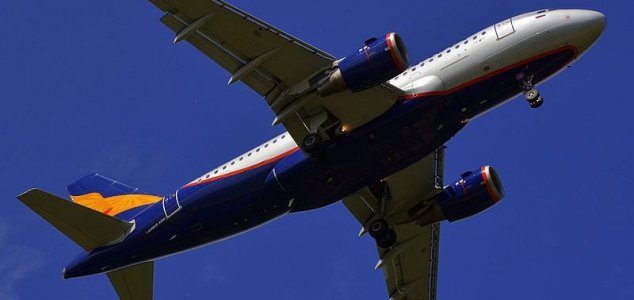
A calm, clear afternoon. You’re in the cockpit of an Airbus A320, a marvel of modern engineering, guiding thousands of pounds of metal and the lives within it safely toward the runway. It’s routine. It’s clockwork. The city of Manchester sprawls below, a familiar patchwork of civilization. Your altitude is 3,500 feet. You’re on the final approach. Checklists are running. The world is exactly as it should be.
Then you see him.
A man. Out your window. Flying.
This isn’t a scene from a superhero movie. This is the chilling, officially documented reality that two veteran pilots faced on July 13th, 2014. A moment that shattered their understanding of the possible and left air safety investigators with a case file that remains one of the most baffling in modern aviation history. A case with no answers, no culprits, and no explanation. Only a single, terrifying image: a human silhouette soaring silently past a passenger jet, miles above the earth, with nothing to hold him up.
Who was he? Where did he come from? And where, in God’s name, did he go?
A Routine Landing Goes Haywire
The flight was unremarkable. Just another day in the sky, another shuttle of passengers heading into Manchester Airport. The pilots, with years of experience between them, guided the aircraft through its descent, passing over the town of Macclesfield. It was about 1:30 PM. The sun was out. Visibility was perfect—about six miles. They were in constant communication with air traffic control. Everything was nominal.
Suddenly, the First Officer, looking out the left-hand side of the cockpit, saw it. A shape. It emerged from their eleven o’clock position, moving fast.
He yelled. An instinctual, shocked sound.
The Captain snapped his head to the left, just in time to see it too. It wasn’t a bird. It wasn’t another plane. It was, impossibly, a person. A man. He was less than 100 meters away—a stone’s throw in aviation terms—and he was flying past them in the opposite direction.
They both saw him clearly for a fleeting, heart-stopping moment. He was in a prone position, almost like a swimmer, legs and arms outstretched. They saw the human form. A head. Limbs. But they saw something else, too. Or rather, they saw a lack of something.
There was no parachute. No canopy of a paraglider. No balloon. No wingsuit. No jetpack spewing fire. Nothing. Just a man, hanging in the sky, as if gravity had simply forgotten about him.
The encounter was over in seconds. The figure zipped past and was gone. The pilots, adrenaline surging, exchanged stunned looks. “Did you just see that?” one asked the other. They had. They both had.
Immediately, they did what they were trained to do. They radioed it in. They checked the instruments. The Traffic Collision Avoidance System (TCAS), a system designed specifically to prevent mid-air collisions, was silent. On the ground, air traffic controllers stared at their screens. Their radar saw only one blip: the Airbus A320. The sky around it was, according to all their multi-million dollar equipment, completely empty.
The Investigation Hits a Dead End
When an incident like this is reported, a serious investigation is launched. The UK Airprox Board (UKAB), the official body responsible for investigating near-misses in British airspace, took on the case. They treat pilot reports with the utmost seriousness. These are not hysterical amateurs; these are trained observers whose lives depend on accurately identifying what’s in the sky around them.
Investigators went to work. They pulled every shred of data they could find.
The Radar Anomaly
First, the radar tapes. They were scrutinized frame by frame. The result? Nothing. Absolutely nothing. But this, strangely, wasn’t a surprise. A lone human body, even one with some equipment, has an incredibly small radar cross-section. It’s simply not big enough or metallic enough for standard air traffic control radar to pick up. So the blank radar screens didn’t disprove the sighting. It just meant the “flying man” was a ghost to their technology.
Searching for Jumpers, Gliders, and Daredevils
Next, they checked the ground. The most logical explanation had to be a human, using some sort of equipment. The UKAB contacted every parachuting club, every hang-gliding organization, and every hot-air balloon operator within a massive radius of the sighting. The answer was a resounding, unified “No.” No one was authorized to be in that airspace. No one had a flight plan. No one was reported missing. No equipment was lost.
Could it have been a rogue daredevil, a thrill-seeker with a wingsuit who jumped from another, smaller aircraft that was flying undetected? Possible, but astronomically unlikely. To time a jump to pass that close to a commercial jetliner, in the opposite direction, would require a level of planning and luck that borders on the supernatural. And the plane they jumped from would have almost certainly appeared on radar.

The official report, when it was finally released, was a masterclass in official bewilderment. The investigators essentially threw their hands up in the air. They couldn’t find a single piece of evidence to explain what the pilots saw. They had two credible witnesses and a complete lack of corroborating data. The report described the incident as “frustrating” because there was no way to confirm or disprove the sighting. The final conclusion was that the object “remained unknown.”
In the dry, technical language of aviation safety, that’s the equivalent of a primal scream.
As aviation expert Chris Yates put it, “It is a complete and utter mystery.”
Theories: From a Human-Shaped Balloon to a Dimensional Rift
When the official explanation is “we don’t know,” the door is thrown wide open for speculation. And the case of the Manchester Spaceman, or the “Macclesfield Jetman” as he’s sometimes called, has attracted some of the wildest theories out there. Let’s break them down.
Theory 1: It Was Just a Thing
This is the sensible, rational explanation. The pilots were mistaken. What they saw wasn’t a man, but an object that *looked* like a man. Perhaps a bizarrely shaped kite that had broken free. Or maybe one of those human-shaped novelty balloons filled with helium that had escaped a party and risen to an incredible altitude.
It sounds plausible. For a second. But then you have to consider the witnesses. These pilots aren’t easily fooled. They know what a balloon looks like at 3,500 feet. They know what debris looks like. Their report was specific: they saw a human being. They saw limbs. To have two experienced professionals both misidentify a balloon as a man, so close to their aircraft, seems highly improbable. They even mentioned in the report that they initially looked for a canopy, and saw none. That tells you their brains were already trying to fit the sighting into a logical box—paraglider, parachutist—and were coming up empty.
Theory 2: The Secret Military Tech
This is where we put on our tinfoil hats, just for a moment. What if the pilots saw something they weren’t supposed to see? A piece of cutting-edge, classified technology being tested in the skies over Britain?
Think about it. A personal flight system. A true jetpack, far more advanced than the clunky, loud water-powered versions we see in videos. A silent, high-altitude propulsion device that would be a game-changer in military infiltration. It would be stealthy. It would have a tiny radar signature. And it would look, for all intents and purposes, like a man flying through the air.
If this were the case, why test it so recklessly close to a commercial flight path? Maybe it wasn’t a test. Maybe the operator of the device lost control. Or maybe it was a deliberate test of the system’s ability to avoid detection by both the airliner’s TCAS and ground control’s radar. If so, it worked perfectly. The only flaw was the most basic detection system of all: the human eye.
Theory 3: The Cryptid Connection and High Strangeness
Now we go deeper. For decades, strange, flying, humanoid figures have been reported all over the world. They are a staple of “high strangeness” and UFO lore. Beings described as “Mothman” in Point Pleasant, West Virginia. Flying humanoids seen over Mexico. Are these all just misidentifications, or are they sightings of something else entirely?
The Manchester Spaceman fits this pattern almost perfectly. A fleeting glimpse of the impossible. A silent, winged (or unwinged) being that appears and disappears without a trace, leaving confused witnesses in its wake.
What could it be? An unknown biological entity? An ultraterrestrial—a being that co-exists with us on Earth but in a way we can’t normally perceive? Is it possible that for a few seconds, some veil between realities thinned, and these pilots saw something from another place bleeding through into ours? It sounds like science fiction. But when all logical explanations have been exhausted, maybe the illogical is all that’s left on the table.
A Sky Full of Ghosts
This incident doesn’t exist in a vacuum. Pilots are on the front lines of observing the skies, and they see things. All the time. In 2013, the pilot of a Boeing 737 over Glasgow reported a near-miss with a blue-and-yellow “man-like” object that passed just a few feet below his aircraft. Again, radar was blind. Again, no explanation was ever found.
In another case, pilots on two separate aircraft approaching London’s Heathrow Airport in 2015 both reported a drone-like object pass between their planes. One pilot described it as “cigar-shaped” and “man-sized.” The investigation, once again, hit a wall.
The stories are out there, whispered in pilot lounges and buried in dry, official reports. They see things that don’t make sense. Things that shouldn’t be there. And the Manchester Spaceman is perhaps the most compelling and personal of them all.
The internet, of course, has kept the story alive. On forums and Reddit threads, digital detectives have tried to crack the case, poring over flight data and weather patterns from that day. They’ve proposed every theory imaginable, from a person somehow launched by a giant catapult to a CGI hoax projected into the sky (a theory with zero evidence).
But the core of the mystery remains untouched. Two men, trusted professionals, saw an impossible sight. And no one, to this day, has been able to tell them what it was.
So the next time you’re on a plane, gazing out the window at the clouds below, remember the story of the Airbus A320 over Manchester. Remember the two pilots who stared out their cockpit window and saw a man flying by. The sky is a vast, open space, but it may not be as empty as we think. And sometimes, just for a second, we get a glimpse of who—or what—we’re sharing it with.