The NASA Bombshell They Hoped You’d Miss: Is Earth’s Magnetic Field About to Flip?
Let’s talk about a planetary time bomb. A silent, invisible countdown ticking away deep within the Earth’s core. It’s a threat that doesn’t announce itself with shaking ground or darkening skies, but with a quiet, terrifying wobble in the one thing we all take for granted: direction.
North. South. East. West. The foundations of our world. But what if they broke?
What if one morning you woke up and your compass, your phone, every navigation system on the planet, pointed South instead of North?
This isn’t science fiction. This is a scientific reality that has happened hundreds of times in our planet’s history. And according to a chilling admission from NASA, hidden within a press conference about the dead planet Mars, we might be hurtling towards another one right now. An event that some researchers believe coincided with the mysterious extinction of the Neanderthals. An event that could plunge our hyper-connected modern world into utter chaos.
Forget what you think you know. This is the story of the coming magnetic pole reversal.
A Ghost Planet’s Terrifying Warning
It all started with Mars. The Red Planet. A frozen, irradiated desert. But it wasn’t always this way. Billions of years ago, Mars had a thick atmosphere. It had flowing rivers, vast oceans, and maybe, just maybe, life.
So what happened? What killed an entire world?
In a landmark announcement, NASA’s MAVEN mission finally gave us the answer. And it’s an answer that should send a shiver down your spine. Bruce Jakosky, the mission’s principal investigator from the University of Colorado, Boulder, laid it out in stark terms. The culprit was the Sun. A relentless, never-ending blast of solar wind—a stream of charged particles—that stripped Mars of its atmosphere over billions of years, boiling away its oceans and leaving it the barren husk we see today.
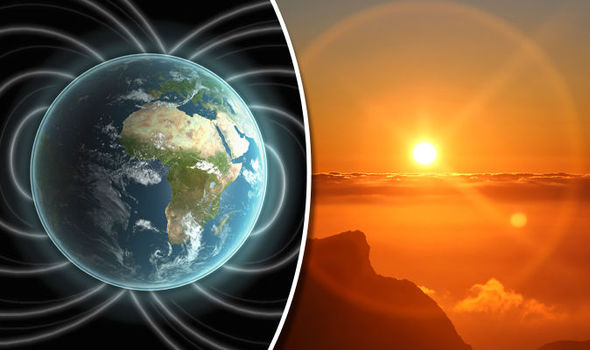
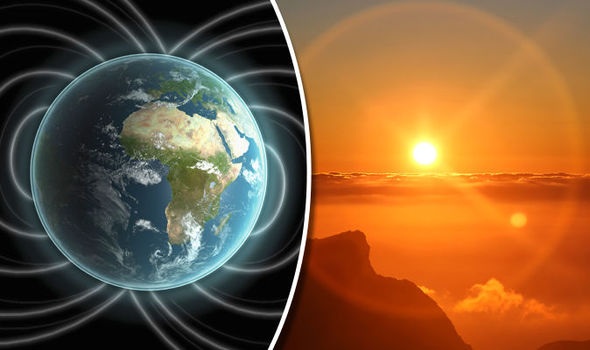
But why Mars and not Earth? One reason. One shield. Earth has a powerful magnetic field, a planetary forcefield generated by the churning, molten iron in its outer core. This shield deflects the deadly solar wind, protecting our fragile atmosphere and all life on the surface.
Mars lost its shield. And it died.

And then, Jakosky dropped the bombshell. He connected the fate of Mars directly to a process happening on our own planet. He talked about the inevitable magnetic pole reversal. And he gave a timeline.
“When the polar shift happens,” he stated, almost casually, “the Earth will have no magnetic field for about 200 years.”
Let that sink in.
For two centuries, our planet’s primary defense against the same solar radiation that murdered Mars would be gone. Neutralized. Switched off. The official NASA line, quickly added by lead scientist Michael Myer, was that 200 years isn’t long enough to strip our atmosphere completely. They assured everyone that our modern Sun is weaker than the young, violent star that blasted Mars. But the admission was already out there. For 200 years, Earth would be vulnerable.
Naked and exposed to the fury of space.
Deep Dive: The 42,000-Year-Old Crime Scene
To understand what this vulnerability looks like, we don’t have to guess. We just have to look back. Around 42,000 years ago, our planet experienced a full-blown magnetic reversal known as the Laschamp Excursion. For a time, the magnetic field collapsed to a fraction of its strength, and the poles wandered chaotically across the globe.
Now, what else was happening 42,000 years ago? Think about it.
The Neanderthals, a species that had dominated Europe for hundreds of thousands of years, were in their final, catastrophic decline. At the same time, massive climate shifts were underway, and giant Australian megafauna were vanishing. For decades, mainstream science called these connections a coincidence.
But new research is painting a much darker picture.
During the Laschamp Excursion, with the magnetic shield down, cosmic radiation flooded the planet. This isn’t just about solar wind; we’re talking about high-energy particles from deep space. This bombardment would have shredded our ozone layer, letting in brutal levels of ultraviolet (UV) radiation from the sun.
Life Under a Broken Sky
Imagine the world of our ancestors during this time. The sky itself would have been a terrifying spectacle. Auroras, the beautiful Northern and Southern Lights, would no longer be confined to the poles. They would have been visible everywhere, shimmering and dancing across the entire night sky as solar particles rained down into the atmosphere. A beautiful, deadly light show.
The consequences would have been devastating:
- Climate Chaos: The massive influx of radiation could have dramatically altered weather patterns, triggering ice ages and massive storms.
- Radiation Sickness: Increased UV and cosmic radiation would have led to soaring rates of cancer and DNA mutations for all living things. Some studies suggest early humans survived by spending more time deep inside caves, which might explain the explosion of cave art from that exact period. Were they hiding from the sky?
- The Neanderthal Question: Could the Neanderthals, already struggling, have been pushed over the edge by this environmental catastrophe? Did their food sources collapse? Were they simply less able to adapt to the brutal new conditions than the more versatile Homo sapiens? The timeline is too perfect to ignore. The pole shift wasn’t just a geological event; it may have been an extinction-level one.
The Laschamp Excursion is our planet’s cold case file. A 42,000-year-old crime scene. And all the evidence points to the magnetic field as the killer.
The Earth’s Faltering Heartbeat
So, this is all ancient history, right? Something to read about in a textbook?
Wrong.
The signs are happening again. Right now. Scientists who monitor the Earth’s magnetic field are seeing changes that are not just routine; they are dramatic and accelerating.
Our magnetic field has been weakening. A lot. Over the past 150 years, it has lost roughly 10 to 15 percent of its overall strength. This isn’t a slow, gentle decline. The rate of decay is picking up speed. It’s as if the engine in the Earth’s core is starting to sputter.
And then there’s the North Magnetic Pole. It’s on the run.
For centuries, it meandered slowly around northern Canada. But in the 1990s, it started moving. Fast. It’s now racing across the Arctic Ocean towards Siberia at a blistering pace of nearly 40 miles per year. It’s moving so fast that geologists have had to issue emergency updates to global navigation models—the ones used by every military, airline, and smartphone on Earth.
Think about that. The planet’s fundamental coordinates are shifting beneath our feet so quickly that we can’t keep up.
Furthermore, there’s a massive, growing “dent” in our magnetic shield, stretching from Africa to South America. It’s called the South Atlantic Anomaly. In this region, the field is so weak that satellites passing through it have to be temporarily shut down to protect their electronics from radiation. This weak spot is expanding and deepening every year.
These aren’t random occurrences. They are symptoms. Symptoms of a vast, planetary system entering a state of chaos. A state that precedes a full reversal.
When North Becomes South: Our Modern World on the Brink
NASA might say 200 years of vulnerability isn’t a civilization-ending threat. But they are thinking about the atmosphere. They aren’t thinking about *our* civilization. Our world is a fragile house of cards built on a foundation of electricity and information. A foundation that would be instantly obliterated by a magnetic field collapse.
Let’s play this out. Not over billions of years, but in the first 24 hours.
The moment the field collapses into a chaotic, multi-pole state, the next solar storm—something that happens regularly—would be catastrophic. Instead of being deflected, a wave of charged particles would hit the Earth head-on.
The First Hour: Lights Out
The electrical grid would be the first to go. The massive influx of energy would induce powerful currents in our power lines, blowing out transformers on a continental scale. Not just a blackout. A “black-sky” event. Frying the grid so badly that it couldn’t be repaired for months, or more likely, years. No electricity. No lights, no refrigeration, no water pumps, no hospitals.
The First Day: Silence
Next, our orbital infrastructure. The thousands of satellites we rely on for GPS, communications, and weather forecasting would be bricked. Zapped by radiation. The internet would shatter. Global communications would cease. GPS would vanish, grounding every plane and stopping every modern ship in its tracks. The global supply chain, which relies on just-in-time delivery, would evaporate. Nothing in, nothing out.
The First Week: The Great Unraveling
This is when the reality sets in for the 8 billion people on the ground. No power. No communication. No running water. No food deliveries. Law and order are maintained by the ability to communicate and coordinate. When that’s gone, how long does society hold together? The original article mentions “fires and rioting on the streets.” That’s putting it mildly. It would be a regression. A worldwide technological collapse pushing us back centuries in a matter of days.
And all the while, the radiation levels on the surface would be creeping up. We wouldn’t be able to see it or feel it, but it would be there, increasing cancer risks and threatening the very building blocks of life. Animals that navigate by the magnetic field—birds, whales, sea turtles—would be thrown into chaos, leading to mass die-offs and ecological collapse.
This isn’t a far-fetched doomsday movie plot. This is the logical, predictable outcome of our technology’s extreme vulnerability to the very forces our planet has always protected us from.
The Official Story vs. The Unspoken Truth
So why isn’t this front-page news every single day? Why are government agencies so quick to say, “Don’t panic, it will be slow, we’ll adapt”?
Maybe it’s because the alternative is admitting that our civilization has no contingency plan for an event of this magnitude. Admitting it would trigger financial panic and social unrest. It’s easier to talk about the slow loss of atmosphere over centuries than the immediate collapse of our electrical grid in a single afternoon.
But the questions linger. Is the weakening of the field really a slow, linear process? Or could it reach a tipping point and collapse suddenly? Internet forums and alternative researchers buzz with theories. Some point to the rapid acceleration of the North Pole’s movement as evidence that the process is happening much faster than the “official” models predict.
They ask: Are governments secretly preparing? Are the deep underground military bunkers and seed vaults not just for nuclear war, but for a geomagnetic one, too? When you understand the fragility of our world, these “conspiracy theories” start to sound a lot more like simple logic.
The evidence is there for anyone willing to look. It’s written in the magnetic patterns of ancient lava flows. It’s etched into the ice cores. It’s in the dead, red dust of Mars. And it’s in the frantic data pouring in from our satellites every day.
The Earth’s magnetic heartbeat is growing fainter, more erratic. The shield is thinning. The great reversal is not a question of *if*, but *when*. The only question left is whether we are living in the final, quiet moments before the storm.
Go outside. Look at your phone and see the compass app pointing north. For now. Something fundamental is changing, deep beneath your feet. Can you feel it?