Space is quiet. It is terrifyingly vast, impossibly dark, and remarkably good at hiding things. When we throw our little metal boxes into the void, we are playing a game of odds so steep that the human brain can barely comprehend them. We launch a machine the size of a washing machine, spin it around the Earth, slingshot it past Mars, and aim for a rock moving thousands of miles per hour deep in the freezing blackness.
Sometimes, we miss.
Sometimes, the machine screams into the silence and never calls back. But sometimes, just sometimes, the impossible happens. This is one of those stories. It’s a story of a lost child, a desperate search, and a discovery that was made literally days before the lights went out forever.
For two years, the location of the Philae lander was one of the most frustrating mysteries in modern space exploration. We knew it was there. We knew it was on Comet 67P/Churyumov–Gerasimenko. But we couldn’t see it. It was a ghost. A phantom signal in the data.
Until now.
The Billion-Mile Needle in a Haystack
Let’s back up. You need to understand the scale of this. The Rosetta mission wasn’t just a trip to the moon. It was a ten-year odyssey. The European Space Agency (ESA) chased this comet for over 6 billion kilometers. Think about that number. It’s not just a drive down the highway. It’s a game of cosmic billiards played across the solar system.
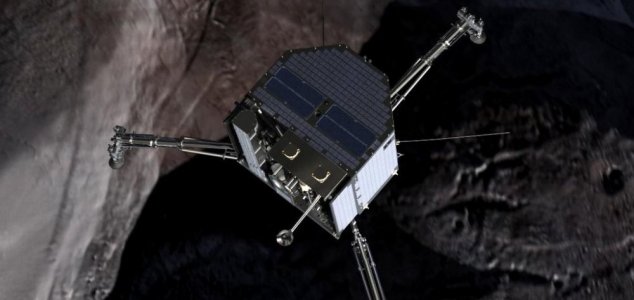
The plan was audacious. Crazy, even. Rosetta would catch up to the comet, orbit it (which is incredibly hard because comets have weak, weird gravity), and then drop a smaller probe, Philae, onto the surface.
Nobody had ever done this before. Landing on a planet? Sure. We do that. Landing on a jagged, tumbling, spewing ball of ice and dust while it hurtles toward the sun? That is science fiction stuff.
And in November 2014, the world held its breath.

The Landing That Went Wrong… Then Right… Then Wrong Again
Here is where the story turns into a thriller script. Philae detached. It drifted down. It was perfect. The telemetry looked good. The team in Darmstadt, Germany, was ready to pop the champagne.
Philae hit the target.
But then, the nightmare scenario kicked in. The harpoons—the critical spikes meant to fire into the ice and anchor the probe—didn’t fire. They failed. In the micro-gravity of the comet, Philae didn’t stick. It bounced.
This wasn’t a little hop. It was a massive, slow-motion leap. Philae bounced off the surface and floated for two hours. Imagine falling, hitting the ground, and then floating back up for two hours. It traveled a kilometer across the surface. It hit the ground again. It bounced again. Finally, it settled.
But where? That was the million-dollar question.
Into the Shadows
The radio signals came back, but they were weak. The engineers looked at the solar data and their hearts sank. Philae wasn’t sitting on a nice, sunny flat plain. It had wedged itself into a dark crack, turned on its side. It was stuck in a cave of ice and dust.
This was a disaster for one specific reason: Power.
Philae ran on solar batteries. It needed sunlight to wake up, to work, to send data. In its original landing zone, it would have had plenty of sun. In this dark crevice? It was getting less than an hour of sunlight per comet-day.
The probe managed to run for about 60 hours on its primary battery. It furiously sniffed the air, drilled, and sent back every byte of data it could before the lights went out. Then, like a exhausted explorer, it went to sleep. The screens on Earth went black. The link was lost.
The Ghost in the Machine
For the next two years, the Rosetta orbiter kept circling overhead. It was doing its own science, sure. It was sniffing the comet’s tail, analyzing the dust, and taking incredible photos. But part of its brain was always listening. Listening for the little lander to wake up.
There were moments of hope. As the comet got closer to the Sun, things heated up. In June 2015, a brief chirp. Philae woke up! It sent a few packets of data. The world cheered. But the connection was unstable. It was stuttering. The geometry was wrong. The probe couldn’t lock on. After a few weeks of sporadic whispers, it fell silent again. This time, for good.
The team was haunted. They had this incredible achievement—the first landing on a comet—but they didn’t know the “Ground Truth.” In science, context is everything. If you take a sample of soil, you need to know where that soil came from. Was it a flat plain? A rocky cliff? A pit of gravel? Without knowing exactly where Philae was, the data it sent back during those first 60 hours was like a puzzle with missing pieces.
The Clock Was Ticking
Fast forward to 2016. The mission was ending. The comet was moving away from the Sun again. Solar power for the main Rosetta spacecraft was dwindling. The ESA made the call: they were going to crash Rosetta into the comet to end the mission in September.
They had weeks left. Just weeks. And they still hadn’t found the body.
They flew Rosetta lower. Dangerously low. They skimmed the surface, taking high-resolution images, scanning every shadow, every boulder. It was the ultimate game of Where’s Waldo, played on a rock darker than coal.
And then, just like that, they found it.
The “Impossible” Photo
Less than a month before the mission was scheduled to self-destruct, the camera caught something unnatural. Look at the image above again. Really look at it. Amidst the chaos of sharp rocks and deep shadows, there is a geometric shape. A box. Legs.
It was Philae.
The image is haunting. You can see the probe wedged on its side, one leg sticking up into the vacuum of space like a desperate hand reaching for help. It looks lonely. It looks trapped.
Rosetta project scientist Matt Taylor put it best when the news broke: “It allows us to go back to the data that Philae took to put it into context a little bit more. Having the precise location of the lander allows you to refine those measurements and get much better resolution from those. It provides us with the ground truth.”
Ground truth. That’s the holy grail.
The Deep Dive: Why Does This Matter?
You might be asking, “Who cares? It’s a broken robot on a rock.”
Here is why you should care. This isn’t just about a robot. It’s about where we came from.
Comets are the leftovers of the solar system’s creation. They are the scraps from the construction site that built Earth, Mars, and Jupiter 4.5 billion years ago. They are time capsules. Deep frozen freezers holding the original ingredients of our reality.
One of the biggest theories in alternative history and mainstream science alike is “Panspermia.” It’s the idea that life on Earth didn’t just spontaneously poof into existence. The theory suggests that the building blocks—water, organic molecules, amino acids—were delivered here. By what? By comets crashing into a young Earth.
Philae found organic molecules. It sniffed the dust and found carbon-based compounds. The stuff of life. Right there on the comet.
By finding the exact location of the lander, scientists could finally figure out if those molecules were common all over the comet, or if Philae had stumbled into a special “trap” where these materials gathered. The photo proved Philae was in a rough, icy crevice—a perfect cold trap for preserving ancient alien chemistry.
The “Singing” Comet
There is another layer to this mystery. Before Philae even landed, Rosetta detected something strange. The comet was “singing.”
Magnetic sensors picked up a weird, oscillating signal between 40 and 50 millihertz. If you sped it up so human ears could hear it, it sounded like a chirping, bubbling song. It wasn’t random static. It was a pattern.
Now, scientists say this was just the solar wind interacting with the comet’s magnetic field. Standard physics. But for those of us who look at the universe with a bit more wonder, it adds to the eerie personality of 67P. It’s not a dead rock. It sings into the void. It smells like rotten eggs and bitter almonds (due to sulfur and cyanide). It breathes gas jets.
And now, it holds our robot hostage.
The Final Resting Place
The discovery of the landing site brought a strange sense of closure to the team. There is a psychological weight to losing something in space. It feels like a failure. Finding it turned the narrative from “lost at sea” to “heroic final stand.”
Philae fought until its last battery cell died. It did its job. It just had a rough landing.
As for Philae, like many other discontinued space probes before it, the ambitious little lander will remain exactly where it is. It is a monument. A silent marker of humanity’s reach. Think about this: long after the Pyramids have eroded into dust, long after our cities are gone, Philae will still be clinging to that rock.
It will ride Comet 67P around the sun for thousands, maybe millions of years. It is a message in a bottle that will never be opened again.
One of its last Tweets (yes, the robot had a Twitter account managed by the team), posted back in July before the final silence, read: ‘It’s time for me to say goodbye.’

It wasn’t just a goodbye. It was a “mission accomplished.”
What If We Went Back?
This discovery sparks a new question. Could we go get it? Technically? Maybe. In a hundred years, when space travel is like taking a flight to London, maybe a museum will fund a retrieval mission. “The Recovery of Philae.”
But maybe we shouldn’t. Maybe it belongs to the void now.
Shortly after finding Philae, the Rosetta orbiter ended its mission. It didn’t just turn off. The team piloted it on a collision course. They flew Rosetta slowly, deliberately, into the surface of the comet. It touched down (or crashed, depending on how you see it) on September 30, 2016.
So now, they are together. The mother ship and the lander. Both sleeping on the same icy rock, spiraling through the dark forever.
The Legacy of the Lost Lander
We live in an age of disposable technology. We throw away phones every two years. But there is something noble about these machines. They are the best of us. They represent our curiosity, our drive to know what is out there.
The image of Philae wedged in that crack is more than just a blurry photo. It is proof that we tried. We threw a dart across the solar system and we hit the bullseye. Even if it didn’t stick perfectly, we touched the primordial past.
So the next time you look up at the night sky, remember that there is a piece of metal up there, the size of a washing machine, holding onto a rock for dear life. And thanks to one lucky photo, we know exactly where it is.
Originally posted 2016-09-16 10:44:27. Republished by Blog Post Promoter