Saturday, May 9, 2026
HomeUnexplained MysteriesModern MysteriesOregon's Lost Lake disappears every year

Oregon’s Lost Lake disappears every year

The Oregon Lake That Dies Every Year: A Natural Wonder or Something More?

Picture this. You hike deep into the sprawling, ancient forests of Oregon. You follow a trail through towering pines, the air crisp and smelling of damp earth. You’re searching for a lake. An 85-acre body of water nestled in the Cascade Mountains. You get there. You stand at the edge. But there’s no water.

None.

Instead, you find yourself staring at a lush, strangely vibrant green meadow. Where a nine-foot-deep lake should be, there is only grass, wildflowers, and bewildered silence. You check your map. You’re in the right place. This is Lost Lake.

But come back in the dead of winter, and you’ll find it. The water is there, cold and clear, reflecting the snow-dusted peaks. So what’s going on? Is this a magic trick? A geological prank? Or is the simple explanation just a cover for a much deeper, much stranger truth hidden beneath the ground?

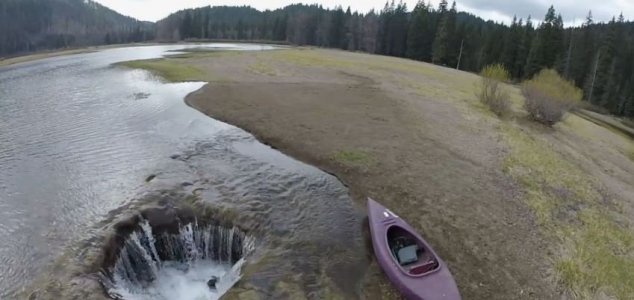
A hole in the middle of a dry lake bed, surrounded by green grass.

The World’s Strangest Vanishing Act

This isn’t a slow evaporation. This isn’t a seasonal drought that makes the shoreline recede a bit. This is a full-scale disappearing act. Every single year, like clockwork, Oregon’s Lost Lake pulls its own plug.

The cycle is baffling to witness. Located in the Willamette National Forest, the lake behaves perfectly normally throughout the wet, cold fall and winter months. Rain and snowmelt from the surrounding mountains pour in, filling the basin. At its peak, the water gets about nine feet deep—a respectable, if unremarkable, mountain lake. It’s a postcard.

But then spring whispers through the trees, and the weather turns warmer and drier. The rain stops. And the lake begins to drain. It doesn’t just evaporate under the summer sun. It empties. As if someone kicked open a celestial drainpipe. Over a few weeks, the entire 85-acre body of water swirls away into nothingness, leaving behind that ghostly, out-of-place meadow. The fish? Gone. The water? Vanished. All that remains is the mud, which quickly sprouts into a field of green, waiting for the autumn rains to drown it all again.

The Official Story: Mother Nature’s Plumbing Problem

So, you ask the forest service. You ask a geologist. They’ll give you a calm, tidy explanation. And on the surface, it makes perfect sense. The culprit, they say, is a feature of the region’s violent, fiery past.

Lava tubes.

The entire Cascade Mountain Range is a chain of volcanoes, both active and dormant. For millions of years, this area was a cauldron of geologic activity. Rivers of molten rock carved their way across the landscape. As the outer surface of a lava flow cooled and hardened, the molten rock inside kept moving, eventually draining out and leaving behind a hollow, underground tunnel. A lava tube.

Think of it like a giant, natural subway system forged by fire.

According to officials, Lost Lake just happens to be sitting directly on top of a particularly large, open-mouthed lava tube. Or, more accurately, two of them. These holes, roughly six feet in diameter, act as continuous, unstoppable drains.

Jude McHugh, a spokeswoman for the Willamette National Forest, laid it out in simple terms. “The lakebed begins to fill in the late fall, when the amount of rain coming in starts exceeding the ability of the lava tubes to drain off the water,” she explained. “And it continues to fill all winter long in a series of rain or snowstorms.”

Once the rain and snowmelt stop feeding the lake in the spring, the equation flips. The drains win. The water pours down into the porous, honeycombed volcanic rock underneath, disappearing into a massive underground aquifer system. Where does it go? The best guess is that it seeps back into the ground, slowly recharging the springs and streams that feed the McKenzie River miles away. The lake is just a temporary holding tank in a much larger, unseen plumbing network.

Case closed, right? A cool geological quirk.

But that feels… too easy.

Deep Dive: When Locals Tried to Plug the Abyss

The “it’s just a lava tube” story doesn’t quite capture the human obsession with this place. For generations, this wasn’t just a geological feature; it was a problem to be solved. An affront to common sense. Lakes are supposed to stay put.

Local lore is filled with stories of people trying to “fix” Lost Lake. They saw a hole draining their water and did what any practical, problem-solving person would do: they tried to plug it.

This wasn’t a scientific endeavor. Oh no. It was a junkyard crusade.

Over the years, during the dry summer months, people have trekked out into that weird meadow and thrown everything you can imagine down that hole. Old car parts. Engine blocks. Random scrap metal. Boulders. Construction debris. They dumped tons of junk into the earth’s gullet, hoping to clog it up for good.

And every single time, nature laughed at them. The next winter, the lake would fill. The pressure would build. And with a gurgle, the lava tube would swallow every last piece of their junk, spitting it out into some unknown cavern deep below. The hole would be as clear as ever. The effort was completely, spectacularly futile. The sheer volume and power of the water is something a few old tires can’t handle. The mountain, it seems, always gets its drink.

What if the Official Story Isn’t the *Whole* Story?

This is where things get interesting. We have an official explanation that works. But the phenomenon is so strange, so visual, that it invites speculation. It prods at the part of our brain that wants the world to be more mysterious than it is. The internet, of course, has run wild with this.

What if the lava tubes aren’t just tubes? What if they’re an entrance?

The Hollow Earth Connection

You can’t have a mysterious hole leading deep into the earth without someone bringing up hollow earth theories. For centuries, people have speculated that our planet isn’t a solid ball of rock and magma, but a hollow shell with a whole other world inside. A world accessible through openings at the poles or, perhaps, through deep, anomalous tunnels… like a massive lava tube in the Oregon wilderness.

Is Lost Lake a drainage pipe for the surface world, and a water source for a world within? Is the water being siphoned off for a purpose we can’t comprehend? It sounds like science fiction. But the image of an entire lake pouring into a dark hole is potent fuel for the imagination. The amount of water that vanishes is immense. Where does it all go, really? Geologists say “into the ground.” But that’s a vague answer for a very specific, and very large, volume of missing water.

Whispers of an Underground Base

Let’s get a little more modern. The Pacific Northwest is a hotbed for UFO sightings and strange military activity. The Cascade Mountains are vast, remote, and sparsely populated—the perfect place to hide something big.

Online forums and late-night radio shows have buzzed with the theory that Lost Lake’s drain isn’t natural at all. Or rather, it’s a natural feature that has been co-opted. Could the steady, predictable draining be part of a cooling system for a clandestine underground facility? A deep-earth base that requires millions of gallons of cold mountain water to keep its reactors, or its experimental technology, from overheating?

Think about it. The cycle is perfect. You get a massive influx of water every winter, for free. You use it all spring, and by summer, the evidence of your massive water consumption has vanished into a picturesque meadow. No pipes, no industrial runoff. It’s the perfect cover. The world’s most elegant secret plumbing system.

An Ancient Gateway?

Before settlers and their junk piles, this land belonged to Native American tribes. While specific, verifiable legends about this exact lake are hard to come by, it’s impossible to believe a place this strange wasn’t significant. Places where the natural world broke its own rules were often considered sacred, powerful, or dangerous. They were portals.

Was this a place where the barrier between our world and a spirit world was thin? A place where water didn’t just seep into the earth, but crossed over into another plane of existence? The annual “death” and “rebirth” of the lake could have been a central part of ancient rituals and stories we’ve now lost. They might have seen it not as a hole, but as a mouth. The earth drinking, and then sleeping. A living, breathing entity.

The Unanswered Questions Keep Piling Up

Even if you stick to the cold, hard science, the mystery doesn’t entirely fade. It just changes shape.

We know the water goes down a lava tube. But we don’t know *exactly* where it goes. No one has ever successfully mapped the underground labyrinth it flows into. Has anyone ever sent a camera down there? A remote-controlled submersible? There are accounts of people trying, but the tubes are complex and the water flow is powerful. The earth doesn’t give up its secrets easily.

What would happen if the tube suddenly collapsed and plugged itself? The 85-acre basin would become a permanent lake. This would drastically change the entire local ecosystem. The meadow, with its unique seasonal life, would be destroyed forever under nine feet of water. Entire plant and animal cycles would be thrown into chaos.

What if the opposite happens? What if erosion widens the hole? Could the lake drain so fast that it never gets a chance to fill at all, even in the wettest winter? The Lost Lake could become… permanently lost.

It exists in a delicate, fascinating balance. A geological spectacle that could be erased by a single rockslide deep underground.

So the next time you see a picture of a simple lake, remember Lost Lake. It’s a reminder that the surface of our world is just that—a surface. Beneath our feet are networks, systems, and secrets we can barely comprehend. Whether it’s just a quirk of volcanic plumbing or the entrance to something far stranger, one thing is for certain. Every year, deep in the Oregon woods, the earth gets thirsty. And it takes a whole lake to quench it.

Arindam Mukherjee
Arindam Mukherjee
Arindam loves aliens, mysteries and pursing his interest in the area of hacking as a technical writer at 'Planet wank'. You can catch him at his social profiles anytime.
RELATED ARTICLES
- Advertisment -

Most Popular

Recent Comments

Warren Pan Abbott on The legend of the Devil Monkey !
chris davies on The McPherson Tape Mystery
Reed Reedly on ET has Internet!
Bea Houseoffashion on Proof Of Time Travellers – Gallery
Marcus2012 on ET has Internet!
Reed Reedly on ET has Internet!
LaughsAtConspiracyNuts on The 9/11 Conspiracy – Myths and Facts
Alex Sliverman on Did the ancients fly?
Doctor Wholigan on Time Traveler in 1938 film
chris davies on The McPherson Tape Mystery
Archie1954 on 10 secret UFO hideouts
chris davies on Ghosts of flight 401
Marcus2012 on ET has Internet!
jason Macdonald on Proof of Time Travel? – China
chris davies on Long-Lost Pyramids Found?
Reed Reedly on ET has Internet!
Milkman on Connected Universe
Tenmiles on Baigong Pipes Mystery
Simon Foster on Sirius – The Documentary
From the 1st April on 2013 – Alien Contact date ?
SkyWatcher on Is ET ignoring us?
I Come From The Future on Obama to make UFO Alien disclouser soon ?
ÛñK?øWn on 2013 – Alien Contact date ?
Just another person on 2013 – Alien Contact date ?
Malcolm Windowcleaner on The strange case of Rudolph Fentz
Mason Servio on Strange Things on Mars
Marke Wisdom Seeker on What will we find as arctic melts?
Andrea A Elisabeth Levyne on Aliens Captured in Varginha, Brazil
Mitch Grouyeki on Amazing Space Shuttle pictures