They Released a New Map of Our Galaxy. What It Shows Will Change Everything.
Forget what you think you know. Seriously. Throw it out the window. Everything you were taught about our home in the universe, that cozy, familiar spiral of stars we call the Milky Way, is wrong. Or at best, it’s a children’s bedtime story. A comforting lie.
For decades, we’ve been staring at a fuzzy, incomplete picture, like a photograph taken through a dirty window in a rainstorm. We thought we knew its shape. We thought we knew its size. We were so sure.
We were wrong.
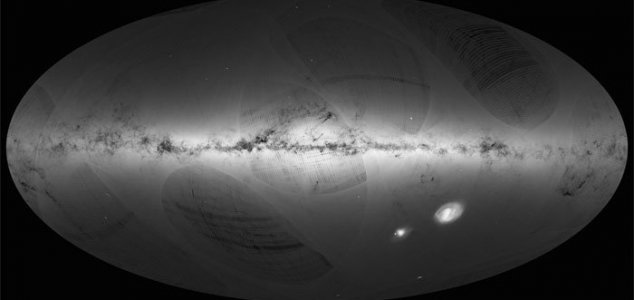
A few years ago, the European Space Agency quietly released a map. It wasn’t just any map. It was a 3D chart of our galaxy with the positions of over a billion stars. A billion. Let that number sink in. And what this map started to reveal wasn’t just a bigger, clearer picture. It was a completely different story. A story of violence, of cannibalism, of ancient ghosts hiding in plain sight, and a future that is rushing towards us at two hundred and fifty thousand miles per hour.
This isn’t just astronomy. This is the greatest mystery unfolding right above our heads.
The Milky Lie We All Believed
Look up on a clear, dark night. Far from the city lights. You’ll see it. A faint, glowing band splashed across the sky like a celestial spill. That’s our galaxy. The name “Milky Way” comes from the ancient Greeks and Romans, their via lactea, or “milky road.” They saw a river of milk poured by a goddess. For millennia, that’s all it was—a myth. A smudge.
Then came a man with a new kind of eye.
In 1610, Galileo Galilei pointed his crude telescope at that smudge and the myth evaporated. It wasn’t milk. It was stars. Millions. More stars than anyone had ever dreamed possible. The celestial river was a river of suns. But even then, our vision was comically limited. For the next three hundred years, we lived in a bubble. Astronomers fiercely believed that our Milky Way was it. The whole show. The entire universe, contained in this one stellar city.
Everything else? Those fuzzy little spiral patches in the sky? Just gas clouds. Minor local attractions. Nothing more.
The Fight That Blew The Doors Off The Universe
The argument came to a head in 1920. They literally called it the “Great Debate.” On one side was Harlow Shapley, who argued passionately that the Milky Way was the one and only galaxy. A universe in a bottle. On the other side was Heber Curtis, who dared to suggest those “spiral nebulae” were actually “island universes”—entirely separate galaxies, just like our own, but impossibly far away.
It was an intellectual brawl for the ages. But it took an astronomer named Edwin Hubble to deliver the knockout blow a few years later. Using the most powerful telescope of his time, he proved Curtis was right. The Andromeda “nebula” wasn’t a cloud of gas inside our galaxy. It was a separate galaxy, two and a half million light-years away. And there were others. Billions of others.
In an instant, our universe didn’t just get bigger. It exploded. We weren’t the center of everything. We were a single grain of sand on an infinite cosmic beach.
And yet, we still didn’t even have a good map of our own backyard.
Gaia: The Billion-Pixel Eye in the Void
Trying to map the Milky Way from the inside is like trying to draw a map of New York City while you’re standing in the middle of Times Square. In a blizzard. You can see the nearby stuff, but the rest is blocked by crowds, buildings, and bad weather. For us, the “blizzard” is thick clouds of interstellar dust and the sheer density of a hundred billion stars.
For decades, our best maps were educated guesses. Clever connect-the-dots games based on limited data. Until Gaia.

The European Space Agency launched the Gaia space observatory in 2013, placing it in a special spot a million miles from Earth. It’s not an ordinary telescope. It’s a celestial surveyor of impossible precision. Gaia carries a one-billion-pixel camera. That’s not a typo. To put that in perspective, a high-end consumer camera might have 50 million pixels. Gaia’s camera is so sensitive it could measure the diameter of a human hair from over 600 miles away.
Its mission: to scan the sky over and over, charting not just the position of stars, but their movement, their speed, their direction, and their brightness. Its goal was to create not a picture, but a 3D, high-definition, feature-length film of our galaxy in motion.
The first major data release, the one that sparked the original news, was staggering. It mapped 1.1 billion stars. It included 400 million stars that were completely unknown to science. The previous best map, from the Hipparcos satellite, had about 100,000. Gaia’s first go was nearly 20 times better.
Timo Prusti, a Gaia project scientist, said at the time, “The beautiful map we are publishing today shows the density of stars measured by Gaia across the entire sky, and confirms that it collected superb data during its first year of operations.”
They thought they had superb data. They had no idea.
That first map was just the trailer. The main feature would prove to be a horror movie.
Deep Dive: The Ghosts Hiding in the Data
The first map was just the beginning. As Gaia continued its work, sending back petabytes of data, scientists began to uncover things that shouldn’t be there. The “what” and “where” was amazing. But the “how fast” and “which way” changed the entire story.
Our Galaxy is a Cannibal
As astronomers analyzed the movements of millions of stars, they found a group of them moving differently. They were going the wrong way. They were… alien. These stars were the ghostly remnants of a smaller galaxy that our Milky Way collided with and *ate* about 10 billion years ago. They call it Gaia-Enceladus.
Think about that. We are living inside the shredded corpse of another galaxy. Its stars are now mixed with ours, like ghosts at a feast. This wasn’t a gentle merger. It was a violent act of cosmic cannibalism that shaped the very galaxy we call home. How many other victims are buried in this galactic graveyard? Gaia’s data suggests there have been many. Our home is built on the bones of others.
Something Punched Our Galaxy in the Face
We’ve always seen pictures of the Milky Way as a beautiful, flat, serene spiral. It’s not. Gaia’s data shows the galactic disk is warped. Twisted. Like a vinyl record left out in the sun. The northern and southern edges are bent in opposite directions. For a long time, no one knew why. The most recent theories, powered by Gaia’s precision, suggest a dwarf galaxy—probably the Sagittarius Dwarf Galaxy—smashed through the plane of our galaxy like a cosmic cannonball, sending ripples and warps through its structure that are still oscillating today.
Our galaxy isn’t a peaceful pinwheel. It’s a crime scene.
The Stellar Streams: Breadcrumb Trails of Dead Galaxies
Gaia didn’t just find one ghost galaxy. It found dozens of “stellar streams.” Imagine long, faint rivers of stars arcing across the sky. These aren’t random. They are the last, stretched-out remains of dwarf galaxies and star clusters that got too close, and the Milky Way’s immense gravity ripped them apart like cosmic taffy. We can now see these trails of destruction, mapping out our galaxy’s long and brutal history of conquest.
The Dark Conspiracy: What Aren’t They Showing Us?
Here’s where it gets really weird. Gaia’s map is the most detailed ever created. But it’s a map of the light. What about the dark?
Astronomers have known for decades that something is wrong with our accounting. When they measure the spin of our galaxy, the outer stars are moving way too fast. Based on the amount of visible matter—stars, gas, dust—those stars should be flung off into the void like kids flying off a merry-go-round. But they aren’t. Something is holding them in. Something with immense gravity.
Something we can’t see.
They call it dark matter. They estimate that all the stuff Gaia is mapping, all the billions of stars and nebulae, makes up less than 5% of the total mass of the galaxy. Let that sink in. The map, this incredible achievement, shows us, at best, 5% of what’s actually out there. We are living in a city where 95% of the buildings are invisible.
Internet theories and fringe science forums are buzzing. Is “dark matter” just a placeholder for something we can’t comprehend? Could the “dark rifts” we see in the Milky Way—the long black patches that block the starlight—be more than just dust clouds? Could massive, non-luminous alien megastructures be hiding in those dark lanes? It sounds insane, until you remember that the “sane” explanation is that our galaxy is held together by an invisible ghost substance that nobody has ever detected directly.
Which theory is crazier?
The Final Revelation: The Map is a Prophecy
Perhaps the most terrifying discovery to come from Gaia’s precision isn’t about the past, but the future. For over a century, we’ve known that the Andromeda galaxy is moving towards us. But the exact trajectory was a guess.
Not anymore.
By tracking the pinpoint movements of stars, Gaia has allowed astronomers to calculate the trajectory of our galactic collision with terrifying accuracy. It’s not going to be a near miss. It’s a head-on collision. The Milky Way and Andromeda, two massive galaxies with trillions of stars and planets between them, are currently hurtling towards each other at over 250,000 miles per hour.
The collision will begin in about 4.5 billion years. The two spirals will smash together, tear each other apart, and merge over hundreds of millions of years into a single, chaotic, giant new galaxy some have already nicknamed “Milkomeda.”
So the map Gaia gave us isn’t just a picture of our home. It’s a snapshot of the battlefield. It’s a prophecy of a cataclysm on a scale that is almost impossible to comprehend. It’s the final chapter in our galaxy’s story, written in the cold, hard math of celestial mechanics.
We set out to map our little corner of the universe. We wanted to know where we were. But what we found is a history of violence, a present filled with invisible phantoms, and a future of unimaginable destruction. The map is a masterpiece. But what it shows is that our quiet, milky river in the sky is anything but peaceful. It’s a monster. And it’s still hungry.