The Amazon’s Phantom Ancestors: A Secret Connection to Australia That Rewrites Everything
Stop what you’re doing. Forget the history you learned in school. The story of how humanity first reached the Americas isn’t just wrong; it’s missing a ghost. A phantom population whose genetic echo, against all logic, connects the deepest parts of the Amazon rainforest with the shores of Australia and the islands of Melanesia.
This isn’t a wild theory from a late-night talk show. This is a bombshell dropped by mainstream science. A genetic mystery that has sent shockwaves through the worlds of archaeology and anthropology. It’s a discovery so profound, so completely unexpected, that it forces us to ask a terrifying question: who were the *real* first Americans?
And what happened to them?

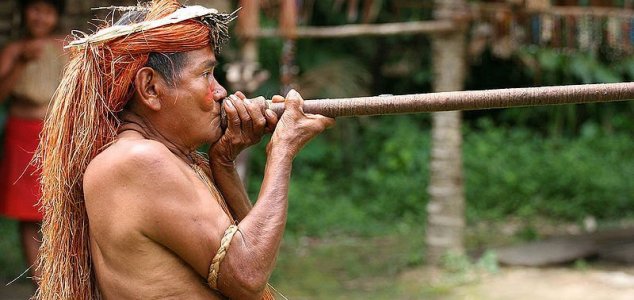
For years, two independent teams of brilliant geneticists were digging through the DNA of indigenous peoples across the Americas. They were looking for clues, for patterns, for anything that could sharpen the fuzzy picture of ancient migration. And then they found it. Something that shouldn’t be there. A genetic signature, a whisper from the past, hiding in plain sight within tribes like the Suruí and Karitiana of the Brazilian Amazon. It was a signal that didn’t link back to Siberia, the accepted homeland of the first Americans. No.
This one pointed an impossible finger clear across the Pacific Ocean.
The Textbook Story Just Imploded
Let’s rewind. The official story is one you probably know. For the better part of a century, we’ve been told a simple, elegant tale. Around 15,000 years ago, maybe a bit earlier, brave bands of Siberian hunters chased mammoths and mastodons across a vast, now-vanished land bridge called Beringia, which connected Asia to Alaska. These people, known as the “Clovis culture,” then poured south, populating two entire continents in a geological blink of an eye.
A nice, clean story. One land bridge. One founding population. One epic journey.
Too bad it’s falling apart.
Archaeological sites like Monte Verde in Chile have long suggested people were in South America thousands of years *before* the Clovis culture even appeared in the North. But this? This genetic data is something else entirely. It’s not just about pushing back a timeline. It’s about introducing a completely new character into the story, a character nobody even knew existed.
As Harvard Medical School’s Professor David Reich, one of the lead researchers, admitted, the find was “surprising and unexpected, and we weren’t really looking for it.” He put it bluntly: “The simplest possible model never predicted an affinity between Amazonians today and Australasians.”
The simplest model is dead. What rises from its ashes is a far stranger, more complex, and infinitely more exciting history of our species.
Meet “Population Y”: The Ghosts in the Genes
Scientists needed a name for this mysterious ancestral group. They called them “Population Y.” The “Y” might as well stand for “Why?” because that’s the question on everyone’s lips.
Why is their DNA here? Why is it strongest in the Amazon? And why does it link them to the Onge people of the Andaman Islands, to Papuans, and to Indigenous Australians?
The two major studies, one published in *Nature* and the other in *Science*, offer two tantalizing, and conflicting, explanations for this genetic ghost.
Deep Dive: The Two Competing Scenarios
On one side of the debate, you have Professor Reich’s team. Their conclusion is explosive. They believe there wasn’t just one founding migration into the Americas, but at least two. The first wave was the one we know, the ancestors of the vast majority of Native Americans today. But then came another group, Population Y, who carried this unique Australasian genetic signature. They also crossed the land bridge, perhaps around 15,000 years ago, but were a distinct population.
What happened next is a story of ghosts and shadows. According to this model, Population Y was almost completely wiped out or absorbed by the larger, first-wave group. They vanished from North America, leaving no trace. But somehow, a remnant of this lost population survived, pushing deep into the continent’s heart, down into the Amazon basin, where their genetic legacy lives on in a handful of tribes today.
It’s a staggering idea. A second, lost migration of people who were genetically distinct from all other Native Americans. A people who were almost erased from history.
But the other team, led by Eske Willerslev at the University of Copenhagen, looked at the same data and painted a different picture. They argue for a single founding migration. In their view, this Australasian DNA wasn’t from a separate migration at all. Instead, it was a “minor” genetic ingredient that was already present in the *one* group of ancestors who crossed from Siberia. It was just a trace element, a faint signal that got diluted and lost in most populations over thousands of years. But, by sheer chance, it remained more concentrated in the isolated groups that eventually settled the Amazon.
So, which is it? A lost wave of pioneers who were almost completely replaced? Or a secret ingredient in the original recipe that only a few can still taste?
The science is locked in a fascinating battle. But either way you slice it, the conclusion is the same: the story is not what we thought.
![]()
The constant re-evaluation of early American history is nothing new. The battle over the Kennewick Man, an ancient skeleton found in Washington State, showed just how complex this story is. Initial analysis suggested features unlike modern Native Americans, sparking a massive controversy. Eventually, DNA testing proved his direct ancestry to modern local tribes. It’s a reminder that skeletons and skulls can tell one story, but the genes tell another, often more surprising one. The discovery of Population Y is like the Kennewick Man controversy on a global scale.
How Did They Get Here? The “What If” Scenarios
This is where we leave the solid ground of peer-reviewed papers and venture into the thrilling fog of speculation. If a group with Australasian ancestry *did* make it to the Americas, how on Earth did they do it?
Scenario 1: The Coastal Super-Highway
Forget the idea of hunters trudging through an icy, inland corridor. Many modern archaeologists now favor a “coastal migration” model. The theory is simple: the first Americans didn’t walk, they boated. They would have followed the rich coastline, a “kelp highway” teeming with fish, seals, and birds, from Asia, around the edge of Beringia, and down the Pacific coast of the Americas.
This model is much faster and more efficient than a land-based one. And it elegantly explains how Population Y could have arrived. Perhaps they were an early coastal people who made this journey, leapfrogging down the continent. It would also explain why their genetic trace is found in South America—they just kept going, following the coast all the way down, before finally turning inland into the great Amazon river basin.
In this version, they weren’t necessarily a separate “wave” that came later, but perhaps the *very first* wave, a vanguard of coastal explorers who were later overwhelmed by larger groups of land-based hunters who followed them. They weren’t pushed south; they were simply the first ones to get there.
![]()
Scenario 2: The Siberian Ghost Mix
What if Population Y never even set foot in Australia? This is where things get really mind-bending. The genetic link isn’t to *modern* Australians, but to a shared, ancient ancestor of both groups. Consider the incredible discovery of the “Mal’ta boy,” a 24,000-year-old skeleton from Siberia whose DNA showed a shocking connection to both Western Europeans and Native Americans. It proved that ancient Siberia was a genetic melting pot, a crossroads of humanity.
Is it possible that an ancient Australasian-related group also made it to this Siberian crossroads? They might have lived there for thousands of years, mixing with the proto-Native American peoples *before* anyone crossed into Alaska. In this scenario, the ancestors of the Amazonian tribes just happened to inherit a slightly larger dose of this ancient “ghost” DNA from the Siberian melting pot. Population Y wasn’t a people; it was a genetic memory, carried across the land bridge within a single, diverse founding population.
Scenario 3: The Impossible Voyage (The Conspiracy Corner)
And then there’s the idea that sends shivers down the spine of every mainstream archaeologist. The one you’ll find debated in hushed tones on internet forums.
What if they sailed?
Across the open Pacific. Thousands of years ago.
It sounds like pure fantasy. But we know that ancient peoples of the Pacific were the greatest navigators the world has ever seen. They settled impossibly remote islands using star charts, wave patterns, and an intimate knowledge of the sea. Could a group from Melanesia or near Australia have made an eastward journey, hitting the coast of South America by accident or by design?
Most scientists dismiss this out of hand. The timeline is wrong, the technology is all wrong. But it’s a tantalizing thought. It’s the ultimate alternative history: a trans-oceanic contact that predates Columbus by 15,000 years. While there is zero archaeological evidence for this, the genetic anomaly forces us to keep every door, no matter how strange, slightly ajar.
The Echoes Keep Coming
This isn’t a one-off discovery. Genetics is consistently blowing up our old, dusty models of the past all over the globe. We’re learning that ancient human history wasn’t a series of neat lines on a map, but a messy, tangled web of migrations, mixing, and mysterious disappearances.
![]()
Take Europe, for example. For a long time, the story seemed simple. But DNA from ancient skeletons revealed a far more dramatic tale. We now know that modern Europeans are a mix of at least three major ancient migrations: the original hunter-gatherers, early farmers who swept in from the Near East, and a later wave of horse-riding pastoralists from the Russian steppe. Each wave largely replaced the people who were there before. History is a story of ghost populations everywhere we look.
So why should the Americas be any different?
The existence of Population Y suggests the American story is just as complex, just as dramatic. It hints at a past filled with forgotten journeys and peoples who lost the great struggle for survival, leaving behind nothing but a faint genetic echo in one of the most remote places on Earth.
The story is far from over. Scientists are now scrambling to sequence more DNA, from both ancient remains and living people, searching for more traces of this phantom lineage. Every new genome is a potential key. Was their DNA once more widespread? Are there other pockets of it in other isolated tribes?
The truth is still out there, buried in the soil and coded in the blood. But one thing is certain: the presence of an Australasian ghost in the Amazonian machine has changed the game forever. The first chapter of human history on these continents has been torn out. Now, the frantic search for the real story begins.
Who were they? Where did they go? And what other secrets are waiting to be found, hiding in our own DNA?