THE MURDER
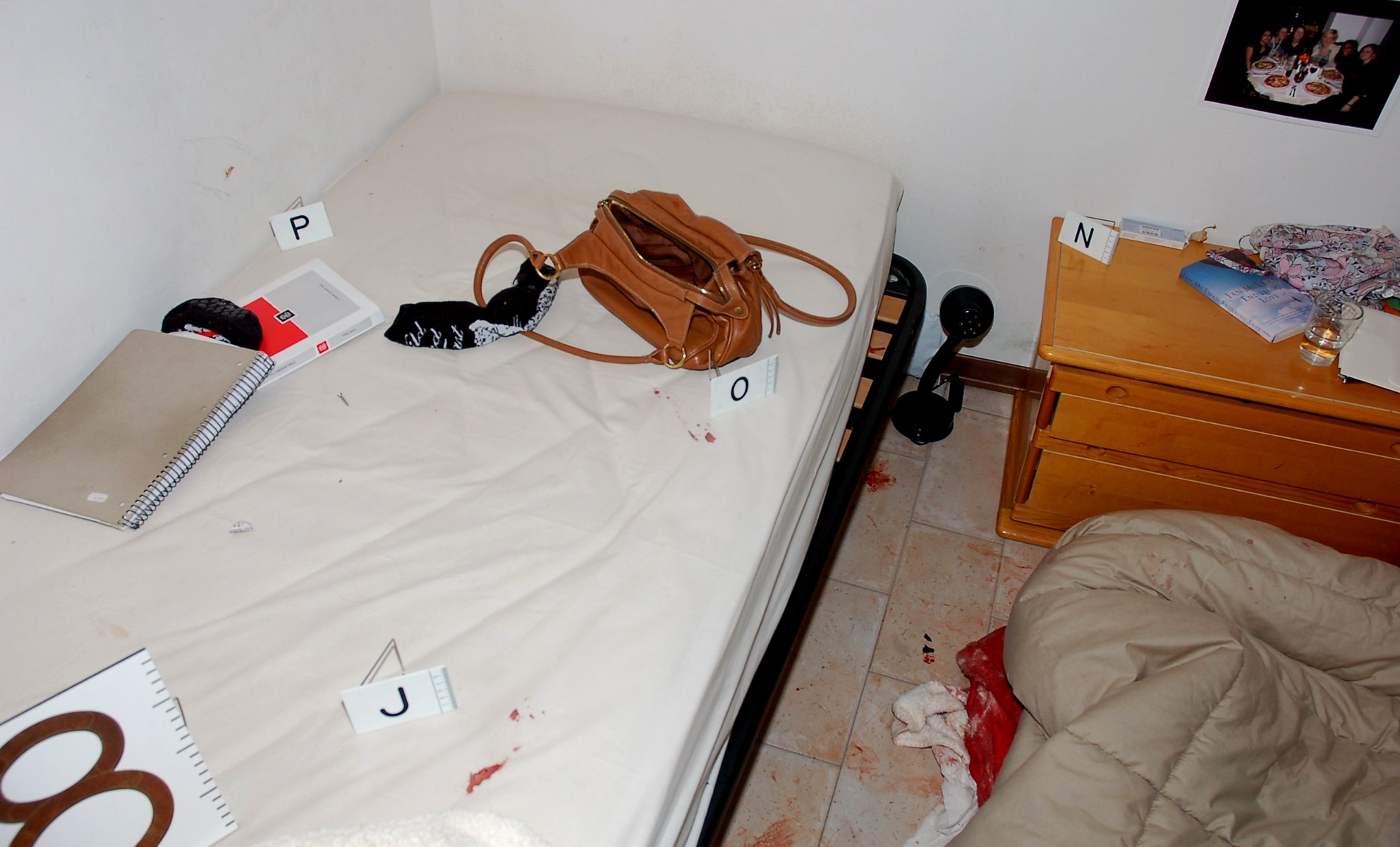
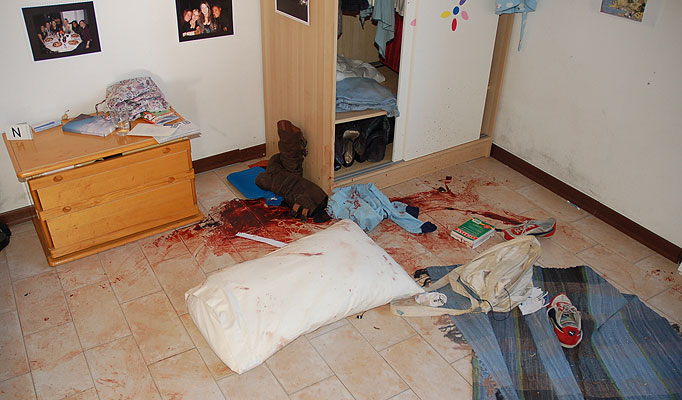
On November 2, 2007, Italian police discovered Meredith Kercher, 21, dead on her bedroom floor, drenched in blood and half-dressed but wrapped in a duvet, a condition which caused police to suspect that the killer or killers included someone who knew the victim or was otherwise sensitive to sexual violence.
Kercher, a student from the University of Leeds, had been fatally stabbed in the throat the night before in the cottage she shared with an American student, Amanda Knox, and two Italian women their age, Filomena Romanelli and Laura Mezzetti. Knox and Kercher were students at the University per Stranieri for Foreigners in the picturesque Umbrian city of Perugia in central Italy.
Foxy Knoxy
Investigation of Kercher’s murder, though, brought to light accounts of a wild student life at the university far exceeding simple youthful indiscretion making study abroad here look less like cultural and educational enrichment and more like an ongoing carnival of self-indulgence.
Lurid British, Italian and American tabloid coverage and unsolicited grassroots efforts to prove Amanda’s innocence by alleging police misconduct casting doubt on the Italian judicial system have transformed the case into a media circus, its sensational headlines eclipsing the sad fate of young Meredith Kercher.
Meredith
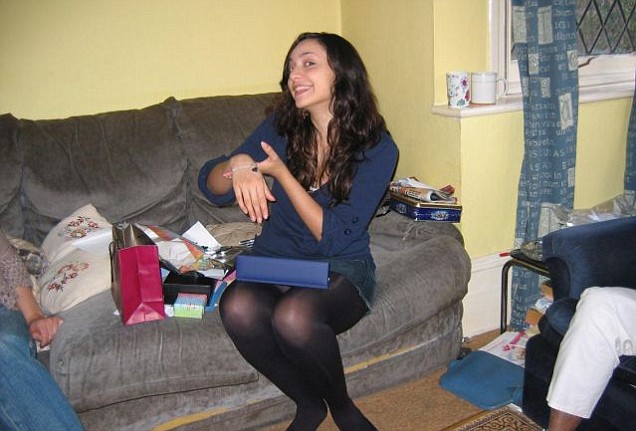
Meredith was a quiet girl, diligent and studious. She wanted to become a teacher. The youngest child of freelance journalist John Kercher and Arline Kercher, she grew up in Coulsdon, a small town within the South London borough of Croydon. Friends and family called her Mez.
She attended a private all-girls school and then the University of Leeds. At Leeds, she made the fateful decision to spend a year learning Italian in Perugia through the European Union’s Erasmus university-exchange program.
The events
Meredith, Amanda and their friends spent Halloween at a party downstairs at the home of Giacomo Silenzi, the Italian boy Meredith was dating.
November 1, the girls went their separate ways. Meredith and countrywomen Sophie Purton and Robyn Butterworth had dinner at Robyn’s apartment, then watched “The Notebook” on DVD. Meredith was tired from the previous night’s party.
They made it an early night. After the credits rolled on the tale of lost love, Sophie walked Meredith part way home, and Meredith arrived back at her cottage around 9:15 p.m. Sometime between then and midnight, investigators concluded, Meredith sustained the fatal throat wound that caused her slow death by asphyxiation.
A Murder Mystery
The next morning a neighbor found two cell phones in the garden near her home. Worried they were part of a terrorist plot perhaps rigged to detonate a bomb, she called the police. The police quickly traced the phones, learned they belonged to Meredith, and stopped by the girls’ cottage on Via Pergola, where they found Amanda and Raffaele outside.
Entering the house and forcing their way into Meredith’s room, which had been locked from the inside, the police discovered Meredith’s body.
Amanda Knox
Both Italian roommates had been away for the night and were still gone. Earlier that morning, Amanda had called Filomena to say that the front door was open and that the bathroom was had blood stains on the floor. She told her friend she was going to go back out to get Raffaelebut first she was going to take a shower.
changed stories
Amanda and Raffaele have changed their stories about that morning and the previous night several times during the investigation.
In one account, they were ostensibly at Raffaele’s from early evening through the next morning. He said he used his computer most of the evening, and they watched Audrey Tatou in Jean-Pierre Jeunet’s whimsical portrait of Paris,
Investigators say his computer had not in fact been used most of that evening. Amanda said she read part of a Harry Potter book there; police saw it at the crime scene, though she hadn’t mentioned bringing it home.
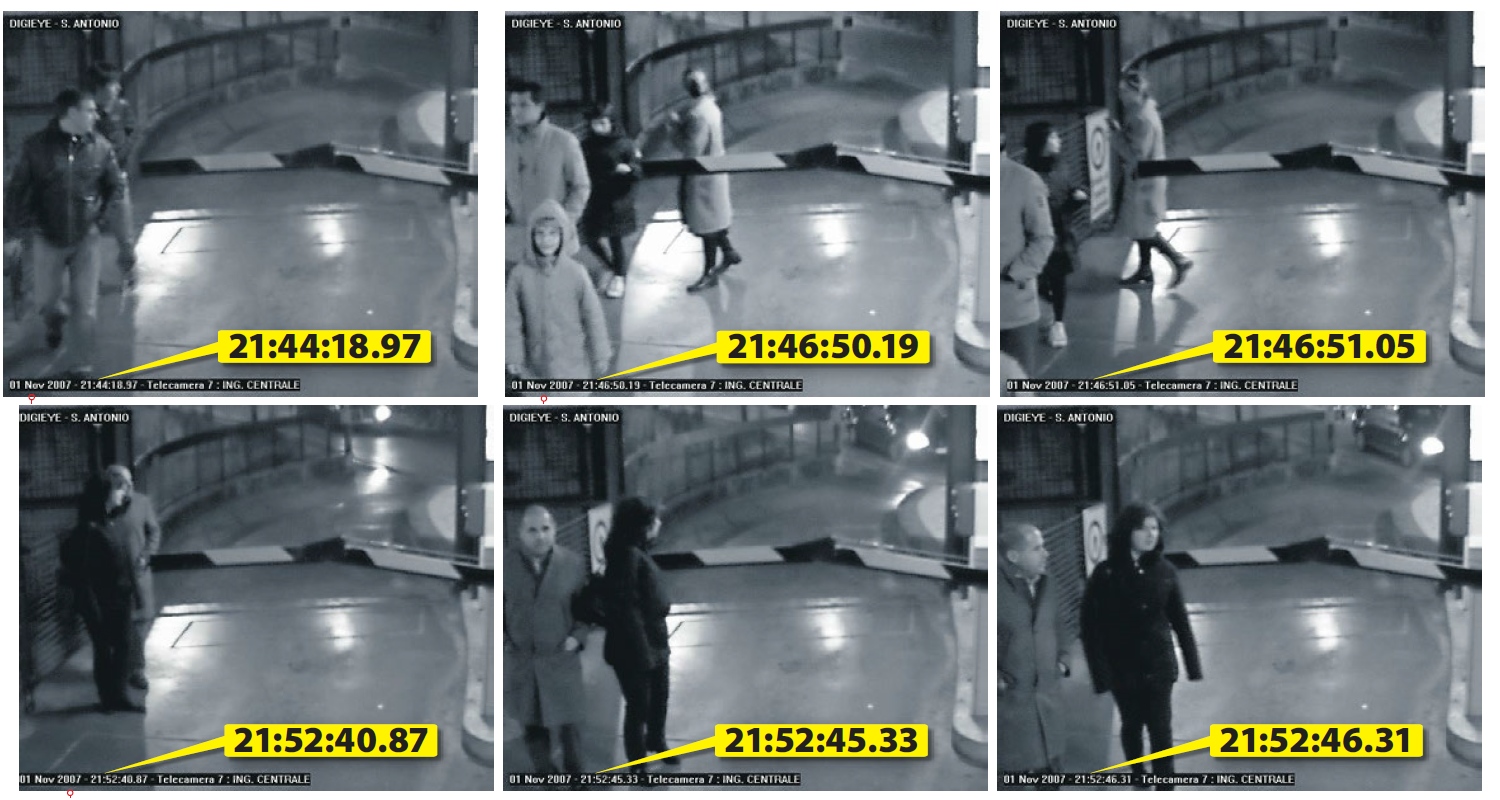
In another account, Amanda said she was home and heard the murder; this would fit with grainy neighborhood closed-circuit television footage that police say shows her getting home around 8:45 p.m. Raffaele in the end claimed that that he was too high, too confused by the regular cannabis consumption that soothed his nerves, even to remember whether Amanda was with him the whole night.
Former director of Perugia’s crime squad, Domenico Giacinto Profazio, notes that both suspects’ cell phones were turned off between 8:00 and 8:30 the night of the killing, and remained off until late in the morning of the next day, a marked departure from both suspects’ usual usage patterns.
That morning, Raffaele told police they’d reached the cottage just before police arrived and that he had been trying to call authorities to report what they thought was a violent break-in, after seeing that a window in one of the rooms was shattered. Police, though, suspect Raffaele broke the window.
Evidence
Investigators say Raffaele’s phone show he made these calls only after the police showed up to investigate the found phones. The couple insists they had no idea Meredith was dead behind her locked bedroom door; yet, despite the fact that the police closed the room off and did not let her in, Amanda has since described the scene. Furthermore, a witness, Marco Quintavalle, testified that a young woman he identified as Knox came into his supermarket early that morning, during the time she’d claimed to be at Raffaele’s.
Murder weapon found
Police report that Raffaele’s apartment smelled of bleach that morning, and that they found a receipt there from Quintavalle’s shop. They believe bleach and cloths found in the house cleaned the house and the murder weapon.
Police brought Amanda and Raffaele in for questioning several times over the next few days. They asked Amanda about a text exchange between her and her boss, Patrick Diya Lumumba.
Lumba
While too young to legally drink in the U.S., Amanda had been able to get a job in Perugia at a bar. Patrick Lumumba, 44, owns and runs Le Chic, a small bar near the university, and doubtlessly figured the outgoing and attractive Amanda would be a positive addition to his staff.
Lumumba met Knox’s roommate Meredith at the bar that October when she saw a Polish vodka and told him that she could make mojitosnormally made with limes, sugar, mint and rumwith it; he invited her back to do so.
Lumumba sent Knox a text on November 1 telling her she didn’t have to come in that night because the bar was nearly empty and he didn’t expect business to pick up. She replied, “See you later.” Just as it is in English, “See you later” is an Italian idiom. It doesn’t always indicate a real plan; sometimes it’s just a sign-off. Furthermore, Knox’s team asserts that the police records’ paraphrase of this text message left out the important final phrase that Amanda typed: “Good night.”
When police probed further, Amanda blamed Patrick for the killing. Anna Donnino, a police interpreter, testified that Amanda seemed relieved when she finally changed her story to say that she was home and had heard Meredith’s screams as Patrick attacked her. Amanda claimed Patrick was infatuated with Meredith; he maintained he had met the English girl only a handful of times.
Knox told police that she had met up with Patrick at a neighborhood basketball court the evening of the murder, and that they had gone together to the cottage around 9:00 p.m. She said that Patrick and Meredith had soon retired to Meredith’s bedroom, and that she later had heard Meredith screaming, in response to which, Knox maintained, she had only plugged her ears. If this version is true, she apparently had forgotten all about it by the next morning, and didn’t connect it to the blood-soaked apartment. Police arrested Amanda that night, in view of her inconsistent statements.
Lumumba was arrested the next day, but was quickly able to prove he’d spent the evening in his bar, and was released on November 20, 2007, for lack of any evidence corroborating Knox’s account. He later sued the police for 516,000 euros in damage for false imprisonment (approximately $670,000 at the time). On March 16, 2009, an Italian court awarded Patrick 8,000 euros ($10,500). He’s now suing Amanda for defamation.
New story!
With Patrick off the hook, police and media attention turned to another African immigrant. While the police had Knox, Lumumba and Sollecito in custody, forensic analysis showed that bloody fingerprints from the crime scene could not be matched to any of the three in custody, but instead were matched to a local small-time drug dealer and petty thief named Rudy Hermann Guede.
Italian police put out bulletins identifying him, but he was shortly located in Germany, detained there by transit police for boarding a train without a ticket. Positively identified there, he was soon extradited back to Italy for suspicion of murder.
Rudy Hermann Guede
Rudy had moved with his father from Côte d’Ivoire to Italy when Rudy was five.
When his father returned to the economically and politically unstable West African nation, Rudy stayed behind with a prosperous businessman, Paolo Caporali, and his family. Rudy remained with the family even after his father returned again to Perugia as a laborer.
Rudy’s adolescent rebellion, though, drove a rift between him and Caporali. He fell into the darker side of Perugia’s extensive student party scene, allegedly becoming a small-time drug dealer. A knife fight left him with an abdominal scar.
Rudy and Meredith, Rudy told police, had met at Silenzi’s Halloween party. He told police that they made a date for the next night, contradicting her British friends with whom she spent the next evening, who maintained that she went home because she was tired, not because she had other plans.
Rudy admitted that he had been in the cottage the night Meredith died, and that they had had consensual sex that night. But he maintained that he didn’t kill her. Rudy insisted that that someone broke in and killed Meredith while he was in the bathroom, suddenly sick from a bad kebab. He had been playing his iPod during his time in the bathroom, he said, but eventually her screams filtered past his headphones.
When he pulled himself together and made it out of the bathroom, he claimed, he saw a brown-haired Italian man who he thinks may have been Raffaele, whom he did not know well.
The man insulted him with an Italian racial slur, reminded him that everyone would assume the black man was the guilty one, and left. Rudy testified that he heard but did not see Amanda, although he told police he’d only met Amanda once at Le Chic. Rudy suggested that she may have mistaken him for Patrick, although the two African immigrants differ in age by over 20 years and bear little resemblance to each other.
In his version of events, Rudy tried to save Meredith, but gave up, panicked, and fled. Police determined that he then went to a student disco until well after midnight, leaving only to head to a bar, where he stayed until dawn. The next night, he went clubbing again. When the DJ that night declared a moment of silence for Meredith, witnesses say Rudy kept dancing. The next day he fled to Germany, where zealous transit police soon detained him.
Rudy accepted a fast-track trial, apparently believing Amanda and Raffaele were framing him. The DNA left behind after his tryst with Meredith and his implausible tale of an exculpatory bout of food poisoning contributed to his 30-year sentence, but he’s appealing the case and suggesting that Amanda killed Meredith during an argument about money. He claimed that Meredith called Amanda a “drugged-up tart” and that Amanda needed the money for drugs.
Italian prosecutors, while pleased with the conviction of Guede, remained convinced that Guede could not have acted alone. In addition to the incongruity, variability and implausibility of their accounts of their actions on the night in question, physical evidence connecting Knox and Sollecito to the crime scene was accumulating.

First Trial
Amanda Knox, 21, and Raffaele Sollecito, 24, are currently on trial for Meredith’s murder and sexual assault; an Italian court has already convicted and sentenced Rudy Hermann Guede, 20, for assault and murder.
Amanda Knox Sex Games
Lead prosecutor Giuliano Mignini says that the trio lured the unwilling Meredith into a violent group sex game. He alleges that Raffaele held Meredith down while Guede sexually assaulted her.
Amanda, he says, taunted Meredith with a knife, nicking a necklace of cuts around her neck and chest before finally slitting her throat.Amanda and Raffaele are charged with sexual assault, which carries a sentence of 6-12 years; theft, 1-6 years; simulation of a crime, 1-3 years; possession of a weapon, up to 1 year; and murder with cruelty, with a life sentence. If Knox is found guilty of slandering Patrick Lumumba by her false accusation, that would earn her an additional 6-20 year sentence.
On March 15, 2009, Amanda was also charged with slander for saying that police hit her and physically and psychologically intimidated her during her interrogation. Police have testified that no one harmed her at the station.
The confession of her presence at the time of the murder which she made the night she was arrested was declared inadmissible because she did not have a lawyer present. There may be other evidence against her: investigators tapped Amanda’s phone even before the arrest, and they intercepted and read her letters and recorded her prison conversations.
Many questions remain. Amanda and a North African musician were reportedly spotted at a laundromat the day after the murder; this same man may have been shown on closed-circuit television in the cottage’s parking area the night of the murder.
Strange actions of Amanda Knox
Observers say Amanda and Raffaele have shown varying attitudes toward each other during the trial. She ignored him at the opening hearing, but approached him during an intermission to compliment his newly shorn hair. Friends and family have reportedly advised her to stay on good terms with Raffaele, even as the prosecution continues to build its case.
The outcome of the two’s trial remains to be determined, but the sensational details of the case have made it a placeholder for a larger debate across Europe and the rest of the world about the modern implications and interactions of the sexual revolution, globalization and higher education.
In a story which placed many of the implicit assumptions of worldly and aspiring families under harsh interrogation and cross-examination, the verdict in the cases of Amanda Knox and Raffaele Sollecito, regardless of the jury’s final decision, will likely remain controversial for years to come.
Amanda and Raffaele got found not guilty in the retrial in 2011.