The Giant Hiding in Plain Sight: Mexico’s Forgotten Pyramid City Rewrites History
You think you know history? Think again.
For decades, scholars, tourists, and locals walked right past it. They looked at the massive, jungle-choked mound rising from the plains of Chiapas, Mexico, and saw a hill. A big one, sure. An impressive work of nature. Nothing more.
They were wrong. So incredibly wrong.
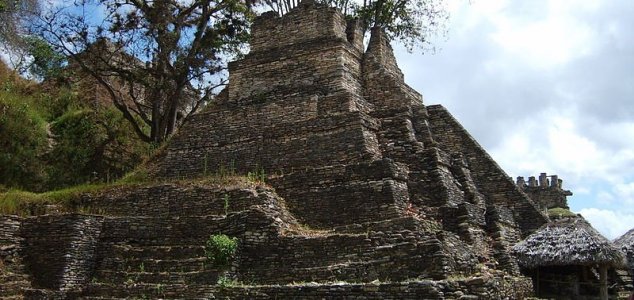
Because that hill wasn’t a hill at all. It was a pyramid. A city. A sprawling, man-made mountain built by one of the most fearsome civilizations in the ancient Americas. This is the story of Toniná, the lost acropolis that was hiding in plain sight, a structure so enormous it forces us to tear up the old textbooks and start over.

The Moment Everything Changed
Imagine being an archaeologist at the Toniná site. For years, the official story was simple: the ancient Maya built their temples and palaces *on top* of a large, natural hill to give them a strategic and spiritual advantage. It made sense. It was logical. It was also completely false.
Using advanced 3D mapping technology—tools that let them see through the earth and vegetation—researchers from Mexico’s National Institute of Anthropology and History (INAH) started to notice something strange. The “hill” wasn’t a solid mass of rock and dirt. It had structure. It had angles. It had intention.
So they started digging. And as they peeled back the layers of soil and time, the truth emerged, stone by ancient stone. This was no hill. It was one of the largest, most complex construction projects in the entire Mayan world.
“It’s a big surprise to see that the pyramid was done almost entirely by the architects and therefore is more artificial than natural,” site director Emiliano Gallaga announced, his words sending shockwaves through the historical community. “This is because it was believed that almost every hill was a natural mound, but recent evidence has revealed that it was almost entirely built by the ancient inhabitants.”
Let that sink in. They didn’t build *on* the mountain. They built the mountain.
Just How Big Are We Talking?
Get ready for your mind to bend a little. The numbers are staggering.
The acropolis of Toniná stands a colossal 75 meters (about 246 feet) tall. To put that in perspective, it’s a stone behemoth on par with the legendary Pyramid of the Sun at Teotihuacan, one of the most famous structures in all of Mesoamerica. It absolutely dwarfs the more famous El Castillo at Chichen Itza.
From its base, a grand central staircase of 208 stone steps climbs towards the sky. But this isn’t just one giant pyramid. It’s an entire city stacked vertically. The structure is a masterpiece of urban planning, composed of seven distinct platforms, each hosting a labyrinth of essential buildings.
A City in the Sky
- The Lower Levels: On the first and second platforms, you’d find the palaces of the ruling elite, administrative offices where the fate of thousands was decided, and a fiercely contested ball court where games of life and death were played.
- The Mid-Levels: Higher up were the temples, sacred spaces dedicated to their powerful gods. Here, priests would perform rituals, read the stars, and make offerings to ensure the continued prosperity—and military dominance—of their people.
- The Peak: At the very top, with an unrivaled view of the entire valley, stood the most important temples. This was the nexus point, the sacred space that connected the earthly plane to the heavens above and the underworld below. It was from here that the rulers of Toniná declared their divine authority.
This wasn’t just a building; it was an entire ecosystem. A fortress, a palace, a cathedral, and a city all rolled into one. A manufactured mountain of power.
The Kingdom of Po’: Warriors and Master Builders
So who were these incredible architects? Who had the vision, the manpower, and the sheer will to erect such a monument? The city was known in its heyday as Po’, and its people were not to be trifled with. For centuries, they were locked in a bitter, bloody rivalry with a neighboring Mayan superpower: Palenque.
Think of it as the Sparta and Athens of the Mayan world. Palenque was known for its elegant art and intricate architecture. Toniná, on the other hand, cultivated a reputation for military might. Their art is filled with images of bound captives, vanquished enemies, and proclamations of their martial superiority. They were aggressive, expansionist, and brutally effective.
The conflict between these two city-states defined the region for over a century. And in this long war, Toniná eventually claimed the ultimate prize. In 711 AD, they captured the king of Palenque, a ruler named K’an Joy Chitam II. It was a devastating blow from which Palenque never fully recovered. Toniná had become the undisputed hegemon, the top dog in the region. Their massive acropolis wasn’t just a home; it was a statement. A monument to their victory and a warning to all who would challenge them.
Deep Dive: The Warlord on the Throne
A structure this ambitious requires a leader of equal ambition. And thanks to the treasures being pulled from the site, we’re starting to learn his name. The evidence points to a Mayan chief known as K’inich B’aaknal Chaahk. He reigned during the absolute peak of Toniná’s power, and many believe he was the mastermind behind the pyramid-city’s grandest phase of construction.
Excavations have uncovered a wall covered in ancient writing, a stony historical record that is rewriting what we know about this era.
“This wall is fundamental to understand a chapter of Tonina history between 680 and 715 AD, when the 6th seignior appears in the dynastic sequence of the site,” explained Dr. Carlos Pallan Gayol, a specialist in Mayan hieroglyphs. “To present, it is known that K’inich B’aaknal Chaahk was the ruler with greater politic and hegemonic power in Tonina.”
The texts depict him as a powerful figure, a warlord and a visionary. It was under his command that Toniná not only defeated its greatest rival but also channeled its energy into this epic building project. Every stone placed was a testament to his power. Every platform raised was another step towards his own immortality.
A Library of Stone and a Tomb of Secrets
The pyramid isn’t giving up its secrets easily, but what it has revealed so far is stunning. Archaeologists have unearthed more than 300 hieroglyphic texts. This isn’t just a few carved stones; it’s a library. These texts detail the dynastic history of the city, its political alliances, its wars, and its religious beliefs. They are a direct conversation with the past.
And then there are the more personal discoveries. Deep within the structure, a stone sarcophagus was found, dated to around 840-900 AD. The tomb, created for an elite member of Toniná’s society, contained a trove of artifacts, including pottery vessels and bone needles. Who was this person? A high priest? A royal family member? A celebrated warrior? The investigation is ongoing, but each discovery adds a new, human layer to the epic story of the city.
Another fascinating find is a sculpture depicting the decapitated head of a captured enemy—a grim reminder of Toniná’s brutal practices. This wasn’t just art; it was psychological warfare, a permanent message to their foes.
What If? Lingering Mysteries and Modern Theories
The discovery that Toniná is a man-made structure opens a Pandora’s box of questions. The official narrative is one of a city-state expressing its power. But is that all there is to it?
The internet, of course, is buzzing with alternative theories. Some point to the precise alignment of the acropolis with celestial events, suggesting it was a massive astronomical observatory, a machine for tracking the movements of the sun, moon, and stars. Could its seven platforms represent the seven stars of the Pleiades or some other celestial body?
Others whisper about the very purpose of pyramids. Were they just tombs and temples? Or were they designed for something more? Modern mystics and online theorists talk about pyramids as energy conductors, structures designed to harness telluric currents from the earth itself. Could Toniná’s massive, layered construction have served a purpose we can’t yet comprehend? A purpose that had less to do with war and more to do with the very fabric of the cosmos?
And the biggest question of all: Why did they leave?
Like so many other Mayan centers, Toniná was eventually abandoned. The great acropolis fell silent, its plazas emptied, and the jungle slowly began to reclaim the stones. Was it the endemic warfare that finally bled the region dry? Was it a catastrophic drought that starved its people? Or did the rulers of Po’, after reaching such incredible heights, simply collapse under the weight of their own ambition?
The fall of Toniná is as mysterious as its construction. The last known date recorded at the site is 909 AD, making it one of the last surviving Mayan centers before the great collapse. They held on longer than most. But in the end, even the mountain they built couldn’t save them.
A Giant Awakens
The rediscovery of Toniná is more than just a cool archaeological find. It is a profound reminder that our understanding of the past is constantly in flux. It shows us that history is not a static book but a living, breathing thing, with new chapters waiting just beneath our feet.
For centuries, a city larger than many in modern Europe lay sleeping under a blanket of green, dismissed as a simple feature of the landscape. It makes you wonder. What else is out there? What other “hills” are actually lost pyramids? What other “myths” are actually forgotten history?
Toniná is a sleeping giant that has finally woken up. And its story is a chilling, thrilling lesson: sometimes the biggest secrets are the ones that have been staring us in the face all along.
Originally posted 2015-09-21 15:41:13. Republished by Blog Post Promoter