A Ghost From the Atomic Age: The USS Independence Lies Waiting in the Deep
There are things sleeping in the dark places of the world. Monsters. Secrets. And sometimes, history itself.
Imagine the crushing blackness, 2,600 feet beneath the waves off the coast of California. The pressure here is immense, a weight that would pulverize a human body in an instant. Nothing moves. Nothing but the slow, silent currents. It is a dead world.
And yet, something is down there.
It sits upright, proud, on the seabed. A flat-topped titan of steel, its silhouette a ghostly memory of a forgotten war. It is an American aircraft carrier from World War II. For over 60 years, it has kept its vigil in absolute silence, a ghost ship haunted by the twin specters of global conflict and atomic fire. This is the story of the USS Independence, the ship that stared into the heart of a nuclear explosion and survived… only to be buried at sea with its secrets.
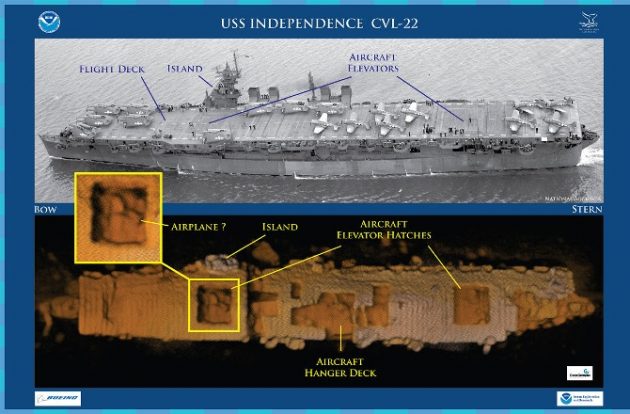
When scientists from the National Oceanic and Atmospheric Administration (NOAA) first saw the sonar readings, they couldn’t believe their eyes. They expected a wreck. A twisted heap of rusting metal. A collapsed ruin. What they found was something else entirely. A ship that looked… ready.
“After 64 years on the seafloor, Independence sits on the bottom as if ready to launch its planes,” said a stunned James Delgado, the chief scientist on the mission. He described the vessel as “amazingly intact.”
Intact is an understatement. It’s a time capsule. A war machine frozen at the bottom of the world.
The Phantom in the Hangar: A WWII Mystery?
The sonar scans painted a ghost story onto the screen. The flight deck, where heroes once launched into battle, was clearly visible. The hull was sound. The command tower stood defiant against the deep. But then the remote sensors picked up something else. A shape. Something hidden away inside the ship’s hangar bay.
It appeared to be an airplane.
Think about that for a second. A World War II warplane, entombed within a sunken aircraft carrier for more than half a century. Why was it there? What kind of plane is it? A Grumman F6F Hellcat? A TBF Avenger? Was it a forgotten relic, overlooked when the ship was prepared for its final journey? Or was it left there for a reason?
The questions are maddening. The hangar bay doors appear to be torn open, perhaps from the scuttling charges or the immense pressure. This gash in the ship’s side offers a tantalizing, frustrating glimpse into a sealed world. We can see the shape, but we can’t see the details. It remains a ghost within a ghost, a mystery locked inside an enigma.
Internet forums have lit up with speculation. Some suggest it was simply too damaged or contaminated to remove after the atomic tests. Others propose it was part of a structural test during the scuttling. A few whisper about more clandestine reasons, that the plane itself was part of the secret cargo the Independence took to its watery grave. We may never know for sure, but the thought of that lone fighter plane, waiting in the dark, is a powerful and haunting image.
Deep Dive: A Ship Forged in Fire
To understand why this discovery is so profound, you have to know where the USS Independence came from. This wasn’t just any ship. She was a legend born from desperation and ingenuity.
In the dark days after Pearl Harbor, America was losing the war in the Pacific. The Imperial Japanese Navy seemed unstoppable. The US Navy was bleeding, short on its most important asset: aircraft carriers. The massive fleet carriers of the Essex-class were under construction, but they would take too long. A solution was needed. Now.
The answer was unconventional. Radical, even. President Franklin D. Roosevelt himself looked at the construction schedules and pushed for a faster alternative. The plan? Take the hulls of fast, light cruisers already being built and convert them. Slap a flight deck on top. Improvise. Create a new class of “light carriers” that could be rushed to the front lines.
The USS Independence (CVL-22) was the first of this new breed. Laid down as the cruiser *Amsterdam*, she was transformed on the slipway. She was smaller, carried fewer planes, and had less armor than her bigger sisters. But she was fast. She was adaptable. And she was *available*.
From November 1943 to the very end of the war in August 1945, the Independence was in the thick of it. She was part of the tip of the spear in the great American naval offensive that rolled back the Japanese Empire across the Pacific. Her planes struck enemy positions. Her guns defended the fleet from air attack. This ship wasn’t a footnote; it was a participant in some of the most ferocious naval combat in human history.
Imagine the life of a sailor aboard that vessel. The constant drone of engines. The smell of salt, sweat, and aviation fuel. The terrifying scream of a kamikaze diving from the clouds. This ship was a living, breathing city of men fighting for their lives, a symbol of the “greatest generation” and the industrial power that turned the tide of WW2.
But the end of the war was not the end of her story. In fact, her most bizarre and terrifying chapter was yet to come.

Operation Crossroads: The Ship that Faced the Atom
In 1946, the war was over, but a new, colder one was beginning. The United States possessed the atomic bomb, a weapon of almost unimaginable power, and it needed to understand what this new weapon could do to a naval fleet.
The answer was Operation Crossroads.
A massive fleet of more than 90 surplus and captured warships was assembled at a remote Pacific atoll called Bikini. German and Japanese battleships, American carriers, cruisers, destroyers—a ghost fleet of former enemies and allies, all gathered for a date with nuclear fire. The USS Independence, a veteran of the war she helped win, was among them.
She was subjected to not one, but *two* atomic bomb tests.
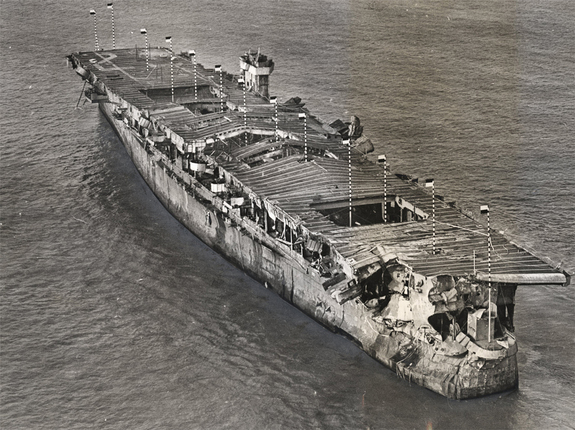
First came “Test Able,” an air burst. The bomb missed its target, but the Independence was close enough to be scorched by a wave of searing heat and blasted by the shockwave. Her flight deck was buckled and burned. Her superstructure was mangled.
Then came “Test Baker,” an underwater detonation. This was something new. Something horrifying. The bomb, suspended beneath a landing craft, erupted from below the surface, sending a column of millions of tons of radioactive water and seabed into the sky. When this column collapsed, it bathed the entire target fleet in a tidal wave of intense, deadly radiation. The ships that weren’t sunk outright were now hopelessly contaminated. They became “hot,” glowing with an invisible poison.
The Independence, amazingly, survived both blasts. She was still afloat. But she was a ghost ship now in every sense of the word. Damaged, twisted, and dangerously radioactive. The heat, the shock waves, and the radiation had turned a proud warship into a nuclear leper.
What Secrets Did the USS Independence Take to the Grave?
The ship was too “hot” to be approached safely. She was towed back to the United States, first to Kwajalein and then to San Francisco’s Hunters Point Naval Shipyard, a place that would become infamous for its own radiological contamination issues.
For several years, the battered carrier was used as a floating laboratory for decontamination studies. Scientists in heavy protective gear tried, and failed, to scrub the atomic poison from her steel plates. They learned a great deal about the persistent nature of radioactive fallout. They learned that you can’t just wash away the legacy of a nuclear blast.
Then, in 1951, the decision was made. The Independence was too damaged, too radioactive, and too costly to keep. She had to be disposed of. On January 26, 1951, she was loaded with something else: barrels of low-level radioactive waste. The official records say about two 55-gallon drums.
But what if there was more?
This is where the story slides from history into the world of conspiracy and deep-state secrets. The area where she was towed and scuttled, just off the Farallon Islands, was already a designated dumping ground. Between the 1940s and 1970s, the U.S. government dumped an estimated 47,800 barrels of nuclear waste into the ocean sanctuary there. The Independence wasn’t just being scuttled; she was being used as a giant, symbolic coffin for nuclear secrets.
Was she only carrying a few barrels? Or was the ship itself, hopelessly contaminated, considered the primary waste? Was she loaded with other materials from the shipyard’s radiological experiments? Things deemed too secret or too dangerous to be documented?
The US Navy sank her with explosives. She slipped beneath the waves and began her long, slow descent into the abyss, taking all of her secrets with her.
California’s Nuclear Graveyard
The discovery of the USS Independence is more than just a cool piece of history. It’s a stark reminder of a hidden danger that lies just off one of America’s most populated coastlines. She is not alone down there. She is the queen of a nuclear graveyard.
Those thousands of barrels of waste are still there, rusting, possibly leaking. The exact contents and their current state are largely unknown. The sanctuary where the Independence rests is a protected marine environment, home to whales, seals, and a rich ecosystem. And at the bottom of it sits a monument to the dawn of the atomic age, an irradiated warship potentially surrounded by drums of poison.
For now, the NOAA has no plans for a closer inspection with remotely operated vehicles (ROVs). The cost is high, and the risks of disturbing the site are real. The ship is a designated historic wreck, and a potential radiological hazard. It is, in a way, its own tombstone.
But the questions remain. They hang in the water like silt. What is the real condition of the ship and its secret cargo? What of the phantom airplane in its hangar? Is the wreck stable, or is it a ticking environmental time bomb?
The USS Independence fought a war, survived the atom, and became a secret. Now, discovered but still untouched, she continues her silent watch in the deep. She is a reminder that the past is never truly gone. Sometimes, it’s just waiting in the dark to be found.