Death from a Clear Blue Sky: The Unbelievable Case of the Man Killed by a Meteorite
It was a story that should have changed history. A headline that ripped across the globe, rewriting a fundamental truth we thought we understood about our safety on this planet. For one brief, shocking moment in 2016, the world believed the impossible had happened.
A man was killed by a rock from space.
Think about that. The odds are so infinitesimally small, so statistically absurd, that they border on zero. You have a better chance of winning the lottery multiple times, being struck by lightning, or being attacked by a shark in the middle of Kansas. Yet, on February 6, 2016, in the Indian state of Tamil Nadu, that statistical impossibility seemed to become a horrifying reality.
A bus driver. A college campus. A sudden, violent explosion. And a declaration from the government that sent shockwaves through the scientific community. But as the dust settled, a much murkier, more confusing story began to emerge. A story of conflicting reports, strange evidence, and a rush to judgment that leaves us asking one haunting question years later: What really happened that day? And if it wasn’t a meteorite… what was it?
An Ordinary Day, An Extraordinary End
It was a Saturday. The air on the campus of Bharathidasan Engineering College in Vellore was probably warm and still. Students were milling about. Life was normal. Predictable. Safe.
Kamaraj, a 40-year-old bus driver for the college, was walking near the college’s water tank. Maybe he was heading for a drink, maybe just stretching his legs. A routine moment in a routine day. He had no idea he was walking toward a destiny so bizarre it would be debated by scientists and conspiracy theorists for years to come.
Then came the bang.
Not just a bang. A deafening, ground-shaking explosion that shattered the peace of the afternoon. It was a sound so violent it blew out the windows of nearby buildings and the windshields of buses parked hundreds of feet away. Students and faculty, terrified, rushed from their classrooms. They found chaos. And they found Kamaraj.
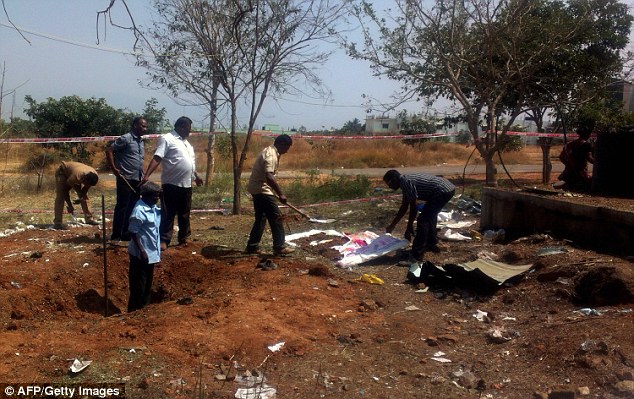
He was grievously injured. Witnesses would later say he was hit by flying debris, lethal splinters sent flying by the force of the blast. Tragically, he died while being rushed to the hospital. Three other people—two gardeners and a student—were also injured in the blast.
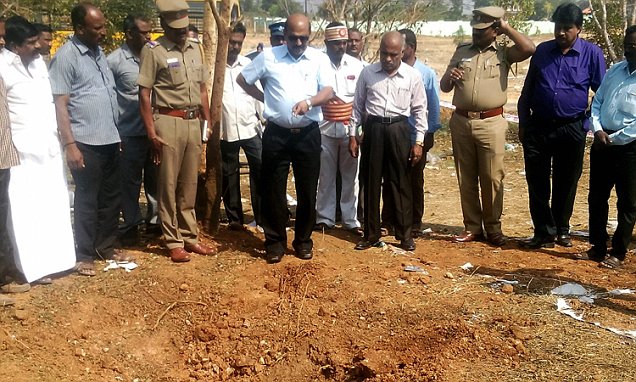
In the middle of the chaos, there was a hole. A wound in the earth itself. A small crater, about five feet wide and two feet deep, marked the epicenter of the event. It was the smoking gun. But a gun fired by whom? Or what?

The Shocking Official Proclamation
Eyewitness accounts poured in, painting a picture straight out of a science fiction movie. People spoke of seeing a mysterious, glowing object hurtling down from the sky just moments before the explosion. It was this detail that lit the fuse of the story.
In a move that stunned observers, the state’s highest-ranking official, Chief Minister Jayalalithaa Jayaram, didn’t wait for a lengthy investigation. She went public almost immediately with a bombshell statement: ‘A mishap occurred yesterday when a meteorite fell in the campus of a private engineering college.’
She announced compensation for Kamaraj’s family and the injured, specifically citing a “meteorite” as the cause. Just like that, it was official. Kamaraj was the first human being in recorded modern history to be killed by an object from outer space. The news went viral. NASA, the European Space Agency, astronomers, and news outlets worldwide scrambled to get the details. A historical first. A tragedy that would be written into science textbooks for centuries.
There was just one problem. The story was already starting to fall apart.
Deep Dive: The Ghost of Ann Hodges and the Search for a Cosmic Killer
To understand why this was such a monumental claim, you have to understand the history of meteorite encounters. Or rather, the lack of them. Every single day, Earth is bombarded with an estimated 100 tons of dust and sand-sized particles from space. Most burn up harmlessly in our atmosphere, creating the fleeting beauty of shooting stars.
Occasionally, something bigger gets through.
The most famous case is that of Ann Hodges of Sylacauga, Alabama. In 1954, she was napping on her couch when an 8.5-pound meteorite crashed through her roof, ricocheted off her radio, and struck her on the hip. It left a massive, pineapple-shaped bruise, but she survived. She remains the only person in modern times with a solidly-verified, direct injury from a meteorite strike.
Are there older stories? Absolutely. Ancient Chinese texts and obscure Ottoman manuscripts mention people being killed by falling stones from the sky. There’s even a theory that the biblical destruction of Sodom and Gomorrah could have been a Tunguska-style airburst from a comet or asteroid. But these are ancient accounts, impossible to verify with modern science. For all intents and purposes, in the age of record-keeping and scientific analysis, the official death toll from meteorite impacts stood at a firm zero.
Until Kamaraj.
The Scientists Arrive: Cracks in the Official Story
While the politicians were making grand declarations, scientists were urging caution. NASA quickly released a statement saying that a death by meteorite was so rare that there had never been a scientifically confirmed case in history. They pointed out that there were no known meteor showers active at that time. The global network of asteroid trackers had seen nothing. It was like claiming a hurricane had appeared out of a clear blue sky.
Then came the “evidence” from the scene.
Investigators at the college had recovered a strange object from near the crater. It was a small, dark, bluish-black stone, jagged and weighing only a few grams. It was immediately sent off for analysis. To the untrained eye, it looked alien. Exotic. Exactly what you might expect a piece of a space rock to look like.

But experts knew what to look for. Real meteorites have tell-tale signs. They often have a “fusion crust”—a thin, glassy, burned layer on their surface from their fiery passage through the atmosphere. They are typically much denser than Earth rocks and contain unique crystalline structures and metallic compositions, like high levels of nickel and iridium, that are rare on our planet’s surface.
As scientists at the Indian Institute of Astrophysics in Bengaluru examined the fragment, the meteorite theory began to crumble. The rock was brittle. It contained no fusion crust. Its chemical makeup was all wrong. Their conclusion, delivered a few days later, was blunt and unequivocal: the rock was not from space. It was a common terrestrial rock, a type known as carbonaceous chondrite, but one of earthly origin.
The case was closed. Or was it?
Conspiracy Corner: If Not a Meteorite, Then What?
This is where the story gets really interesting. When an official explanation is yanked back so quickly and replaced with another, it creates a vacuum. And in that vacuum, theories begin to grow. The official story that emerged was that the explosion was caused by old explosives, likely gelignite sticks, left behind from construction work and detonated by accident.
But does that really fit all the facts? Let’s break down the competing theories that still swirl around this strange event.
Theory 1: The “Convenient” Explosives Story
This is the official line. The police suggested that leftover explosives from when a well or the water tank was dug had somehow been set off. On the surface, it seems plausible. It would explain the bang, the crater, and the death. But it raises some serious questions.
- Why now? Why would explosives buried for years suddenly detonate on a random Saturday afternoon? What was the trigger?
- What about the falling object? This explanation completely ignores the multiple witnesses who claimed they saw something streaking across the sky. Were they all mistaken? A case of mass hysteria? Or did they see something real that the government wanted to cover up?
- The rock fragment. Why was a strange rock found at the scene at all? If it was just a dynamite blast, where did this specific, isolated fragment come from that was initially so compelling it was sent for analysis?
Theory 2: The Space Junk Cover-Up
Okay, so maybe it wasn’t a natural rock from the asteroid belt. But what if it was an artificial object from space? Our planet is orbited by a cloud of junk—defunct satellites, spent rocket stages, and fragments from old collisions. Thousands of pieces of this debris re-enter our atmosphere every year.
What if the object seen by witnesses was a piece of a decaying satellite or a rocket body? Perhaps a fuel tank or a solid metal component that was dense enough to survive re-entry and impact the ground with explosive force. This would explain the falling object, the explosion, and the crater. It would also explain why a government might be so quick to cover it up.
If the debris belonged to India’s own space program, it would be a huge embarrassment. If it belonged to another country—like the US, Russia, or China—it could create a diplomatic incident. Claiming it was a freak meteorite, and then quietly changing the story to a mundane dynamite accident, would be a very neat way to make an international problem disappear.
Theory 3: The Secret Weapon Test Gone Wrong
This one ventures deeper into the shadows. Could the “falling object” have been a piece of military hardware? An experimental projectile? A drone that malfunctioned? A missile test that went disastrously off course?
An impact from a high-velocity military projectile could certainly create the kind of crater and explosive force seen at the college. And this scenario provides the strongest possible motive for a cover-up. No government would ever admit that a secret test resulted in the death of a civilian. The “meteorite” story could have been an initial, panicked explanation, later replaced by the less exciting “construction explosives” story to kill public interest and deflect questions.
The Enduring Mystery of Vellore
So, we are left with a puzzle. A man is dead, and the cause of his death remains, for many, an open question. The official scientific verdict is that it was not a meteorite. The official police verdict is that it was a terrestrial explosion. But the inconsistencies—the eyewitness accounts of an object falling from the sky, the immediate and very specific “meteorite” claim from the Chief Minister—have never been fully reconciled.
What if the fragment tested by the scientists wasn’t the real impactor? What if the actual object vaporized on impact, and the rock they found was just an incidental piece of ground debris? What if the witnesses were right?
If it *was* a meteorite, it means that the cosmos is a far more immediate and personal threat than we imagine. It means that the shield of our atmosphere is not perfect, and that a cosmic sniper’s bullet could have anyone’s name on it. It would force a global re-evaluation of the risks from above.
But if it wasn’t a meteorite, the implications are almost more disturbing. It means that a man died, and the true cause—whether it was dangerous negligence, falling space junk, or a secret military operation—was deliberately obscured and hidden from the public. A truth was buried along with Kamaraj.
The story of the Vellore meteorite death faded from the headlines, dismissed as a mistake. But for those who look a little closer, it remains a tantalizing and unsettling mystery. A case where, for one brief moment, the veil was lifted, showing us a universe that is far more chaotic and dangerous than we like to admit, before being hastily drawn closed again. We may never know what truly fell from the sky that day, but we know this: a man is gone, and the story of his death is far from simple.