Saturday, April 11, 2026
HomeWeird WorldPhoto GalleriesGhost Towns - Gunanjima (Japan) : the forbidden island

Ghost Towns – Gunanjima (Japan) : the forbidden island

The Concrete Ghost Ship: Uncovering the Dark Secrets of Gunkanjima

There are places on this earth that feel… wrong. Places where the silence is too loud. Where the wind whispers stories the history books try to forget. Out on the churning waters of the East China Sea, about 15 kilometers from Nagasaki, a shape looms out of the mist. It’s not a trick of the light. It’s not a mirage.

It’s an island.

But it looks like a warship. A massive, gray, decaying battleship steaming toward a forgotten horizon. This is Hashima Island. A name few people know. But whisper its nickname, and a chill runs down the spine of anyone who knows the story.

Gunkanjima.

Battleship Island.

It’s one of 505 uninhabited islands in Nagasaki Prefecture, but this one is different. It wasn’t always uninhabited. Far from it. This tiny speck of rock was once the most densely populated place on the entire planet. A concrete city packed with thousands of souls, a testament to Japan’s industrial might. And then, in the blink of an eye, it was empty. A ghost town left to rot in the sea, holding secrets of incredible ambition, unimaginable suffering, and a sudden, silent exodus.

So, what really happened on Battleship Island? Why was it abandoned? And what chilling secrets are still trapped within its crumbling concrete walls?

From Barren Rock to Black Diamond

Before the concrete. Before the people. Before the name *Gunkanjima* was ever spoken, Hashima was nothing. It was a worthless, windswept rock, a glorified seabird toilet battered by typhoons. For centuries, it was a place sailors actively avoided. But beneath the waves, something valuable was sleeping. A treasure that would fuel an empire.

Coal.

The story of Gunkanjima is really the story of modern Japan. In the late 19th century, Japan was a nation in a hurry. The Meiji Restoration had thrown open the country’s doors to the world, and Japan was frantically racing to catch up with the industrial powers of the West. The engine of that revolution was steam, and the fuel for that steam was coal. Coal was black gold, and Japan needed it. Desperately.

In 1890, one of Japan’s emerging industrial giants, Mitsubishi, bought the island. Their plan was audacious. Insane, even. They weren’t just going to mine coal *on* the island; they were going to use the island as a staging ground to drill deep beneath the seabed. They would build a city on a rock to support a mine under the ocean.

Ghost Towns - Gunanjima (Japan) : the forbidden island

A City Without Ground

As the mine shafts pushed deeper into the earth’s crust, the island itself began to grow. Not outwards, but upwards. Land was the one thing they didn’t have. So they built a vertical city. A concrete forest on the water.

The first truly massive structure went up in 1916. It was a nine-story apartment block, Japan’s very first large-scale reinforced concrete building. It was built not just to house the swarms of workers flocking to the island for high-paying jobs, but to serve as a massive shield. A breakwater against the ferocious typhoons that regularly smashed into the island. They didn’t just build a city; they built a fortress.

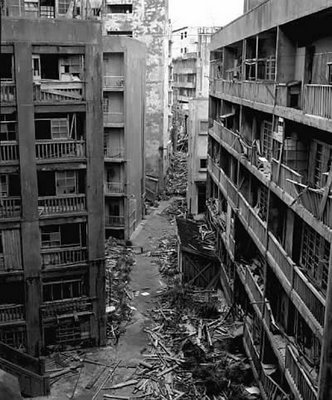
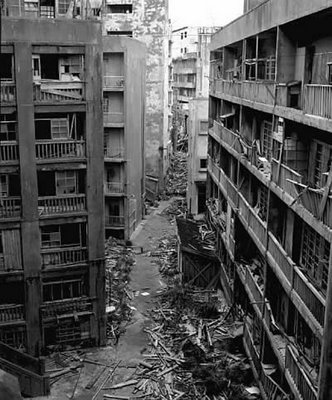
Soon, the island was a maze of these concrete giants, all connected by a labyrinth of covered corridors, courtyards, and dizzying staircases. It was a city that never touched the earth. No soil. No trees. No space. Every square inch was dedicated to industry or housing. Residents grew gardens on their rooftops, desperate for a splash of green in a world of gray. This was life in the “Staircase Town.”

And what a life it was. By 1959, over 5,200 people were crammed onto this tiny island, which is barely 16 acres. This resulted in a population density that remains one of the highest ever recorded in human history. It was a complete, self-contained world. There were schools, a hospital, a cinema, bathhouses, a Shinto shrine, and even a brothel. It was a tight-knit community, bound together by the shared danger of the mines and the isolation of the sea. But beneath this story of progress and community, a much darker chapter was being written.

The Whispers in the Walls: Gunkanjima’s Hidden History

The official history, the one you might read on a tourist brochure, paints a picture of a bustling, prosperous community. But that history has a gaping hole in it. A dark period that, for decades, Japan refused to acknowledge. The period during World War II.

As the Japanese empire expanded, its hunger for resources grew. The mines on Gunkanjima had to produce more coal, faster. Japanese workers were being conscripted into the military, so to fill the gap, the empire turned to forced labor.

Starting in the late 1930s and through the end of the war, hundreds of Korean civilians and Chinese prisoners of war were forcibly brought to Hashima. They were not workers; they were slaves. They were forced into the deepest, most dangerous parts of the mine, working in unimaginable heat and oppressive humidity. Their living conditions were abysmal, their rations were starvation-level, and brutal beatings were commonplace.

The Price of Progress

Accounts from the few survivors paint a hellish picture. Many died from exhaustion, malnutrition, or mining accidents. The island, which was a symbol of prosperity for some, became a prison camp surrounded by the sea. A place of no escape.

Some tried. They would attempt to swim for the mainland, a desperate, suicidal gamble against the powerful currents. Almost none survived. It’s said that over 1,300 forced laborers died on this tiny island, their stories buried with them in the deep, dark mines.

This is the ghost story that truly haunts Gunkanjima. Not the empty buildings, but the memory of the souls who suffered and died there. This dark past became a point of international controversy in 2015 when the island was approved as a UNESCO World Heritage site. South Korea protested, demanding that Japan acknowledge the full history of the site, including the forced labor. While Japan agreed to create an information center to explain the history, the controversy remains a raw, open wound—a reminder that some ghosts refuse to stay buried.

The Silent Exodus

The post-war years saw a return to prosperity. The mine boomed again, and the island city thrived. But a new power source was rising to dominate the world. One that would seal Gunkanjima’s fate.

Petroleum.

In the 1960s, Japan began to shift its energy focus away from coal and toward cheaper, more efficient oil. Coal mines across the country began to shut down. The writing was on the wall for Gunkanjima, but the community held on, hoping for a reprieve that would never come.

In January 1974, Mitsubishi made the official announcement. The mine was closing. For good.

The news was a death sentence for the island. The mine was its heart, its only reason for being. Without it, the city could not survive. The exodus was shockingly swift. Residents were given mere weeks to pack up their entire lives and leave the only home many of them had ever known. The company offered them jobs elsewhere, and they had no choice but to accept.

The last resident left the island on April 20, 1974. One day, Gunkanjima was a bustling city of thousands. The next, it was silent. People left in such a hurry that they abandoned personal belongings—televisions, furniture, bicycles, children’s toys—fully expecting, or perhaps hoping, to one day return. They never did. The last boat pulled away, and the concrete battleship was left to its fate, a modern Marie Celeste adrift in the ocean.

From Forbidden Zone to Hollywood Star

For nearly 30 years, Gunkanjima was a forbidden zone. A crumbling ruin strictly off-limits to the public, pounded into dust by the relentless sea and wind. The concrete cancer of decay set in. Walls crumbled. Roofs collapsed. Nature, the one thing the island never had, began its slow, methodical reclamation. Weeds choked the stairways. Greenery burst through apartment floors. The wind howled through the empty corridors, the only resident of a concrete necropolis.

But you can’t keep a place this strange and compelling a secret forever. The age of the internet arrived, and with it, a new breed of adventurer: the urban explorer. Photos and hushed stories of the forbidden “ghost island” began to circulate on forums, turning Gunkanjima into a legend. A holy grail for those who seek beauty in decay.

Then, Hollywood came calling.

The Bond Connection: Silva’s Lair

In 2012, the world was introduced to Gunkanjima on a massive scale. In the James Bond film *Skyfall*, the island served as the inspiration for the villain Raoul Silva’s sinister, abandoned lair. While the actors never actually set foot on the real island for safety reasons—the scenes were a combination of footage shot on location and massive sets built in the UK—the film burned the island’s haunting image into the global consciousness. Suddenly, everyone wanted to know about the real “dead city.”

The island’s pop culture resume doesn’t end there. It was a key location in the brutal 2003 Japanese film *Battle Royale II: Requiem* and inspired levels in video games like “Killer7.” It has become a symbol, a go-to backdrop for any story needing a setting that screams isolation, decay, and post-apocalyptic dread.

Digital Ghosts: Exploring Gunkanjima from Your Keyboard

The global fascination had an effect. In 2009, after safety improvements were made, a small, secure portion of the island was officially opened to tourists. Now, boats ferry curious visitors to a specially constructed walkway, allowing them to gaze upon the ruins from a safe distance. But the vast majority of the island remains dangerously unstable and strictly off-limits.

But what if you want to see more? In a strange twist of fate, you can. In 2013, a Google employee with a Street View Trekker backpack walked the forbidden paths of the island, mapping its decaying streets and even the interiors of some of its crumbling buildings. You can now virtually wander through apartments with 1970s televisions still sitting on the floor, or stand in the middle of an empty, silent courtyard. You can become a digital ghost on an island of ghosts.

What is the ultimate fate of Gunkanjima? It is a monument to a forgotten industrial age. It is a memorial to the thousands who toiled and suffered in its depths. It’s a stark, powerful warning about how quickly our own bustling cities could be silenced and reclaimed by time.

The concrete battleship doesn’t move. It sits on the horizon, rusting and crumbling, carrying its cargo of stories and secrets. And it waits.

Amit Ghosh
Amit Ghoshhttps://coolinterestingnews.com
Aloha, I'm Amit Ghosh, a web entrepreneur and avid blogger. Bitten by entrepreneurial bug, I got kicked out from college and ended up being millionaire and running a digital media company named Aeron7 headquartered at Lithuania.
RELATED ARTICLES
- Advertisment -

Most Popular

Recent Comments

Warren Pan Abbott on The legend of the Devil Monkey !
chris davies on The McPherson Tape Mystery
Reed Reedly on ET has Internet!
Bea Houseoffashion on Proof Of Time Travellers – Gallery
Marcus2012 on ET has Internet!
Reed Reedly on ET has Internet!
LaughsAtConspiracyNuts on The 9/11 Conspiracy – Myths and Facts
Alex Sliverman on Did the ancients fly?
Doctor Wholigan on Time Traveler in 1938 film
chris davies on The McPherson Tape Mystery
Archie1954 on 10 secret UFO hideouts
chris davies on Ghosts of flight 401
Marcus2012 on ET has Internet!
jason Macdonald on Proof of Time Travel? – China
chris davies on Long-Lost Pyramids Found?
Reed Reedly on ET has Internet!
Milkman on Connected Universe
Tenmiles on Baigong Pipes Mystery
Simon Foster on Sirius – The Documentary
From the 1st April on 2013 – Alien Contact date ?
SkyWatcher on Is ET ignoring us?
I Come From The Future on Obama to make UFO Alien disclouser soon ?
ÛñK?øWn on 2013 – Alien Contact date ?
Just another person on 2013 – Alien Contact date ?
Malcolm Windowcleaner on The strange case of Rudolph Fentz
Mason Servio on Strange Things on Mars
Marke Wisdom Seeker on What will we find as arctic melts?
Andrea A Elisabeth Levyne on Aliens Captured in Varginha, Brazil
Mitch Grouyeki on Amazing Space Shuttle pictures