The Shadow Syndicate: Unmasking the CIA’s Secret War *for* Drugs
You hear it on the news every night. The endless, grinding, multi-billion-dollar “War on Drugs.” A noble fight, we’re told. A crusade to protect our streets, our children, our very way of life. It’s a clean, simple story of good versus evil. Cops versus cartels. Us versus them.
But what if it’s a lie? A grand piece of theater.
What if the same government agency tasked with protecting American interests abroad has been, for decades, one of the single largest, most protected, and most effective enablers of global drug trafficking the world has ever seen? What if the “War on Drugs” was never about stopping drugs at all? What if it was about controlling them?
Strap in. Because the truth is darker, stranger, and far more disturbing than you can imagine. We’re peeling back the curtain on a history they never wanted you to see. This isn’t a conspiracy theory. This is a story told through declassified documents, government reports, and the words of insiders who dared to speak out. This is the story of how the Central Intelligence Agency became the world’s most powerful drug syndicate.
Ghost Flights and Golden Dreams: The Opium Kings of Air America
Our story begins in the smoldering ashes of World War II. China is in turmoil. Mao Zedong’s Communists are sweeping across the mainland, and the CIA’s chosen faction, the nationalist Kuomintang (KMT), is in a desperate retreat. They flee south, into the remote, mountainous jungles of Burma and Thailand.
They’re defeated. Stranded. But they’re not done fighting. And the CIA needs a proxy army to keep the red tide of Communism at bay in Southeast Asia. There’s just one problem: money. How do you fund a secret army, off the books, without congressional oversight?
You find a local product with an insatiable global demand.
The KMT found themselves squatting on prime real estate. An area that would soon be infamous: The Golden Triangle. The world’s poppy field. They took control of the opium cultivation and trade, a business that had existed for centuries, and supercharged it. Suddenly, the CIA had its answer. A self-funding army.
Enter: The World’s Spookiest Airline
To make it all work, they needed logistics. They needed a way to move guns and supplies in, and… other things out. So, the Agency did what it does best. It created a front company. A seemingly legitimate business that was anything but.
It was called Air America.
To the public, it was just a quirky little airline flying cargo in a difficult part of the world. But to those in the know, it was the CIA’s private air force. Its pilots were daredevils, flying unmarked planes through treacherous mountain passes, landing on dirt strips carved out of the jungle. They delivered rice and rifles to anti-communist allies. And, according to countless reports and insider accounts, they flew back with something else entirely.
Opium. Tons of it.
Planes owned by the CIA, flown by CIA-contracted pilots, were allegedly transporting raw opium from the KMT’s poppy fields to refineries in Bangkok. The heroin that resulted from this unholy alliance would pour into the veins of addicts around the world, including American soldiers fighting just next door in Vietnam. The profits? They flowed right back to the KMT, arming them for their secret war. The Agency’s hands were clean, officially. But the fingerprints were everywhere.
Heroin for “Holy Warriors”: Bleeding the Soviets in Afghanistan
Let’s jump forward to 1979. The Soviet Union makes a fatal mistake. They invade Afghanistan. Washington sees an opportunity. A chance to give the Soviets their own Vietnam. The CIA launches “Operation Cyclone,” one of its longest and most expensive covert operations ever.
The goal: arm and train the local resistance fighters, the Mujahideen. President Reagan would later call them “freedom fighters” and compare them to America’s founding fathers.
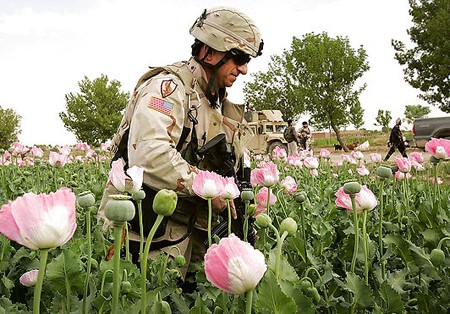
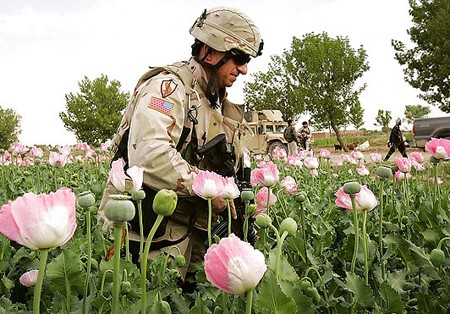
But freedom, like everything else, costs money. The Mujahideen commanders, many of them regional warlords, had their own funding streams. And in the rugged, lawless terrain of the Afghanistan-Pakistan border, the most lucrative crop by far was the opium poppy.
Did the CIA know? Of course, they knew. It was impossible not to. As the CIA flooded the region with weapons and cash, the borderlands exploded into the world’s number one source of heroin. Poppy cultivation skyrocketed. Heroin labs, protected by Mujahideen commanders, sprung up all along the Pakistani border.
The Agency’s official position was that its mission was to fight the Soviets, not police the drug trade. A convenient excuse. They provided arms, transport, and political protection to the very men who were becoming the new heroin kings. Trucks that brought in CIA-supplied Stinger missiles were allegedly used to transport opium out on the return trip. The priorities were clear: bleeding the Russians was all that mattered. The flood of deadly narcotics hitting the streets of Europe and America? Just collateral damage.
Cocaine, Contras, and the Crack Firestorm
This is the big one. The one that hit home. The one that a brave journalist named Gary Webb lost his career—and ultimately his life—exposing.
The 1980s. The Reagan administration is obsessed with a tiny Central American country: Nicaragua. A leftist Sandinista government has taken power, and the White House wants them gone. Their chosen instrument is a collection of right-wing rebel groups known as the Contras.
But Congress, wary of another Vietnam, passes the Boland Amendment, explicitly forbidding the U.S. government from funding the Contras. So, the CIA and a shadow group within the National Security Council, led by Oliver North, go rogue. They create an “off-the-shelf” enterprise to fund the Contras illegally. You’ve heard of the Iran-Contra Affair—the part where they secretly sold weapons to our sworn enemy, Iran.
But there was another, far dirtier side to the money trail.
The Contras needed cash. Lots of it. And their associates in South America were swimming in a product that was taking America by storm: cocaine. A direct pipeline was established. Contra-affiliated traffickers would move multi-ton loads of cocaine from Colombia and into the United States. They were given a free pass. Federal investigations were squashed. DEA agents were told to back off. These weren’t just drug dealers; they were CIA “assets.”
From the Jungle to South Central L.A.
This is where it gets truly devastating. The cocaine flowing north under the CIA’s protective umbrella didn’t just vanish. It had to be sold. One of the main distribution networks landed right in the heart of Los Angeles.
A Contra-funder named Danilo Blandón began selling staggering amounts of cheap, high-quality cocaine to a young, ambitious street-level dealer named “Freeway” Rick Ross. Ross, a marketing genius in his own right, figured out how to cook the powder cocaine into a smokable, highly addictive, and incredibly cheap new form.
Crack.
The river of Contra cocaine became a firestorm of crack that incinerated inner-city communities, particularly Black neighborhoods in Los Angeles. The very same government that was declaring a “War on Drugs” and passing mandatory minimum sentencing laws that would jail generations of young Black men, was simultaneously protecting the very traffickers who were supplying the raw material for the epidemic. The profits from the poison on American streets went south, to buy guns for the Contras’ war in Nicaragua.
Think about that. It’s a perfect, horrifying loop of destruction.
Don’t take my word for it. In 1989, a Senate subcommittee chaired by then-Senator John Kerry released its final report on the matter. The “Kerry Committee Report” was damning. It found that members of the U.S. State Department had provided direct assistance to drug traffickers and that the CIA had turned a blind eye, allowing cocaine smuggling to flourish in the name of the Contra cause.
A Rogues’ Gallery of “Assets”
The list of the CIA’s dubious partnerships doesn’t stop there. It’s a global tour of narcotics and national security interests colliding.
Mexico: The License to Traffic
In the 1980s, the CIA’s main partner in Mexico was the DFS (Dirección Federal de Seguridad), the country’s intelligence agency. The CIA helped create and fund it. The DFS, in turn, became the primary protector of the emerging Guadalajara Cartel, the forerunner of all modern Mexican cartels. Top drug traffickers were given DFS credentials. A badge that was, in essence, a license to traffic drugs without fear of arrest by honest local police. It was a state-sponsored drug syndicate, with the CIA’s blessing.
Haiti: The Anti-Drug Drug Runners
In Haiti, the CIA created a special unit, supposedly to fight drug trafficking. It was called the National Intelligence Service (SIN). In reality, SIN’s own members were deeply involved in the cocaine trade, using their official cover to eliminate rivals and protect their own shipments. The unit became an instrument of political terror and a key node in the Caribbean drug route, all while being funded by U.S. taxpayers.
Panama’s Man in Washington
And then there was Manuel Noriega of Panama. For years, he was one of the CIA’s most valued assets in Latin America, receiving hundreds of thousands of dollars a year directly from the agency. George H.W. Bush, when he was Director of the CIA, kept him on the payroll. Everyone knew Noriega was a brutal dictator. And everyone knew he was a major drug trafficker, working with the MedellÃn Cartel.
The DEA tried repeatedly to indict him, but the CIA blocked them at every turn. He was too useful. Noriega helped the U.S. support the Contras and provided valuable intelligence. In return, he was allowed to continue his drug business. It wasn’t until he became more of a liability than an asset that the U.S. decided to act, invading Panama in 1989’s “Operation Just Cause” to arrest a man they had protected for over a decade.
Venezuela’s Ton of Trouble
Perhaps the most brazen case involves a Venezuelan National Guard General and CIA asset named Ramon Guillen Davila. In the early 1990s, the CIA allowed his organization to ship at least one ton of pure cocaine into the Miami International Airport. The official excuse? It was a “controlled” delivery designed to “gather information” on the Colombian cartels.
But there was no control. The cocaine wasn’t seized. It was allowed to be transported out of the airport and was sold on the streets of America. The CIA itself owned the warehouse where the drugs were stored. The operation was a complete sham, a thinly veiled cover for a massive drug shipment facilitated by a U.S. intelligence agency.
The Final, Pathetic ‘Confession’
For years, the Agency denied everything. Gary Webb was professionally destroyed. The stories were dismissed as tinfoil-hat paranoia.
But then, the pressure became too much. In 1998, the CIA quietly released a massive, two-volume internal report. It was a bombshell hidden in plain sight, a masterclass in bureaucratic doublespeak.
The report admitted that the CIA had worked with known drug traffickers. It admitted that it “overlooked” their criminal activities. It confessed that information about Contra links to the drug trade was sent up the chain of command and deliberately ignored. Worse, the report revealed that the CIA actively “dissuaded” the DEA and other law enforcement agencies from investigating their drug-running “assets.”
It wasn’t a full-throated confession. It was a carefully worded damage control operation. But reading between the lines, the truth was undeniable. They knew. They let it happen. They protected it.
So the next time you see a news report about the never-ending, ever-failing War on Drugs, remember this hidden history. Remember the ghost flights of Air America, the poppy fields of Afghanistan, and the river of cocaine that flowed into our cities to fund a secret war. Ask yourself who the real enemy is.
The story told to the public is one of simple morality. The reality is a labyrinth of cynical geopolitics where narcotics are just another tool in the toolbox, a form of off-the-books currency to fund shadow wars. And the true cost isn’t measured in dollars spent on enforcement, but in lives destroyed, communities shattered, and trust in our own institutions irrevocably broken. The biggest drug bust in American history has never happened, because the biggest trafficker of them all has always been untouchable.