Home Unexplained Mysteries Ancient Mysteries Evidence of ancient aliens?

Evidence of ancient aliens?

0
58

Ancient Alien Fingerprints: The Evidence Mainstream History Wants to Hide

Look around you. At the screen you’re reading this on. At the technology that powers our world. We think we’re so advanced, don’t we? The pinnacle of human achievement. But what if I told you that everything you think you know about the past is wrong? What if the history written in our textbooks is a sanitized, simplified version of the truth? A version that conveniently leaves out the most earth-shattering parts.

What if our ancestors weren’t alone?

Across the globe, scattered like cosmic breadcrumbs, are monuments and texts of such impossible scale and sophistication that they defy all conventional explanation. These are not just quaint relics of forgotten cultures. They are questions. Questions carved in stone, etched into desert floors, and written in ancient, sacred scripts. Questions that point to a single, terrifying, and exhilarating possibility: that we have been visited. That advanced extraterrestrial beings were not just a fantasy, but a foundational part of our history.

Mainstream academia will scoff. They’ll talk about primitive tools and endless manpower. They’ll offer up theories that crumble under the slightest scrutiny. But we’re not going to listen to them today. Today, we’re going to look at the evidence with open eyes. We’re going to connect the dots they refuse to see. Prepare yourself. Because once you see the patterns, you can’t unsee them.

The Cosmic Drawing Board: Decoding the Nazca Lines

Imagine a desert. A vast, arid, unforgiving plateau in southern Peru. It’s one of the driest places on Earth. And on this sprawling canvas, something impossible has been drawn.

They are called the Nazca Lines.

20130611-001742.webp

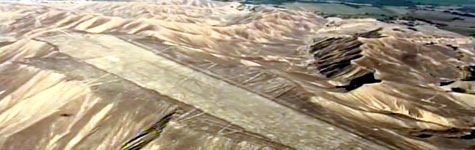
This isn’t just a few doodles in the sand. We’re talking about a collection of over 800 straight lines, 300 geometric figures, and 70 breathtaking designs of animals and plants. Some of the straight lines run for an astonishing 30 miles. Some of the animal figures—a spider, a hummingbird, a monkey, a lizard—are gargantuan, spanning hundreds of feet. The hummingbird alone is 310 feet long. The condor has a wingspan of over 440 feet.

Here’s the kicker. The absolute mind-bending part of it all.

You can’t see them from the ground. Not really. From eye level, they’re just shallow trenches in the dirt. Indistinguishable. Meaningless. To see them for what they are, to appreciate the perfect form of the spider or the elegant lines of the hummingbird, you have to be in the air. Hundreds of feet up.

So, I ask you: who were they for?

A Message for the Sky Gods?

The Nazca people, who are credited with creating these geoglyphs between 500 B.C. and 500 A.D., had no known form of aviation. No hot air balloons. No gliders. Certainly no airplanes. So why would a civilization spend generations meticulously creating colossal works of art that they themselves could never fully appreciate?

Conventional archaeologists suggest they were ritual pathways for religious ceremonies. Others claim they are linked to astronomy or point toward underground water sources. And while some lines may align with celestial events or water, these theories utterly fail to explain the giant animal figures. Why create a 440-foot-wide bird as a ritual pathway?

The ancient astronaut theory presents a far more compelling, if startling, explanation. These weren’t just art or rituals. They were messages. Signals. A welcome mat for visitors from the stars. The long, straight lines? They look an awful lot like runways, don’t they? Guidance systems for craft descending from the heavens.

Think about it. An advanced alien race visits an early human culture. How do you ensure they can find their way back? You create massive symbols on the ground, symbols so large they can only be recognized from a great altitude. You turn your entire world into a landing strip. The animal figures could have been clan symbols, markers to show visiting “gods” which specific group they were dealing with. It’s a chillingly logical explanation for a mystery that otherwise makes no sense.

India’s Ancient Flying Machines: Fact or Sanskrit Fiction?

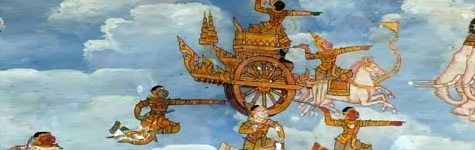
Let’s journey from the deserts of Peru to the ancient lands of India, where stories are not carved in earth, but in text. Specifically, the ancient Sanskrit epics like the Mahabharata and the Ramayana. These aren’t just religious fables. They are detailed histories, filled with kings, warriors, and… flying machines?

Yes. They’re called Vimanas.

20130611-001818.webp

These ancient texts, written down over two thousand years ago, don’t just mention Vimanas in passing. They describe them in stunning detail. They speak of “two-storied celestial chariots with many windows,” that “roared like a lion” and blazed with a red flame as they flew through the sky. They were said to be able to travel vast distances, to hover in place, and to move at the “speed of the mind.”

More Than Myth? The Vimana Texts

One text in particular, the Vimanika Shastra, claims to be a guide to building and piloting these machines. It speaks of power sources involving mercury vortex engines, discusses the metals used in their construction (some unknown to us today), and even details the diet and clothing required for pilots undertaking long interstellar journeys.

Skeptics are quick to dismiss this. “It’s just poetry,” they say. “Mythology.” But the descriptions are so strangely technical. The texts describe battles in the sky with powerful weapons that sound eerily like modern high-tech ordinance. One weapon, the “Brahmastra,” is described as creating a blast “as bright as a thousand suns,” leaving the land poisoned and barren for years. It sounds terrifyingly like a nuclear explosion.

Could it be that these ancient Indian writers weren’t just making up stories? Could they have been describing what they actually saw? Imagine witnessing a battle between two warring alien factions in the skies above your home. You wouldn’t have the words “laser” or “plasma cannon.” You would describe it in the terms you understood: divine weapons, celestial chariots, the wrath of the gods. The ancient astronaut theory suggests that is precisely what happened. The Vimanas weren’t myths; they were machines. Alien technology witnessed and recorded by our ancestors, the true meaning lost and distorted into legend over millennia.

The Silent Sentinels of Easter Island

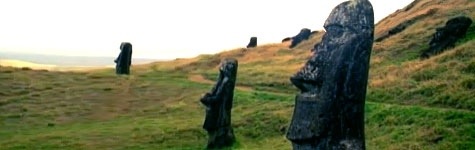
In the middle of the vast Pacific Ocean lies the most remote inhabited island on the planet. Rapa Nui. You know it as Easter Island. And on this tiny, isolated speck of land stands one of the world’s most profound and haunting mysteries.

The Moai.

20130611-001846.webp

Nearly 900 of them. Giant monolithic human figures, carved from volcanic tuff, with oversized heads and solemn, enigmatic expressions. They stand guard along the coastline, their backs to the sea, watching over the island. The average Moai is 13 feet tall and weighs a staggering 14 tons. But that’s just the average. The largest, a beast named “Paro,” was over 33 feet tall and weighed 82 tons. An even bigger, unfinished Moai still in the quarry would have been 69 feet tall and weighed an estimated 270 tons. That’s the weight of a Boeing 757 airplane.

And here is the question that has stumped engineers and historians for centuries.

How Did They Move 80-Ton Giants?

The official story is that the ancient Rapa Nui islanders, using only stone tools, carved these giants and then dragged them miles across the island using ropes and log rollers. Experiments have been done. People have tried to “walk” the statues upright with ropes. And while they’ve had some limited success with smaller replicas, these experiments fail to account for the sheer scale of the operation.

The island’s resources were finite. The “log roller” theory would have required the complete deforestation of the island, a suicidal act for the inhabitants. How did they lift 10-ton red stone “hats” (called Pukao) onto the heads of 30-foot-tall statues?

What if they didn’t have to drag them? The island’s own legends speak of the Moai “walking” to their final positions, moved by a spiritual power or “mana.” Was this “mana” a misunderstood form of technology? Did visiting extraterrestrials, with access to acoustic levitation or anti-gravity devices, help position these silent giants? Perhaps the Moai were not just statues, but something more. Markers? Power conductors? A warning?

Recent excavations have revealed that the Moai have bodies, extending deep into the earth, covered in intricate carvings protected from the elements. These weren’t just heads on a hill. They were complex structures, built with immense effort. Why would a small, isolated population expend such incredible energy? Unless they had help. Or unless they were trying to replicate technology they had once witnessed, a cargo cult to the gods who came from the sky and moved mountains with their minds.

year-of-the-ancient alien 2013

Puma Punku: The Impossible Stonework of the Andes

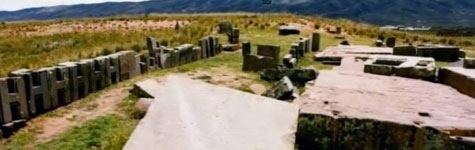
High in the Bolivian altiplano, at an altitude of 13,000 feet, lies a field of ruins that shatters everything we know about ancient civilizations. It’s not as famous as Stonehenge or the Pyramids, but it is infinitely more baffling. Its name is Puma Punku.

What you find there is not a temple. It’s a disaster site. A collection of massive, intricately carved stone blocks scattered across the landscape as if by a cataclysmic explosion. The site is dated to around 500 A.D., but the stonework… the stonework looks like it belongs in the 21st century.

20130611-002003.webp

We are talking about giant blocks of red sandstone and andesite, weighing up to 130 tons each. Andesite is an incredibly hard volcanic rock, just below diamond on the Mohs scale of hardness. The people of this era supposedly had only soft bronze and stone tools. Yet these blocks are cut with a precision that is, frankly, impossible.

Precision That Defies Explanation

The cuts are perfectly straight. The angles are perfect 90-degree right angles. The surfaces are polished smooth. Some of the blocks are carved into complex, interlocking shapes, like pieces of a giant, high-tech 3D puzzle. The most famous are the H-blocks, all uniformly shaped to snap together. This isn’t just good craftsmanship; this is machine-level precision.

There are grooves in the stone that are only millimeters wide and perfectly uniform in depth. There are holes drilled clean through the andesite. How do you do that with a stone hammer and a bronze chisel? You don’t. You simply don’t.

Engineers and stonemasons today would struggle to replicate Puma Punku’s construction, even with our modern diamond-tipped saws and laser cutters. To suggest that a primitive culture accomplished this is not just an insult to our intelligence; it’s a denial of physical reality.

So what really happened at Puma Punku? The ancient astronaut theory provides the only sensible answer. This wasn’t a temple built by humans. It was something else. A landing platform? A complex machine? A structure built by, or with the direct help of, an extraterrestrial civilization that possessed advanced cutting and shaping technology. The site was not built *for* the gods; it was built *by* them. And something, at some point, went horribly, catastrophically wrong.

Ezekiel’s Wheel: A UFO Sighting in the Bible?

Our final piece of evidence comes not from stone or sand, but from one of the most revered books in human history: the Bible. In the Book of Ezekiel, the prophet describes a stunning and terrifying encounter with a divine being. Or was it divine?

Read the words and decide for yourself. Ezekiel describes seeing a “whirlwind” approach, a “great cloud with raging fire flashing around it.” From within this fiery cloud came what he called “living creatures.” But his description of the vehicle they arrived in is what has captured the imagination of researchers for decades.

20130611-002003.webp

He describes a craft made of gleaming metal, like “burnished bronze.” He talks of its landing gear, which he calls “a wheel within a wheel,” able to change direction without turning. The sound it made was “like the roar of rushing waters.”

“A Wheel Within a Wheel”

In the 1970s, a NASA engineer named Josef F. Blumrich set out to debunk the idea that Ezekiel was describing a spacecraft. He was a senior engineer on the Saturn V rocket program, a man who knew advanced aeronautics. He meticulously analyzed the biblical text from an engineer’s perspective. The result? He didn’t debunk it. He became convinced it was a real, nuts-and-bolts vehicle. He even went on to patent a design for an omnidirectional wheel based on the “wheel within a wheel” description.

Think about the language. Ezekiel lived 2,600 years ago. He had no concept of a spaceship, of rocket engines, of metallic alloys, or of advanced landing gear. How would he describe such a thing? He would use the vocabulary he had. A “whirlwind.” “Fire.” “Burnished bronze.” A “throne” for the pilot. He was an ancient man describing advanced technology in the only way he knew how: through the lens of the divine.

This wasn’t a vision of angels. This was an eyewitness account of a UFO landing. A close encounter of the third kind, recorded for posterity in the pages of the Bible itself.

The Nazca Lines. The Vimanas. The Moai. Puma Punku. Ezekiel’s Wheel. These are not isolated mysteries. They are a pattern. A global tapestry of evidence pointing to the same unbelievable truth. We have been lied to. Our history is not what we think it is. The proof is all around us, waiting for those with the courage to see it for what it truly is: the fingerprints of the gods.

They were here. The only question is… are they coming back?

Originally posted 2013-06-10 22:21:15. Republished by Blog Post Promoter