Home Unexplained Mysteries Ancient Mysteries Easter Island heads have bodies

Easter Island heads have bodies

0
54

The Easter Island Heads Have Bodies: The Secret Buried For Centuries is Finally Unearthed

You’ve seen the pictures. Everyone has. They’re burned into our collective consciousness. The giant, silent stone heads of Easter Island. Brooding. Mysterious. Staring out at the vast, empty Pacific with an ancient, unknowable gaze. They are the ultimate symbol of a lost world and an unsolvable riddle.

But what if I told you that iconic image is a lie? What if the most famous part of the mystery… isn’t the whole story? Not even close.

Because those aren’t heads.

They have bodies. Massive, multi-ton bodies buried deep beneath the earth, hidden from the world for centuries. And the truth of their existence is a thousand times more shocking and mind-bending than you can possibly imagine.

The Photo That Broke The Internet

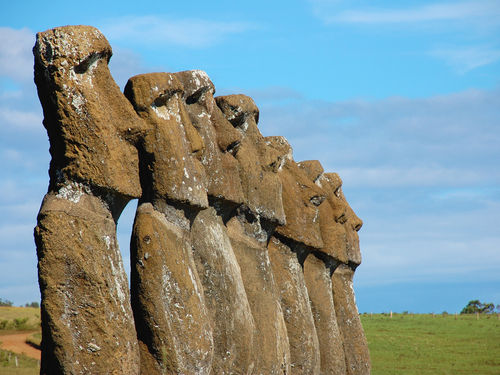
For decades, the world knew the Moai as the “Easter Island Heads.” That was the brand. Postcards, documentaries, textbooks… they all showed the same thing. A line of colossal, long-faced heads perched on the island’s hillsides. The mystery was already profound enough. Who built them? How? Why?

Then, it happened.

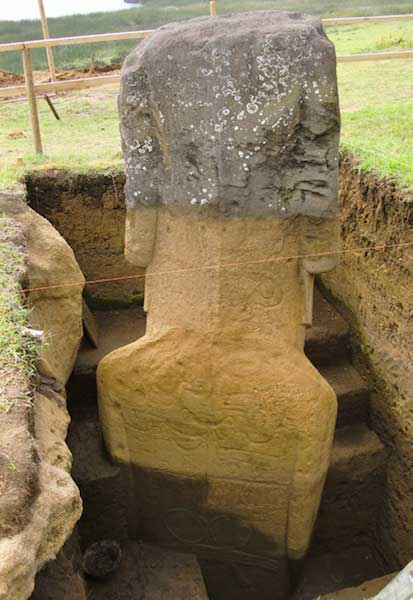
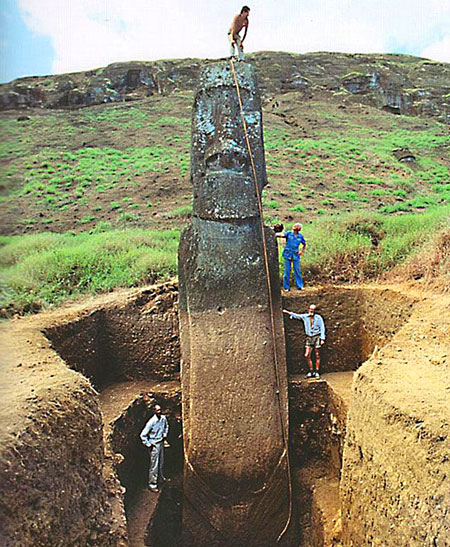
A few photos started circulating online. Photos that seemed impossible. They showed one of the famous heads, but with a massive trench dug around it. And connected to that familiar stone face was a torso. A gigantic, 30-foot-tall body stretching down into the dirt, covered in strange and elaborate carvings. The internet exploded. Was it a hoax? A Photoshop masterpiece? The secret had been known to archaeologists for a while, but for the general public, this was like finding out the Statue of Liberty has a secret underground bunker the size of a city.

The photos were real. They came from the Easter Island Statue Project (EISP), which had begun meticulously excavating two of these “head” statues. What they found didn’t just add a new chapter to the story of Rapa Nui—it ripped the old book to shreds.

What Exactly Did They Find Down There?

Imagine the scene. A team of archaeologists, slowly, painstakingly brushing away centuries of soil. They knew, in theory, that some statues had buried torsos. Many of the famous Moai standing on coastal platforms, the *ahu*, have always been visible as full-body figures. But the ones on the slopes of the quarry volcano, Rano Raraku, were a different story. These were the ones that time and erosion had swallowed, leaving only their stoic faces to greet the sky.

No one was prepared for the sheer scale. Or the secrets they were protecting.

More Than Just Stone Torsos

These weren’t just crude bodies. The excavated statues revealed immense, elongated torsos with slender arms held rigidly at their sides. Their hands, with long, delicate fingers, rested across their stomachs in a specific, ceremonial pose. One statue, when fully unearthed, measured a staggering 33 feet tall and weighed an estimated 80 tons. That’s the weight of a space shuttle.

And these are not even the biggest. A single, unfinished Moai still lying in the quarry, nicknamed “El Gigante,” is an almost unbelievable 72 feet long and would have weighed around 270 tons. That’s heavier than a blue whale. The sheer ambition is breathtaking. Why go to such monumental lengths?

The Cryptic Carvings: A Lost Language From the Gods?

This is where the mystery deepens into something truly strange. As the soil came away, the archaeologists discovered the backs of the statues were covered in intricate petroglyphs. Swirls, crescents, and symbols that had been perfectly preserved by their earthen tomb. The most prominent design found on several statues is a large canoe, or *vaka*. Others show what appear to be birds, human figures, and symbols related to the “birdman” cult that later dominated the island.

Were these carvings a story? A history of their tribe? Or were they instructions? A user manual for a technology we can’t comprehend? Some theorists point to the island’s other great mystery: the undeciphered Rongorongo script. Could these symbols be a precursor, a Rosetta Stone to a language so ancient it predates known human history? A language whispered to them by visitors from the stars?

The mainstream explanation is that these carvings were added later, but the question remains: why carve them on the backs of statues that were immediately buried? It makes no logical sense. Unless, of course, the burial itself was the point.

The Billion-Dollar Question: How Did They DO It?

Knowing the statues have bodies only makes the central enigma a thousand times harder to solve. It’s one thing to move a big head. It’s another thing entirely to quarry, carve, and transport an 80-ton monolithic giant across miles of rugged, volcanic terrain.

How did a primitive, Stone Age society with no wheels, no draft animals, and no metal tools pull off an engineering feat that would challenge us even today?

Quarrying Giants from a Volcano’s Heart

The story begins at Rano Raraku, an extinct volcano that served as a massive, open-air statue factory. All 887 known Moai were carved from its unique volcanic tuff—a compressed ash that is relatively soft when first quarried but hardens over time when exposed to the elements. You can still see them there today. Hundreds of statues in every stage of completion, littering the hillside like a divine assembly line that was suddenly abandoned. Some are still attached to the bedrock, sleeping giants waiting for a call that never came.

The official story is that teams of carvers used basalt stone tools, called *toki*, to slowly chip away at the rock, freeing the colossal figures. It must have taken teams of men years, or even decades, to complete a single statue.

The “Walking” Statues Conspiracy

Okay, so they carved it. But how did they move it? This is the point where mainstream archaeology and high strangeness collide. The islanders’ own oral traditions say the statues… walked.

They didn’t say they were carried or dragged. They said they *walked*.

For years, this was dismissed as a myth. A quaint legend. But in 2012, archaeologist Carl Lipo and anthropologist Terry Hunt proposed a radical theory. By tying ropes to the head of a replica statue, they demonstrated that with three teams of people pulling in a coordinated rhythm, they could make the statue rock from side to side, “walking” it forward in a shuffling motion. It’s a stunning theory, and it aligns with the islanders’ legends.

But does it really explain moving an 80-ton giant up and down hills? Many are skeptical. The forces involved are immense. One slip, one snapped rope, and your sacred, irreplaceable statue becomes a million pieces of volcanic rubble. Was there another way? A forgotten way?

When Mainstream Explanations Fail: Enter the Unthinkable

This is where we leave the comfortable world of textbooks and step into the shadowlands of what-if. The “walking” theory is clever, but to some, it feels like an attempt to fit a cosmic-sized peg into a tiny, terrestrial hole. The sheer number of statues, their size, and the apparent ease with which this tiny, isolated population produced them just doesn’t add up for many investigators.

The Ancient Astronaut Connection

Let’s just say it. Aliens. The moment you look at the evidence with an open mind, the idea doesn’t seem so crazy. For ancient astronaut theorists, Rapa Nui is Exhibit A. Why do the Moai have such distinct, non-human features? The long faces, the heavy brows, the thin lips, the elongated noses. Do they represent the Rapa Nui people? Or do they represent their “gods”?

Were these statues carved by the islanders in the image of powerful beings who visited them in the distant past? Beings who perhaps shared technology, allowing them to quarry and move these stones with an ease we can’t fathom? Maybe the statues weren’t walked with ropes, but levitated with sonic emitters or advanced gravitational technology. The oral traditions say a chief used a power called *Mana* to make the statues move. What if *Mana* wasn’t spiritual energy, but a word used to describe a form of technology they no longer understood?

A Warning From The Past

Here the story takes a dark, cautionary turn. Whatever method the Rapa Nui used, it came at a terrible cost. The mainstream archaeological view is that the obsession with statue-building led to a catastrophic environmental collapse. An “ecocide.”

The island was once a lush, subtropical paradise covered in giant palm trees. These trees were cut down. All of them. They were used for lumber, to transport statues, to make canoes. With the forests gone, the soil eroded and washed into the sea. Seabirds no longer nested there. Without canoes, the people couldn’t fish effectively. The society turned on itself. Starvation, warfare, and even cannibalism followed. The statue-building stopped abruptly, as if the civilization simply ran out of steam and collapsed under the weight of its own ambition.

It’s a terrifying story. A warning scrawled across history for all of us. But is it the true one?

Or was the collapse caused by something else? Did their celestial “gods” depart, leaving the islanders without the technology they had become dependent on, leading to chaos? The truth is, we don’t know for sure. The end of the Rapa Nui is as mysterious as their beginning.

The Secrets Still Waiting Underground

The discovery that the Easter Island heads have bodies didn’t solve the mystery. It blew it wide open. It proved that what we see on the surface is just a fraction of the truth. Hundreds of Moai remain partially or fully buried on the slopes of Rano Raraku and across the island.

What secrets do they hold? What other carvings lie just a few feet beneath the grass, waiting to be read? Every new excavation reveals another piece of a puzzle so vast and so old that it challenges everything we think we know about our own past.

The silent stone giants of Rapa Nui are finally starting to talk. They are telling us a story of incredible achievement, of cosmic connections, and of a terrible, world-ending collapse.

The only question is… are we ready to listen?

Originally posted 2016-03-18 08:28:19. Republished by Blog Post Promoter