Imagine the safety of your own living room. It’s the one place on Earth where the chaos of the outside world isn’t supposed to touch you. You lock the door. You draw the curtains. You are safe. But for one woman in Philadelphia, that safety was an illusion. It was a lie.
This isn’t just a missing person case. This is a locked-room mystery that defies physics, logic, and sanity. It’s a story about a woman who vanished from the face of the earth while her children slept just feet away, carried off by a phantom who spoke with a gentle, terrifying calmness.
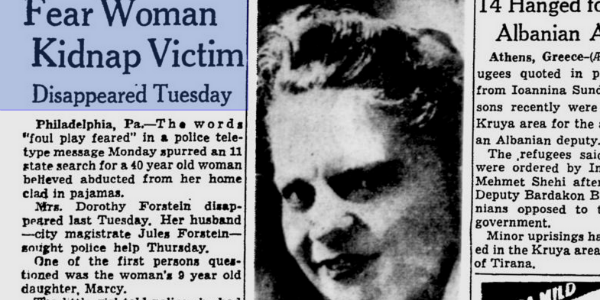
Dorothy Forstein appeared to have it all. She was happily married. She was comfortably well-off. She was a loving mother in a bustling American city. She was, in short, one of the last people anyone would imagine as a victim of one of the creepiest disappearances in American history.
The Shadow Over Philadelphia
To understand the nightmare, we have to look at the players. The year is 1944. The world is at war, but in the Forstein household, the battles are supposed to be over. Dorothy had been married for two years to Jules Forstein, a city magistrate. In the hierarchy of the city, a magistrate is a powerful figure. They make decisions that ruin lives. They make enemies. But Jules? He seemed untouchable.
The couple had a full house. There were three young children: Myrna and Marcy, Jules’ daughters from his first marriage, and their new baby, Edward. It’s worth noting here—because in these mysteries, every detail matters—that Jules’ first wife, Molly, had died sometime around 1940. A widower, remarried to a younger, beautiful woman. A classic setup. A happy ending.
Or so it seemed.
The terror didn’t start the night she vanished. It started five years earlier. It was a warning shot.
The 1944 Overture: A Brutal Warning
One evening in 1944, Mrs. Forstein did what any mother would do. She dropped her children off at a neighbor’s house to run errands. Just a quick shopping trip. Mundane. Normal. By the time she returned home, the sun had dipped below the horizon. It was nearly dark. The shadows in the house were long.
She put her key in the lock. She stepped inside. And then, hell broke loose.
As she entered her house, someone suddenly sprang from the darkness. This wasn’t a stumble in the dark; it was an ambush. The attacker beat the helpless woman into unconsciousness with a ferocity that shocked the police. Her fall knocked over the telephone. The line went live. The operator, miles away, sat frozen, listening to the sickening thuds and strange noises echoing through the receiver. She alerted the police immediately.
When the siren lights cut through the night, they found Mrs. Dorothy Forstein broken. Her nose was shattered. Her jaw was broken. Her shoulder was fractured. She was suffering from a massive concussion. She was a mess of blood and bruises.
After she regained consciousness, dazed and in agony, all she could whisper was, “Someone jumped out at me.”
The Clue That Wasn’t There
Here is where the story takes its first turn into the bizarre. Investigators were totally stumped. Why? Because usually, when someone lies in wait inside a house to beat the homeowner, they want something. Money. Jewelry. Silverware.
Burglary could not have been the motive. Nothing in the house had been taken. Not a single dime.
So, the eyes turned to the husband. Jules Forstein. The prime suspect in 99% of spousal attacks. But Jules? He had a cast-iron alibi. He was nowhere near the house. He was cleared almost immediately. Dorothy had no known enemies. She was a housewife. She wasn’t involved in illicit deals or gambling rings. Jules Forstein racked his brain but could think of no one who held enough of a professional grudge against him to target his wife in such a specific, violent way.
The fact remained, however, that someone had enough hatred for this seemingly inoffensive woman to lie in wait and nearly beat her to death. But who? And more importantly… why did they leave her alive?
Living in Fear: The Silent Years
The assault remained a cold mystery. Mrs. Dorothy Forstein recovered physically from her injuries, but let’s be real—you don’t walk away from that. Her emotional health was never the same again. How could it be? Every shadow in the hallway looked like a man waiting to strike. Every creak of the floorboard sounded like footsteps.
Quite understandably, Mrs. Dorothy Forstein became fearful, paranoid, and constantly on her guard. She checked locks. She jumped at loud noises. She lived in a prison of her own anxiety.
Five years went by. Time heals, or at least, it makes the scars fade. Life for the Forstein family gradually returned to a semblance of normal. The 1944 attack became a bad memory, something they didn’t talk about at dinner.
The Night of the Vanishing: October 18, 1949
The night was chilly. It was October 18, 1949. Mr. Forstein was away from home for the evening, attending a political banquet. He was a man about town, after all. The eldest child, nineteen-year-old Myrna, was also absent, visiting friends. The house was quiet. It was just Dorothy and the two younger children, Marcy (now nine) and Edward.
It was a routine evening. Around nine PM, Dorothy Forstein picked up the phone. She called a friend to arrange a shopping trip for the next day. This is a vital piece of the puzzle. Suicidal people rarely make plans for tomorrow. People planning to run away don’t schedule shopping dates. She sounded fine. Normal. She showed no sign she suspected anything was amiss.
She hung up the phone. She likely checked the doors. She went about her night.
Then, the clock ticked toward midnight.
Mr. Forstein returned home about 11:30 PM. He walked into a silent house. He climbed the stairs. He found young Edward and Marcy cowering in an upstairs bedroom, clinging to each other in the dark. “Mommy’s gone!” they told him.
Now, pay attention. This is where human behavior gets strange. Very curiously, particularly in light of the previous savage attack on his wife five years earlier, Jules Forstein did not panic immediately. In fact, according to reports, he waited two days before officially contacting the police.
Two. Full. Days.
Why? Was he frantically searching for her himself, hoping to avoid a scandal? Was he convinced she had just walked out on him? Or does this delay point to something darker? That delay gave the trail time to go ice cold.
The Search for a Ghost
When the call finally came in, officers launched a massive manhunt all over Philadelphia. They checked hospitals. Morgues. Bus stations. Train depots. They found absolutely nothing.
The physical evidence inside the house only deepened the mystery. Her purse was there. Her keys were there. If she had left of her own free will, she had walked out into the cold night with no money and no way to get back in. As with the earlier attack, nothing in the house was taken. No jewelry missing. No silver gone.
The front door? Locked. The windows? Secured. There was no shattered glass, no jimmy marks on the jambs. The house was a fortress.
Marcy’s Story: The Stuff of Nightmares
All we know about her disappearance—the only narrative we have—comes from the lips of a terrified nine-year-old girl. Marcy Forstein.
She told police a story that sounds like the script of a horror movie. She said that in the dead of night, she was awakened by a sound. Not a crash, but a presence. The sound of someone entering the house. She crept out of her bed. She went out into the hallway, peering through the banisters to the floor below or perhaps looking towards her mother’s room.
She saw a man. A stranger.
He was coming upstairs. He wasn’t running. He wasn’t ransacking the place. He was moving with purpose. Marcy described seeing her mother, clad in pajamas, lying face-down on the floor of her bedroom. Marcy used a very specific, chilling word. She said her mother looked like she was “resting.”
Was Dorothy unconscious? Drugged? Dead? We will never know.
Marcy watched, paralyzed, as this strange man bent down. He picked up the dazed or unconscious Dorothy. He lifted her easily. He threw her over his shoulder like a sack of flour.
And then, the interaction that haunts everyone who reads this case. Marcy spoke. She asked him, “What are you doing?”
The intruder didn’t run. He didn’t threaten her. He didn’t pull a weapon. He paused. He looked at the child.
He replied, “Go back to sleep, little one, your mother is all right.”
He patted Marcy on the head. A gesture of affection? A gesture of dominance? Then, he turned and walked down the stairs, carrying Mrs. Dorothy Forstein’s limp body on his shoulder. He walked out the front door and vanished into the night. About fifteen minutes later, she said, her father returned home.
Analysis: The Impossible Crime
Police were reluctant to credit the girl’s story. You can see why. It sounds impossible.
- No Fingerprints: There were no strange prints found anywhere. Not on the railing. Not on the door knob. The man was a ghost.
- The Locked Room: There was no sign of forced entry. This implies one of two things: either Dorothy opened the door for him, or he had a key.
- The Public Exit: It seemed impossible that anyone could carry a woman’s body down a busy Philadelphia street without a single neighbor, passerby, or driver noticing.
- The State of the Victim: How could Mrs. Dorothy Forstein have been rendered dazed or unconscious before this stranger entered the house? Did he strike her instantly? Did he drug her?
However, despite the skepticism, Marcy consistently stuck to this account. She never wavered. She never changed the details. Psychiatrists who examined her were convinced she was telling the truth. She wasn’t making it up for attention. She had seen a monster.
Deep Dive Theories: What Really Happened?
Since 1949, armchair detectives and historians have obsessed over this case. Let’s look at the modern theories.
1. The “Magistrate’s Revenge”
Jules Forstein locked people up for a living. The 1944 beating feels like a message: “We can get to your family.” The 1949 abduction feels like the follow-through. The man’s behavior—patting the child’s head—suggests a professional who was strictly there for the target. He didn’t want to hurt the kid. He was there for a job. But why wait five years between attacks?
2. The Husband Theory
We cannot ignore the two-day delay in reporting. Did Jules arrive home, find his wife dead (perhaps accidental, perhaps not), and stage a removal? But this requires us to believe he coached his nine-year-old daughter to tell a fantastically complex lie about an intruder and stick to it under police interrogation. That is a massive gamble. Plus, the 1944 attack gives credence to an external threat.
3. The “Townsend” Connection
In the dark corners of the internet, researchers often link this to unidentified remains or serial offenders of the era, but no solid link has ever stuck. Some speculate the intruder was someone Dorothy knew—someone she opened the door for. An obsessive stalker? A secret lover turned violent? The “pat on the head” implies a twisted familiarity.
A Cold Conclusion
As bizarre and incomprehensible as the girl’s story may have been, it is all we have to go on in trying to solve the mystery of Dorothy Forstein’s disappearance. There was no ransom note. No body was ever found in the Delaware River. No shallow grave in the woods. She simply ceased to exist.
Did she die that night? Was she kept captive? Or did she, in some wild twist of fate, choose to leave, staging her own abduction? The latter seems impossible given her love for her children. The most likely reality is the darkest one: someone hunted her, waited for her, and took her.
Dorothy Forstein walked into the darkness of 1949 and never walked out. And somewhere, perhaps, an old man once lived with the secret of what he did with the body of the magistrate’s wife.
Originally posted 2016-11-17 07:06:02. Republished by Blog Post Promoter