The Moon is a graveyard. It is a silent, dusty tomb where billions of dollars of hardware go to die. We leave our trash there. We leave our flags. We leave our dreams.
But sometimes, the dead things wake up.
For forty years, a ghost sat on the Sea of Rains. It was a metal beast, a relic of a fallen empire, freezing in the lunar night and baking in the lunar day. It was lost. Totally gone. The people who built it didn’t know where it was. The Americans looking for it couldn’t find it.
Until a laser beam cut through the darkness and hit a bullseye so perfect, it defied logic.

The Soviet Ghost That Wouldn’t Die
Let’s rewind. The year is 1970. The Space Race is bleeding out. America has already walked on the Moon. Apollo is the golden child. The Soviet Union? They are hurting. They lost the race to put a boot on the ground, so they decided to change the game. If you can’t send a man, you send a tank.
Enter Lunokhod 1.
This thing wasn’t just a rover. It was a statement. Imagine a bathtub. Now, put eight wheels on it, fill it with pressurized nitrogen, slap a lid on top that looks like a toilet seat, and stuff it with enough radioactive polonium to keep it warm during the frozen lunar nights. That was Lunokhod. It looked like something Jules Verne hallucinated during a fever dream.
It landed on November 17, 1970. And for eleven months, it was a beast.
It crawled. It took pictures. It analyzed soil. It was supposed to survive three lunar days (about three Earth months). It lasted eleven. It traveled over 6 miles. This was 1970s tech. Your toaster has more processing power today than this entire rover did. Yet, the Soviets drove it from Earth using a joystick, dealing with a crippling time delay that made driving a nightmare.
Then came September 14, 1971. The date the line went dead.
The Day the Signal Flatlined
It was supposed to be a routine hibernation. The lunar night is brutal. It gets down to minus 200 degrees Fahrenheit. To survive, Lunokhod had to close its lid (which housed the solar panels) and hibernate, relying on a radioactive isotope heat source to keep its internal electronics from shattering in the cold.
The team in Moscow sent the command. Sleep tight.
When the sun rose again on the Sea of Rains, they sent the wake-up call. Nothing. Static. They tried again. Silence.
The Soviet Union panicked. They scrambled. But you can’t go up there and kick the tires. Lunokhod 1 was officially declared lost. The location? “Somewhere in the Mare Imbrium.” That’s like losing your car keys in the Pacific Ocean.
The 40-Year Game of Hide and Seek
Here is where the story gets weird. We aren’t just talking about a dead robot. We are talking about a specific piece of equipment on the robot.
Lunokhod 1 carried a retroreflector. Basically, a fancy French-made mirror designed to bounce laser beams back to Earth. Scientists use these mirrors to measure the exact distance from the Earth to the Moon. We shoot a laser, it hits the mirror, it bounces back, we count the time.
We knew where the Apollo mirrors were. We knew where Lunokhod 2 was. But Lunokhod 1? Gone.
For decades, scientists at observatories fired powerful lasers at the coordinates provided by the Soviet Union. They swept the area. They burned grid patterns into the lunar dust hunting for a reflection.
Zero. Zip. Nada.
The silence birthed theories. Did the rover crash into a crater? Did the Soviets lie about where it landed? Did the retroreflector get covered in dust? The Moon is a dirty place. Electrostatic dust clings to everything. Most experts assumed the mirrors were coated in grime, rendering them useless.
The rover became a myth. A piece of space junk lost to history.
The Eye in the Sky: LRO Changes Everything
Fast forward to the modern era. NASA launches the Lunar Reconnaissance Orbiter (LRO). This satellite is a beast. It’s mapping the Moon in high definition. It can see footprints. It can see the descent stages of the Apollo landers.
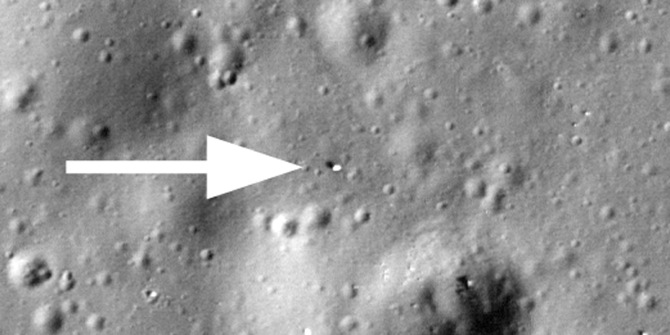
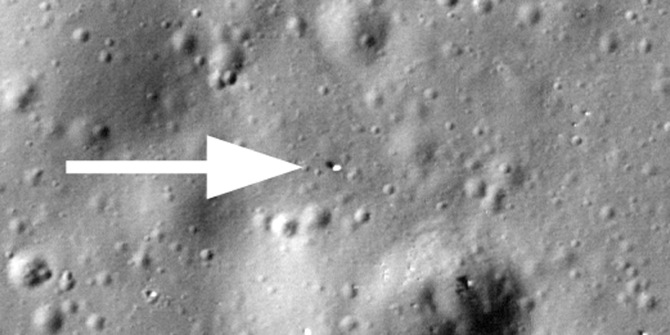
A team of researchers, obsessed with finding the lost Soviet tank, started scanning the LRO images. They weren’t looking for a rover; they were looking for a speck. A tiny, unnatural shadow in a sea of grey.
In March, they found it.
And guess what? The Soviets were wrong. The coordinates were off. Way off. The rover wasn’t where the history books said it was. It was miles away, sitting quietly in the middle of nowhere.
This was the “Eureka” moment. But finding it on a picture is one thing. Touching it with a laser is another.
The Laser Strike
On April 22, a team at the Apache Point Observatory in New Mexico decided to take a shot. They had the new coordinates from the LRO team. They calibrated the telescope. They aimed a high-powered laser pulse at the spot where the LRO said the rover was sitting.
They fired.
Laser light takes about 2.5 seconds to go there and back. One Mississippi… Two Mississippi…
Ping.
The photon detector spiked. They got a return signal.
But they didn’t just get a signal. They got a scream.
The “Impossible” Brightness Anomaly
This is the part that keeps me up at night. This is the part that doesn’t make sense.
When the signal came back from Lunokhod 1, it wasn’t weak. It wasn’t “barely there.” It was blazing.
The return signal was five times brighter than the signal from Lunokhod 2. Let that sink in. Lunokhod 2 landed later. It should be in better shape. Lunokhod 1 has been sitting exposed to the harshest environment in the solar system for forty years. It should be dead. It should be covered in dust. Its mirrors should be degraded.
Tom Murphy, one of the researchers, put it bluntly: “We got about 2,000 photons from Lunokhod 1 on our first try. It was almost too good.”
Why?
Why is a 40-year-old lost rover returning a signal stronger than anything else up there? There are a few theories, and some of them are wild.
- The Parking Job: Maybe, just by blind luck, the rover died in a position where the lid was angled perfectly to protect the mirrors from dust accumulation.
- The “Wind”: Is there an electrostatic phenomenon we don’t understand that cleaned the mirrors?
- The Orientation: Perhaps Lunokhod 2 is the one that’s broken? Maybe Lunokhod 2 is overheating or positioned badly, and Lunokhod 1 is actually performing as designed?
Or maybe, just maybe, we don’t understand the lunar surface as well as we think we do.
Why Does This Matter? (The Big Picture)
You might be thinking, “Who cares about a mirror on the Moon?”
You should care. Because this changes the map. Literally.
These lasers are used to test Einstein’s Theory of General Relativity. They measure the Moon’s orbit to within a millimeter. By recovering Lunokhod 1, we now have a new data point on the other side of the Moon (relative to the Apollo reflectors). It creates a wider network. It stabilizes the geometry.
It means we can measure the liquid core of the Moon (yes, it has one) with more precision. It means we can test if gravity is changing over time.
But beyond the science, there is the mystery of survival. The fact that this Soviet tank, built with 1960s transistors and vacuum tubes, is still functioning as a passive scientific instrument is mind-blowing. It outlasted the country that built it. The Soviet Union fell. The Berlin Wall came down. The Internet was born. And all that time, Lunokhod 1 was just sitting there, waiting for someone to call.
The Final Twist
The recovery of Lunokhod 1 proves something unsettling: We can lose things in plain sight. We looked for this rover for decades. We scanned the surface. We thought we knew the Moon.
We didn’t.
If we could lose a car-sized rover for 40 years, what else is hiding in the craters? What other anomalies are sitting there, just waiting for the right person to look at the right shadow at the right time?
The Moon holds its secrets tight. But every once in a while, if you shoot a laser into the dark, something shines back.
The connection is re-established. The ghost is back online. The only question now is: what are we going to find next?