
Thursday, April 9, 2026
HomeUnexplained MysteriesModern MysteriesMystery of Agatha Christie's diamonds solved

Mystery of Agatha Christie’s diamonds solved

The Queen of Crime. The Duchess of Death. Agatha Christie invented the modern murder mystery. She gave us Hercule Poirot twirling his mustache and Miss Marple peering through lace curtains. Her books are puzzles, designed to trick you, confuse you, and eventually, shock you. She sold billions of copies. Billions.

But here is the thing about Agatha Christie that most people forget.

Her life was just as strange as her fiction. Maybe stranger.

She disappeared for eleven days in 1926, sparking a nationwide manhunt that looked like something out of Gone Girl. She traveled the world on archeological digs, brushing dust off ancient tombs. She knew about poisons, secrets, and double lives. So, it makes perfect sense that the final twist in the Agatha Christie saga didn’t happen on a page. It didn’t happen while she was alive.

It happened inside a rusted, battered traveling trunk, decades after she took her last breath.

Agatha Christie

The $170 Ticket to History

Let’s set the scene. The year is 2006. The location is the Greenway Estate in Devon, England. This was Christie’s holiday home, a magnificent place overlooking the River Dart. It’s the kind of house where you expect a body to fall out of a closet.

The family had decided to organize a massive estate sale. They were clearing out the attic, the cellar, the nooks, and the crannies. Fans, collectors, and curious bystanders flooded the auction. Everyone wanted a piece of the legend.

Enter Jennifer Grant.

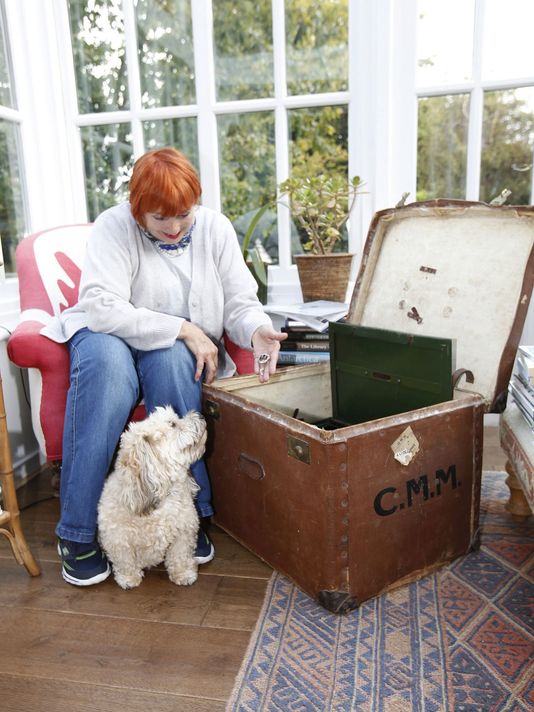
Jennifer wasn’t a high-rolling antique dealer looking to flip artifacts for millions. She was a fan. A normal person. She was looking for a keepsake. Something that had been near the author. She spotted an old traveling steamer trunk. It wasn’t particularly pretty. It was heavy, clunky, and locked.

The price? 100 British Pounds. About $170 at the time.

Think about that. You spend more than that on groceries. You spend more than that on a bad weekend getaway. Jennifer threw down the cash, hauled the heavy trunk into her car, and took it home.

She had no idea she was driving away with a fortune.

The Mystery of the “Pod of Gold”

For years, biographers and historians had whispered about the “lost jewels.” It sounds like a bad movie title, right? But it was real.

Agatha Christie’s autobiography mentions a specific collection of jewelry inherited from her mother. These weren’t just trinkets. We are talking about high-value diamonds and family heirlooms. Christie wrote about them with a sense of sadness and confusion. In her later years, she seemingly lost track of them. She mentioned putting them in a “dispatch box” or a safe place, but after she died in 1976, nobody could find them.

Family members searched. Experts looked through inventory lists. Nothing.

The consensus was simple: They were gone. Maybe stolen decades ago? Maybe sold off quietly during hard times? Or perhaps, they were just a figment of an aging writer’s memory.

The trail had gone cold. Ice cold.

The Trunk in the Corner

Back to Jennifer Grant. She gets this trunk home. It sits there. It’s a conversation piece. “Oh, that old thing? Agatha Christie owned it.” That’s a cool story at a dinner party.

But there was a problem. The trunk was locked. And there was no key.

For a long time, Jennifer didn’t force it. There is a certain respect we pay to antiques. You don’t want to smash a historic object just to see if it’s empty. Most of the time, these trunks are empty. Maybe some old mothballs or a dusty newspaper from 1950. Nothing worth breaking a lock for.

So, the trunk sat. And sat. And sat.

It sat for years.

Can you imagine the frustration of the universe? The ghost of Agatha Christie must have been screaming from the other side. “Open the box! It’s right there!”

The Crowbar Moment

Sometimes, destiny needs a push. Or in this case, a literal pry bar.

Years after buying the trunk, Jennifer Grant was having some renovation work done on her house. There were tools lying around. Hammers. Saws. Crowbars. She looked at the trunk. She looked at the crowbar.

Curiosity finally beat out respect.

She decided to crack it open. She wasn’t expecting gold. She just wanted to see the inside of the box she had owned for nearly a decade. She wedged the iron bar under the lid. Wood creaked. Metal groaned. With a loud snap, the heavy lid popped open.

At first glance? Nothing special. Just an old box.

But then, she looked closer. Inside the trunk, bolted to the bottom, was a heavy strongbox. A lockbox within a lockbox. A mystery inside a mystery.

This is classic Christie. She didn’t just hide things; she buried them in layers.

Grant pried open the inner strongbox. The smell of stale air and old metal hit her. And then, the sparkle.

The Reveal: A Bag of Diamonds

Inside the box was a purse. Inside the purse were the jewels.

Jennifer Grant froze. She wasn’t looking at costume jewelry. She wasn’t looking at glass. She was looking at the history of the Miller family (Christie’s maiden name). She recognized them immediately.

“I had read the biography and so I knew exactly what I was looking at,” Grant later told reporters. “They matched the description exactly. I was nearly hyperventilating!”

Why was she hyperventilating? Because she was holding the “lost” collection.

What Was Inside?

  • The Diamond Brooch: A stunning, intricate piece from the 19th century.
  • The Three-Stone Ring: Massive diamonds set in gold.
  • Assorted Gems: Loose stones and other heirlooms.

It was a literal treasure chest. The kind of thing you dream about finding when you walk past a garage sale, but never actually do. This was the “Antiques Roadshow” fantasy come to life, but on steroids.

The $20,000 Payday (And Why It Was Worth More)

Grant took the items to auction. The experts were floored. They verified the provenance immediately. These weren’t just random diamonds; these were the specific items mentioned in Christie’s own writings.

The estimated value? Over $20,000. Not a bad return on a $170 investment.

But let’s stop and think about the historical value. If these items belonged to a random person, they would be worth the price of the gold and the stones. But because they touched the skin of the woman who wrote The Murder of Roger Ackroyd, their value becomes intangible. They are artifacts of literary history.

Some conspiracy theorists in the literary world have asked: Why did she hide them so well? Was she hiding them from the taxman? Was she hiding them from her husband? Or did she simply forget?

The Psychology of the Hiding Spot

Agatha Christie was a woman of secrets. We have to remember the context of her life.

In 1926, her husband, Archie Christie, asked for a divorce. He was in love with another woman. Agatha was crushed. That was the year she staged her own disappearance, leaving her car by a chalk pit and vanishing, only to be found days later at a spa hotel, claiming memory loss.

During that time, and the years that followed, Christie became fiercely protective of her assets and her privacy. She traveled to Iraq and Syria. She lived out of trunks. A heavy steamer trunk wasn’t just luggage to her; it was a mobile bank vault.

It is entirely possible that she locked those diamonds away during a period of paranoia or instability and simply never felt the need—or the safety—to take them out again. They became a secret she kept even from herself.

Modern Theories: The “Safe House” Concept

Internet sleuths and amateur historians love this story because it validates the “Safe House” theory. The theory goes like this: People who live through trauma (like WWI, which Christie did, or a public divorce) often stash wealth in physical objects rather than banks.

Banks can fail. Stocks can crash. But a diamond ring inside a double-locked trunk in the attic? That is insurance.

We see this all the time in estate sales. People find cash taped behind paintings. Gold coins buried in mason jars in the garden. Christie was wealthy, but she was also a product of her time. She trusted physical things. She trusted locks.

The trunk was her personal Fort Knox.

What Else Is Out There?

This discovery forces us to ask a tantalizing question: What else did we miss?

Christie’s estate was vast. Dozens of notebooks were found. Manuscripts. But if a box of diamonds can go unnoticed for nearly 40 years after her death, what about other things? Are there lost manuscripts hidden in the false bottom of a desk somewhere? Are there letters explaining her 1926 disappearance tucked inside the lining of an old coat?

The Greenway Estate sale in 2006 dispersed thousands of items to buyers all over the world. Most people bought a chair or a lamp and put it in their living room. They probably never took a crowbar to it.

How many other “Jennifer Grants” are sitting on a fortune right now and don’t even know it?

The Final Twist

Agatha Christie wrote the perfect ending to her own story, and she didn’t even have to write it down. She let reality handle the plot.

She left a clue (the autobiography). She left a container (the trunk). And she left it to time to provide the detective (Jennifer Grant).

When Grant saw those diamonds sparkling in the gloom of the open trunk, it was the final scene of a mystery that had been running for eighty years. The loose ends were tied up. The lost treasure was found.

So, the next time you see a battered old trunk at a yard sale, or a heavy box at an estate auction, don’t walk past it.

Look closer. Lift it up. Shake it.

Because you never know. The Queen of Crime might have left something for you.

Arindam Mukherjee
Arindam Mukherjee
Arindam loves aliens, mysteries and pursing his interest in the area of hacking as a technical writer at 'Planet wank'. You can catch him at his social profiles anytime.
RELATED ARTICLES
- Advertisment -

Most Popular

Recent Comments

Warren Pan Abbott on The legend of the Devil Monkey !
chris davies on The McPherson Tape Mystery
Reed Reedly on ET has Internet!
Bea Houseoffashion on Proof Of Time Travellers – Gallery
Marcus2012 on ET has Internet!
Reed Reedly on ET has Internet!
LaughsAtConspiracyNuts on The 9/11 Conspiracy – Myths and Facts
Alex Sliverman on Did the ancients fly?
Doctor Wholigan on Time Traveler in 1938 film
chris davies on The McPherson Tape Mystery
Archie1954 on 10 secret UFO hideouts
chris davies on Ghosts of flight 401
Marcus2012 on ET has Internet!
jason Macdonald on Proof of Time Travel? – China
chris davies on Long-Lost Pyramids Found?
Reed Reedly on ET has Internet!
Milkman on Connected Universe
Tenmiles on Baigong Pipes Mystery
Simon Foster on Sirius – The Documentary
From the 1st April on 2013 – Alien Contact date ?
SkyWatcher on Is ET ignoring us?
I Come From The Future on Obama to make UFO Alien disclouser soon ?
ÛñK?øWn on 2013 – Alien Contact date ?
Just another person on 2013 – Alien Contact date ?
Malcolm Windowcleaner on The strange case of Rudolph Fentz
Mason Servio on Strange Things on Mars
Marke Wisdom Seeker on What will we find as arctic melts?
Andrea A Elisabeth Levyne on Aliens Captured in Varginha, Brazil
Mitch Grouyeki on Amazing Space Shuttle pictures