Saturday, July 11, 2026
HomeUnexplained MysteriesModern MysteriesDeath Valley's sailing stones mystery solved

Death Valley’s sailing stones mystery solved

The Silent Movers of Death Valley: What’s REALLY Pushing the Sailing Stones?

There’s a place on this Earth so desolate, so alien, that it feels like the surface of another planet. A place where the silence is a physical presence. It’s called Racetrack Playa, a dried-up lakebed nestled deep within the unforgiving heart of Death Valley National Park. And on this cracked, sun-scorched floor, something impossible happens.

The rocks move.

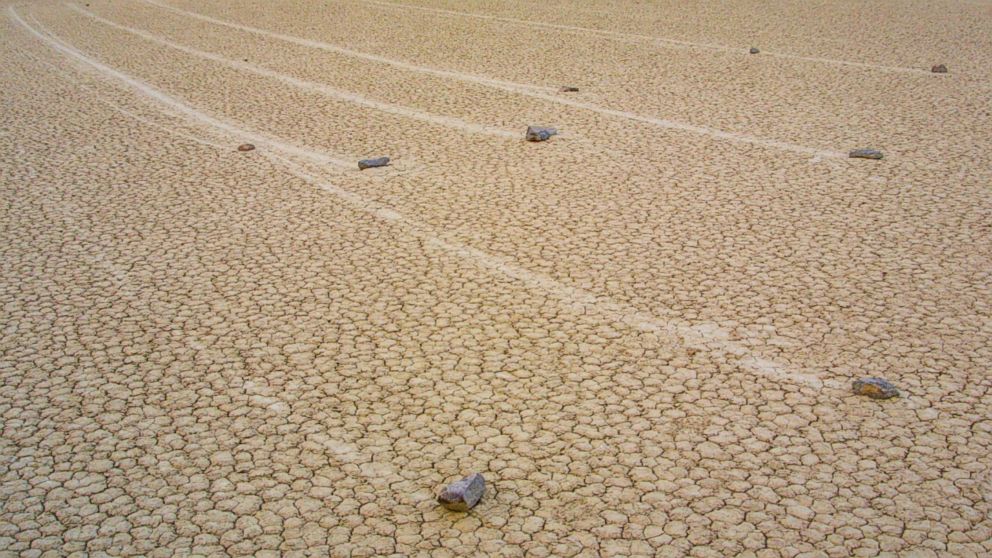
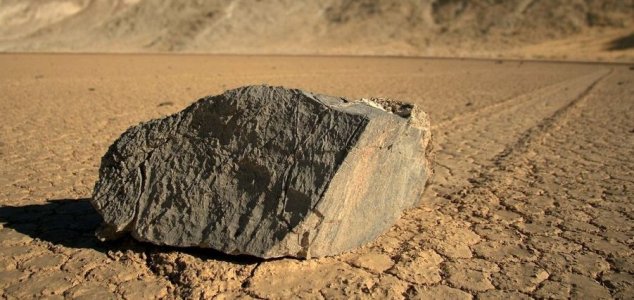
Not just pebbles. We’re talking about colossal boulders. Slabs of dolomite weighing hundreds of pounds, some tipping the scales at over 700 pounds—heavier than a grizzly bear. And they slide across the desert floor, seemingly on their own, carving long, elegant, and utterly baffling tracks in the hard-packed clay. For decades, this was one of our planet’s most profound and visually stunning mysteries. No one had ever seen them move. No footprints. No signs of intervention, human or animal. Just the rock. And its long, silent trail.

A geological crime scene with no witnesses.

So what’s the truth? Was it a clever, long-running hoax? A bizarre, localized magnetic anomaly? Or something else entirely? Science claims to have the answer now. An answer involving ice, wind, and a perfect storm of conditions. But as with any great mystery, the official story only seems to open the door to even more questions.

A Century of Whispers on the Playa

The stories began as whispers among the hard-bitten prospectors and miners who first braved the furnace-like heat of Death Valley in the early 1900s. They’d stumble upon the playa—this bizarrely flat, expansive surface—and see the evidence. Grooves etched into the ground, some hundreds of feet long, terminating with a heavy, solitary rock. It made no sense. It defied logic.

One of Death Valley's mysterious sailing stones with a long trail behind it.

By the 1940s, the phenomenon was no longer a local legend; it was a bona fide scientific enigma. Geologists were stumped. The rocks moved in different directions. Some traveled in straight lines, others in graceful curves. Pairs of rocks would start together, travel in parallel for a while, and then abruptly veer off in opposite directions. How? What force could be so precise yet so random?

The setting itself only deepens the mystery. Racetrack Playa is almost perfectly flat, with the northern end just a couple of inches higher than the southern. There’s no slope to explain a simple gravitational slide. The air is still and heavy for much of the year. The ground, a mosaic of dried mud polygons, is baked hard as concrete by the relentless sun. Pushing a 700-pound rock across that surface would require immense, sustained force.

The Conspiracy Corner: When Logic Fails, Imagination Runs Wild

For decades, with no concrete explanation, the void was filled with speculation. And some of it was truly wild. The mystery of the sailing stones became a canvas for every fringe theory imaginable, a testament to our need to find answers, no matter how strange.

H3: Magnetic Fields and Earth Energy?

One of the most popular early theories revolved around magnetism. Could the rocks themselves be uniquely magnetic? Or was Racetrack Playa situated on a powerful magnetic anomaly, a “vortex” of telluric currents powerful enough to drag these stones across the surface? Proponents pointed to other mystery spots around the world, like the Oregon Vortex or the strange magnetic hills found in various countries. They argued that conventional science was too quick to dismiss the powerful, unseen forces of our own planet. The problem? The rocks are mostly dolomite. Not magnetic. And comprehensive geological surveys of the playa have never found any significant magnetic anomalies. Strike one.

H3: The Prankster Hypothesis

Could it all be a hoax? A massive, decades-long practical joke carried out by a secret society of incredibly strong, dedicated pranksters? Think about the logistics. They’d have to haul equipment into one of the most remote and inhospitable places in North America, move hundreds of rocks weighing thousands of pounds in total, and do it all without leaving a single footprint or tire track on the delicate playa surface. They’d also have to do it consistently for nearly a hundred years. The sheer effort, coordination, and secrecy required make this theory even more unbelievable than the rocks moving on their own.

H3: Sonic Levitation and Wind Harmonics

This one sounds more scientific, but it’s just as far out. Some theorized that the unique geography of the surrounding mountains could, under specific wind conditions, create a powerful resonant frequency. A sort of natural acoustic weapon. The idea was that this sound, perhaps below the range of human hearing, could vibrate the rocks just enough to reduce their friction with the ground, allowing even a gentle breeze to push them along. It’s a fascinating concept, but there’s absolutely no evidence to support that such a phenomenon can occur on this scale in nature.

Science Enters the Ring: Operation “Slithering Stone”

The mystery festered for over 70 years. Then, in 2011, a team of scientists decided they’d had enough of the speculation. They were going to catch the rock-mover red-handed, even if it took years. A team from Scripps Institution of Oceanography, led by Richard D. Norris and his cousin, engineer Jim Norris, launched one of the most patient experiments in modern geology.

They weren’t the first to try. Previous studies had attempted to solve it, but they were always missing the key element: being there when it happened. The Norris team knew they couldn’t camp out for years, so they did the next best thing: they set a trap.

H3: The GPS-Tagged “Hero” Rocks

They knew they couldn’t use the original, protected sailing stones. So, with permission from the National Park Service, they brought in their own. They selected 15 rocks, similar in size and composition to the playa’s natural movers, and chiseled out small cavities in their tops. Into these cavities, they fitted custom-built, motion-activated GPS units. These weren’t your average car navigation systems; they were high-precision instruments designed to wake up and record their position with impeccable accuracy the moment a rock began to move.

They also installed a high-resolution weather station right there on the playa, capable of measuring wind gusts down to a single second and temperature changes to a fraction of a degree. They placed their “hero rocks” in a part of the playa where movement had been documented before. And then… they waited.

And waited. For two full years, nothing happened. The GPS units remained silent. The weather station dutifully recorded the brutal heat and the bitter cold. The rocks sat, inert and mocking. The project seemed like it might be a bust, another failed attempt to pin down a ghost.

The Perfect Storm: A Recipe for a Miracle

Then, in the winter of 2013, the conditions finally aligned. The secret to the sailing stones, it turns out, isn’t one single event. It’s a fragile, almost magical sequence of events. A recipe that has to be followed perfectly.

Step 1: The Water. First, you need rain. Or melted snow from the surrounding mountains. But not too much. You need just enough water to flood the vast playa, creating a shallow, temporary lake just a few inches deep. Deep enough to allow for ice to form, but shallow enough that the rocks still poke out from the surface.

Step 2: The Freeze. Next, you need the cold. A deep, penetrating cold that drops temperatures below freezing for a sustained period overnight. This allows the surface of the shallow pond to freeze into a vast, thin sheet of what scientists call “windowpane” ice. It’s strong enough to maintain its structure but thin enough to be easily broken.

Step 3: The Thaw. The next morning, the powerful desert sun has to come out. As the day warms up, the ice sheet begins to melt and crack. It doesn’t just disappear; it breaks apart into huge, floating panels. Some of these ice floes can be dozens, even hundreds of feet across.

Step 4: The Wind. Finally, you need wind. And surprisingly, not a hurricane. Just a light, steady breeze of around 10 miles per hour is enough. This gentle but persistent wind pushes against the massive ice panels, which act like enormous sails. The entire frozen surface of the pond begins to move as one.

And any rock frozen into one of these ice sheets? It gets taken for a ride. The ice panel acts as a giant bulldozer blade, shoving the rock forward, leaving a tell-tale track in the soft mud beneath the water. The movement is slow, graceful. Almost invisible. A mere two to five meters per minute. It’s not a dramatic, high-speed event. It’s a silent, creeping, inexorable slide.

“We Actually Saw It Happen!”

In December 2013, Richard Norris and Jim Norris arrived at the playa to check on their experiment and found the place transformed. A shallow pond covered the southern end. That afternoon, they witnessed it with their own eyes. They saw the ice shifting, heard the cracking and popping as the great sheets moved, and watched as rocks, hundreds of feet away, slowly drifted across the landscape.

Their GPS units went wild, capturing the event in exquisite detail. They had done it. They had solved it.

“It’s possible that tourists have actually seen this happening without realising it,” said co-author Jim Norris. “It is really tough to gauge that a rock is in motion if all the rocks around it are also moving.” Imagine that. Standing there, thinking nothing is happening, while a 500-pound boulder is silently gliding past you just a few hundred feet away. It’s a mind-bending thought.

But Does the Official Story Really Close the Case?

So, there you have it. A neat, tidy, scientific explanation. Mystery solved. Case closed. Right?

Maybe not.

For the true believer, the dedicated skeptic, the official story feels… a little too convenient. It explains *a* way the rocks can move. But does it explain *all* of the movements seen over the last century? The internet’s new generation of digital detectives certainly has its doubts.

H3: The Problem of the Lone Movers

The ice sheet theory perfectly explains rocks moving in parallel. But what about the ones that don’t? How does one rock get pushed by an ice floe while another one, just a few feet away, remains perfectly still? The official explanation suggests differences in how firmly a rock is embedded in the mud or the shape of the ice around it. But to a skeptic, it looks like a selective force at work—something the ice sheet theory struggles to fully account for.

H3: The Intricate Tracks

Some of the tracks found on the playa are incredibly complex. They show sharp, right-angle turns, complete reversals of direction, and circular patterns. Can a massive, wind-driven ice sheet really perform such delicate maneuvers? It seems more like the movement of something with its own agency, not something being shoved by a giant, clumsy raft of ice. Could different phenomena be at play? Could the ice-wind mechanism be just one of several ways these stones travel?

H3: Modern Findings vs. Old Legends

The conditions required for the ice-and-wind event are rare. Some climatologists argue they may only occur once every decade or so. Yet, historically, new tracks have been reported on the playa far more frequently. Is it possible that the climate has changed, and this mechanism is a recent development? Could something else—something we still don’t understand—have been moving the rocks in the past?

Online forums and Reddit threads are filled with armchair geologists poring over satellite images from Google Earth, trying to correlate track appearances with weather data. Some claim to have found new tracks that appeared during periods when the specific weather conditions for ice formation weren’t met. Is it flawed data, or a flaw in the theory?

The Final Verdict… For Now

The work done by the Scripps team was brilliant. It provided the first-ever direct observation of the sailing stones in motion and gave us a scientifically sound, evidence-based mechanism for how this impossible-seeming event can occur. It is, without a doubt, the most compelling explanation we have.

But the world is a strange place. Death Valley, even more so. The ice-sheet theory is a fantastic answer. But is it the *only* answer? It feels like the end of a chapter, not the end of the book.

Out on that vast, silent, cracked expanse, under the blaze of a billion stars, the stones sit and wait. They wait for the rain, for the freeze, for the wind. And they keep their secrets. Science has given us an explanation that satisfies our logic. But the playa still holds an undeniable magic, a sense of wonder that can’t be fully captured in a scientific paper. The stones are still out there. And they’re still silent.

Arindam Mukherjee
Arindam Mukherjee
Arindam loves aliens, mysteries and pursing his interest in the area of hacking as a technical writer at 'Planet wank'. You can catch him at his social profiles anytime.
RELATED ARTICLES
- Advertisment -

Most Popular

Recent Comments

Warren Pan Abbott on The legend of the Devil Monkey !
chris davies on The McPherson Tape Mystery
Reed Reedly on ET has Internet!
Bea Houseoffashion on Proof Of Time Travellers – Gallery
Marcus2012 on ET has Internet!
Reed Reedly on ET has Internet!
LaughsAtConspiracyNuts on The 9/11 Conspiracy – Myths and Facts
Alex Sliverman on Did the ancients fly?
Doctor Wholigan on Time Traveler in 1938 film
chris davies on The McPherson Tape Mystery
Archie1954 on 10 secret UFO hideouts
chris davies on Ghosts of flight 401
Marcus2012 on ET has Internet!
jason Macdonald on Proof of Time Travel? – China
chris davies on Long-Lost Pyramids Found?
Reed Reedly on ET has Internet!
Milkman on Connected Universe
Tenmiles on Baigong Pipes Mystery
Simon Foster on Sirius – The Documentary
From the 1st April on 2013 – Alien Contact date ?
SkyWatcher on Is ET ignoring us?
I Come From The Future on Obama to make UFO Alien disclouser soon ?
ÛñK?øWn on 2013 – Alien Contact date ?
Just another person on 2013 – Alien Contact date ?
Malcolm Windowcleaner on The strange case of Rudolph Fentz
Mason Servio on Strange Things on Mars
Marke Wisdom Seeker on What will we find as arctic melts?
Andrea A Elisabeth Levyne on Aliens Captured in Varginha, Brazil
Mitch Grouyeki on Amazing Space Shuttle pictures