Is Tupac Alive? The 7 Day Theory, the Cuban Connection, and the Conspiracy That Refuses to Die
The official story is neat. Tidy. Sealed and delivered.
On September 7th, 1996, a black BMW 750iL carrying two of hip-hop’s most powerful figures paused at a red light on Flamingo Road in Las Vegas. A white Cadillac pulled alongside. Gunfire exploded. The world changed forever.
Six days later, on Friday the 13th, Tupac Amaru Shakur, the poet, the prophet, the most electrifying voice of a generation, was pronounced dead. Cause of death: respiratory failure and cardiopulmonary arrest. He was 25 years old.
Case closed, right?
Wrong. So very wrong.
Because for millions around the globe, that isn’t the end of the story. It’s the beginning of the greatest mystery in music history. A tangled web of whispers, clues, and chilling coincidences that suggest Tupac didn’t die. He escaped. He executed the ultimate disappearing act, and the official report was nothing more than the closing curtain on a masterfully staged play.
Forget what you think you know. We’re going down the rabbit hole. And at the bottom, we might just find Makaveli himself, alive and well, waiting for the right moment to return.
The Official Story: A House of Cards?
Before we can see the cracks, we have to look at the wall itself. The night of the shooting is etched into pop culture legend. The adrenaline of the Mike Tyson fight at the MGM Grand. The beatdown of a rival gang member, Orlando Anderson, in the casino lobby—an act of retaliation that many believe sealed Tupac’s fate.
Then, the drive. Tupac in the passenger seat, Suge Knight, the imposing head of Death Row Records, behind the wheel. They were headed to Club 662. They never made it.
Thirteen shots were fired into the BMW. Four struck Tupac. One hit Suge Knight in the head, grazing him. The chaos, the sirens, the arrival at the University Medical Center. It all feels so brutally real. Doctors performed emergency surgery, removing his shattered right lung. They placed him on life support. His mother, Afeni Shakur, made the impossible decision to cease medical intervention six days later.
That’s the story they sold us. But from the very moment the news broke, things started to feel… off.
Cracks in the Coffin: The Questions That Won’t Go Away
Think about it. When a global icon dies, the world stops. There are vigils. Tributes. A massive public funeral. A spectacle of grief. Princess Diana, Michael Jackson, Kobe Bryant—their passings were global events.
So where was Tupac’s funeral?
There wasn’t one. Not a public one, anyway. The official reason? His mother was concerned about security risks and media frenzy. A plausible explanation, perhaps. But then it gets weirder.
Tupac was supposedly cremated on September 14th, the day after he died. A man of his stature, a legend, turned to ash in less than 24 hours? With no viewing, no ceremony for his legions of fans? It felt rushed. It felt… like a cover-up.
And then there’s the story of the cremator. The man who was supposedly paid $3 million in cash to handle the cremation has never been officially named. In fact, according to some online investigators, he vanished after doing the job. Coincidence? Or was he paid for his silence and a service he never actually performed?
Deep Dive: Enter Makaveli and The 7 Day Theory
This is where the story pivots from a tragic crime to a calculated conspiracy. To understand it, you have to understand the mind of Tupac in his final months. He wasn’t just a rapper anymore. He was a student of war and strategy, obsessed with the writings of the Italian philosopher Niccolò Machiavelli.
Who was Machiavelli? He was a 16th-century political strategist who famously wrote in his book, The Prince, that faking one’s own death was a legitimate tactic to deceive one’s enemies.
Tupac was so inspired, he adopted a new stage name: Makaveli.
Just weeks after his “death,” a new album dropped. An album he had finished before the shooting. The title? The Don Killuminati: The 7 Day Theory. The cover art is chilling. It depicts Tupac crucified, a direct parallel to Jesus Christ, who was resurrected after his death. Was this a message? A prediction?
Let’s look at the numbers. The “7 Day Theory” isn’t just a title. It’s a breadcrumb trail.
- He was shot on September 7th.
- He survived for six days and died on the 7th day.
- His official time of death was 4:03 PM. 4 + 0 + 3 = 7.
- He was 25 years old. 2 + 5 = 7.
- The album dropped exactly 7 months after his previous blockbuster, All Eyez on Me.
The coincidences pile up until they stop feeling like coincidences at all. They feel like a plan. A meticulously crafted exit strategy laid out in plain sight for anyone willing to look.

The Cuban Connection: A Safe Haven for a King?
So if Tupac faked his death, where would he go? He was one of the most famous people on the planet. He couldn’t just move to another state. He needed to disappear. He needed a place with no cameras, no extradition treaty with the United States, and powerful allies.
He needed Cuba.
The theory that Tupac is living in Cuba has been the most persistent and, frankly, the most logical of all the survival theories. Why? One name: Assata Shakur.
Assata is Tupac’s aunt and godmother. A prominent member of the Black Liberation Army, she was convicted of murder in 1977, escaped from prison in 1979, and fled to Cuba, where Fidel Castro granted her political asylum. She lives there to this day, protected from the US government.
Could it be any more perfect? Tupac, feeling the walls closing in, hounded by enemies in the rap game and watched by the FBI, turns to the one person who knows how to escape the system. His own family. Assata could have provided the network, the logistics, the safe passage. In Cuba, he would be untouchable.
Over the years, the “evidence” has trickled out. Grainy photos from Cuban villages showing a man with Tupac’s unmistakable bone structure and tattoos. Videos of men who sound just like him. Mainstream media dismisses them as fakes and lookalikes. But are they all? Websites and YouTube channels have popped up alleging he’s been spotted, from small towns to exclusive resorts.
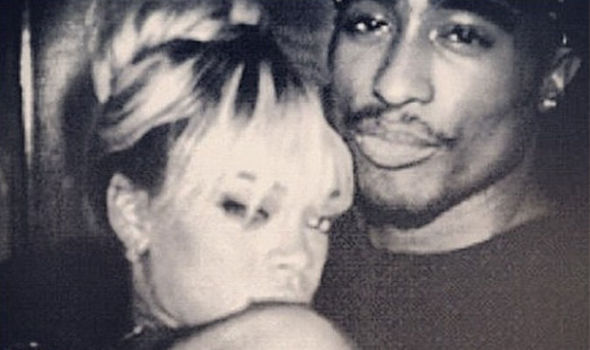
Look at the picture above, which once circulated with stories claiming he was seen with Rihanna. While that specific photo is easily debunked (Rihanna would have been a child), it represents the thousands of “sightings” and digital whispers that keep the flame alive. For every one fake, could there be one that’s real?
Modern Sightings and the Suge Knight Bombshell
The conspiracy isn’t just a relic of 90s internet forums. It’s alive and kicking today. In recent years, Suge Knight’s own son, Suge J. Knight, has fanned the flames on social media, posting messages claiming Tupac is alive and well and living in Malaysia. He even posted photos of an older man who bears a striking resemblance to the rapper, along with cryptic messages like “He never left us.”
Is this the desperate cry for attention from the son of a disgraced music mogul? Or does he know something? His father was the only other person in the car. The only witness. For years, Suge Knight has been cagey, offering hints and half-truths. Perhaps he told his son the full story.
The internet has run wild with this. Digital sleuths analyze new photos, comparing tattoos that were supposedly airbrushed out. They run audio clips through voice-recognition software. They believe Tupac has been dropping clues all along, hiding messages in the lyrics of other artists he secretly ghostwrites for.
What If? Imagining the Great Escape
Let’s just imagine for a second. Let’s play out the scenario. What if he did it?
The plan would have to be flawless. First, you need a motive. Tupac was tired. Tired of the fame, tired of the threats, tired of the gangster persona he felt trapped in. He wanted out. The shooting in Vegas wasn’t an assassination attempt; it was the first act of the play.
Suge Knight had to be in on it. He takes a minor graze to make it look real. The ambulance that arrives? It’s not a public one. It’s a private transport, staffed by people they paid off. They rush Tupac not to the nearest hospital, but to a private airfield.
A body double, perhaps someone already terminally ill, is taken to the real hospital to play the part of the dying rap star. While the world’s media camps outside the University Medical Center, the real Tupac is on a private jet to a non-extradition country. Cuba is the obvious choice. His aunt Assata is waiting.
The quick cremation? There was no body to cremate. The missing funeral? You can’t have a funeral for a man who isn’t dead.
The millions of dollars that were supposedly missing from Death Row Records? Maybe that was Tupac’s getaway fund. He buys his silence, buys his new life, and vanishes from the face of the earth, leaving behind a legacy, a legend, and a mystery for the ages.
The Legend That Will Never Fade
So, is Tupac Shakur sipping a mojito on a Cuban beach, watching the chaos of the world he left behind with a knowing smile? Or is this all just the collective wishful thinking of a fan base that can’t accept the loss of its hero?
Maybe the truth doesn’t even matter anymore. The story of Tupac’s “death” has become a modern myth. A tale of defiance against a system that he felt was trying to destroy him. Whether he died in that Las Vegas hospital or orchestrated the most brilliant escape in modern history, one thing is certain: he won.
His voice is louder now than it ever was. His music is timeless. His message continues to inspire, provoke, and challenge.
The official story may be written in ink, but the legend of Makaveli is written in stone. And it leaves us with one haunting, electrifying question: if he did pull it off, is he ever coming back?
Originally posted 2016-04-09 14:40:58. Republished by Blog Post Promoter