The Man Who Dreamed of Lightning: Was Nikola Tesla Erased from History?
You think you know the story of electricity. You think of Thomas Edison. A lightbulb. A flash of simple genius. That’s the story they want you to know. But it’s a lie. A whisper of the truth. The real story, the one that’s been buried, classified, and fought over for a century, belongs to another man. A man who saw the future in bolts of lightning. A man who bent the forces of the universe to his will and was punished for it.
His name was Nikola Tesla.
And he didn’t just invent a better lightbulb. He invented the modern world. Then, they tried to erase him.
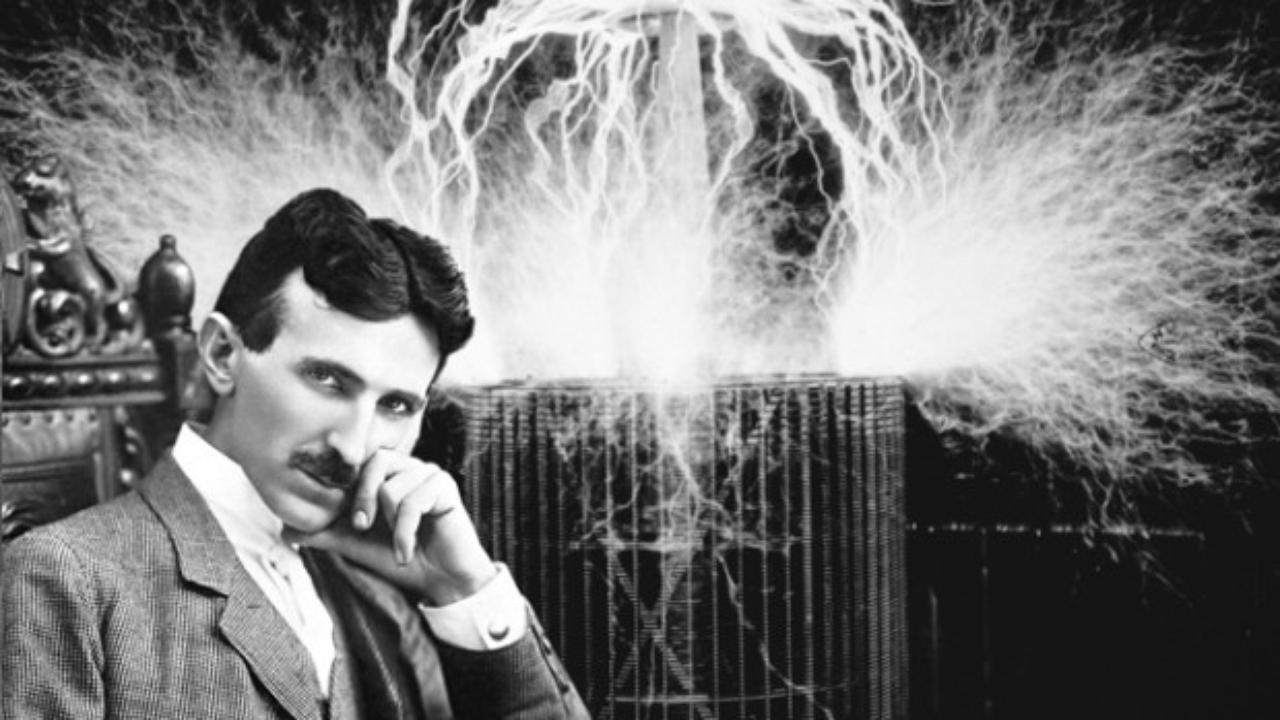
The official story is neat. Tidy. Tesla (born 10 July 1856 – 7 January 1943) was a Serbian-American inventor, an electrical and mechanical engineer. The textbooks will tell you his work on alternating current (AC) power systems formed the bedrock of our electrical grid. They’ll mention his victory in the “War of Currents” against Edison. They’ll praise him as a genius. Then, the story sours. They’ll call him eccentric. A mad scientist. They’ll talk about his bizarre claims and how he died penniless and alone in a New York hotel room, his grandest dreams shattered.
But what if that’s not the end of the story? What if it’s the beginning of the biggest cover-up in scientific history?
What if I told you Tesla discovered a way to transmit limitless, free energy wirelessly to any point on the globe? What if he built a weapon capable of stopping armies in their tracks? And what if, after his death, the FBI swooped in, seized every last scrap of his research, and locked it away under the cover of national security? This isn’t just a story of an inventor. This is the story of a man who held the future in his hands, and the powerful forces that ripped it away.
Forget what you learned in school. We’re going deep.
The Mind of a Thunderstorm
To understand the mystery, you first have to understand the man. And Tesla wasn’t like other men. He wasn’t even like other geniuses. He was something else entirely.
Legend says he was born at the stroke of midnight during a fierce electrical storm. The midwife, terrified, called it a bad omen. “He will be a child of darkness,” she supposedly said. His mother replied, “No. He will be a child of light.”
Whether the story is true or not, it fits. From a young age, his mind worked differently. He was plagued by blinding flashes of light, often accompanied by vivid visions. He didn’t need blueprints or models. He claimed he could build, test, and even break his inventions entirely inside his head, visualizing every gear and wire with perfect clarity before ever touching a tool. An eidetic memory on a level that seems almost superhuman.
This wasn’t just a party trick. It was the source of his power. While other inventors tinkered through trial and error, Tesla saw the finished product, perfect and humming, in the theater of his mind. He saw alternating current. He saw the AC motor. He saw radio a decade before Marconi. He saw it all. Complete.
This ability is what brought him to America, to the doorstep of the one man who would become his greatest champion and his most bitter enemy: Thomas Edison.
Deep Dive: The War of Currents – More Than a Business Dispute
This wasn’t just about technology. It was a war for the soul of the 20th century.
When Tesla arrived in America, he carried little more than a letter of recommendation to Edison. Edison, the “Wizard of Menlo Park,” was already a celebrity. His system of direct current (DC) was slowly lighting up pockets of New York City. But DC had a fatal flaw. It was weak. It couldn’t travel more than a mile without losing power, requiring a power station on every few city blocks. It was inefficient. A financial dead end.
Tesla arrived with the solution. A phantom in the wire. Alternating current.
AC vs. DC: The Simple Showdown
Think of it like this. Edison’s DC was like pushing a rock up a hill. It only moves in one direction, and it takes a ton of constant effort. You lose steam fast.
Tesla’s AC was different. It was a vibration. A pulse. The electrons essentially dance back and forth in the wire, transferring energy over vast distances with almost no loss. It was elegant. Powerful. And with the use of transformers, it could be stepped up to high voltage to travel hundreds of miles and then stepped down to safely power a home.
It was the future. And Edison knew it.
He also knew it threatened his entire empire. So, he did what powerful men do when faced with a superior idea. He tried to destroy it. And the man who brought it to him.
A Campaign of Fear
Edison launched one of the most vicious smear campaigns in history. He declared AC a deadly menace. A killer. To “prove” his point, he and his associates began holding public demonstrations. They would take stray dogs and cats, drag them onto a stage, and electrocute them with high-voltage AC. They paid schoolchildren 25 cents for every stray they brought in for the slaughter.
It got worse. Much worse. Edison’s campaign culminated in the public execution of Topsy, a circus elephant, and the secret promotion of the first electric chair—powered by Tesla’s AC—all to forever associate the rival technology with death in the public consciousness.
But you can’t stop the future. Backed by George Westinghouse, Tesla’s AC system won the bid to power the 1893 Chicago World’s Fair. When President Grover Cleveland flipped a switch, 100,000 incandescent bulbs blazed to life, bathing the “White City” in an otherworldly glow. It was a spectacle of magic and power, all running on AC. The war was over. Tesla had won. He had given the world light.
But his real work was just beginning.
Wardenclyffe: The Tower of World Power
With the War of Currents won, Tesla turned his gaze to a dream far grander than lightbulbs. It was a vision that would have transformed human civilization. Or possibly destroyed it.
It was called the World Wireless System.
On Long Island, with funding from the powerful banker J.P. Morgan, Tesla began construction on a colossal structure. A 187-foot tower topped by a 68-foot-wide copper dome. Below it, an iron root system plunged 300 feet into the earth. This was Wardenclyffe Tower.
Publicly, Tesla claimed it was a global communications hub. He would send messages, voices, and even images instantly across the planet. Decades before the internet, he was designing the wireless age.
But that was only part of the story. The secret, the part that likely terrified his investors, was its other purpose.
Was This a “Free Energy” Device?
Tesla wasn’t just trying to send signals *through* the air. He had discovered something incredible about the Earth itself. He believed our planet was a giant electrical generator, a resonating sphere of untapped energy. He wasn’t building an antenna. He was building a tuning fork. He planned to plunge his “earth grip” deep into the ground and pump energy into the planet at a specific frequency, causing the entire globe to resonate. He believed he could then draw that power out. Anywhere.
No wires. No power plants. Limitless energy, plucked right out of the air and the ground, free for everyone.
Do you see the problem? Think about it. Who gets rich from free energy? Nobody. You can’t put a meter on it. You can’t build an empire on a gift to humanity.
When J.P. Morgan supposedly asked Tesla, “Where do we put the meter?” Tesla had no answer. And just like that, the funding vanished. The project collapsed. The tower, a skeleton of a utopian future, was eventually torn down for scrap to pay off Tesla’s debts. The dream died.
Or did it go somewhere darker?
The Seized Files: What the FBI Found in Room 3327
On January 7, 1943, Nikola Tesla was found dead in his room at the Hotel New Yorker. He was 86, impoverished, and alone. But the moment his death was announced, a strange and frantic chain of events began.
Within hours, agents from the FBI and the Office of Alien Property stormed the hotel. They sealed his room. They opened his safe. They seized two truckloads of his personal papers, notebooks, and research. Two truckloads.
Now, stop and ask yourself: Why? The official reason given was that Tesla worked on some secret projects for the U.S. government during the war, and they wanted to ensure his technology didn’t fall into enemy hands. But Tesla was a U.S. citizen. The Office of Alien Property had no jurisdiction. It was a flimsy excuse then, and it’s a transparent one now.
They were looking for something. Something they were terrified of.
For decades, these documents were classified. Hidden. Internet researchers and historians filed Freedom of Information Act (FOIA) requests for years, only to be denied or given documents that were so heavily redacted they were almost entirely blacked out. What was in those missing files? The rumors have swirled for nearly a century.
Deep Dive: The Forbidden Inventions
What were the Feds so desperate to find? Decades of research and modern theories point to two devices that sound like they were ripped from the pages of science fiction.
Teleforce: The “Death Ray”
In the 1930s, as the world slid toward another great war, Tesla announced he had conceived of a new kind of weapon. He called it “Teleforce,” but the press, ever sensational, dubbed it the “Death Ray.”
This wasn’t a laser. It was something far more advanced. He described a particle beam accelerator that would shoot a concentrated stream of particles through the air at such high velocity that it could bring down a fleet of 10,000 airplanes from 200 miles away. It would, he claimed, create an impenetrable wall of force around a country, making war impossible.
Mad ravings of an old man? Maybe. But this is the man who visualized the AC motor. And modern military forces around the world are now actively developing and deploying “directed-energy weapons.” Did the plans for this ultimate weapon end up in a government vault, becoming the seed of a new, terrifying kind of warfare?
The Earthquake Machine
Another legendary Tesla device was his mechanical oscillator. A small, simple, piston-driven device that could be tuned to the specific resonant frequency of any object. He claimed that, in his lab once, he attached a pocket-sized version to a steel beam in the building’s frame. As he tuned the frequency, the entire building began to shake violently. Plaster fell. Windows shattered. The vibrations were so intense he had to smash the device with a sledgehammer to stop it just as the police burst through the door.
He boasted that with a large enough oscillator and the right frequency, he could split the Earth in two. Is it true? The story is part of the Tesla mythos. But it points to his profound understanding of vibration, resonance, and energy—an understanding that we are only now beginning to appreciate.
The Tunguska Connection: A Global Experiment Gone Wrong?
This is where we go from conspiracy to something that feels almost cosmic. On June 30, 1908, something happened in a remote part of Siberia. A massive, cataclysmic explosion flattened over 800 square miles of forest. The blast was estimated to be 1,000 times more powerful than the atomic bomb dropped on Hiroshima. It was seen and heard hundreds of miles away.
The official explanation is a meteor or comet exploding in the atmosphere. But there’s a problem. A huge one. No one has ever found an impact crater. Not a single fragment of a meteorite has ever been definitively linked to the event.
So, a fringe theory has persisted for decades, one that connects this strange event directly to Tesla’s work at Wardenclyffe. The tower had been mostly inactive for years by 1908, but what if it wasn’t? What if, in a desperate attempt to prove his system worked, Tesla fired it up for a test?
What if he aimed for an unpopulated region of the planet—like, say, the arctic circle near Siberia—to demonstrate the awesome power of his wireless energy transmission? The dates are suspicious. The event took place while Tesla was known to be experimenting. His system was designed to transmit enormous amounts of electrical energy through the earth and the atmosphere.
Could the Tunguska event have been the result of a test shot from Wardenclyffe that went horribly, catastrophically wrong? It’s a wild theory. But in the world of Nikola Tesla, the wild is often where you find the truth.
The Ghost in Our Machine
They tore down his tower. They seized his papers. They wrote him out of the popular history books, recasting him as a sideshow character in Edison’s story. But they couldn’t erase him. Not really.
His ghost is everywhere in our modern world. Every time you charge your phone on a wireless pad, you’re using a principle he demonstrated over 100 years ago. Remote controls? He patented a remote-controlled boat in 1898. The very foundation of radio? His patents. Neon lights, the spark plug, and countless other technologies we take for granted all have his fingerprints on them.
We are living in the world Tesla built. But it is a shadow of the world he wanted to give us. He dreamed of a world of abundance, not scarcity. A world of connection, not conflict. A world where energy was a human right, as free as the air we breathe.
So, what happened? Was he just a dreamer whose ideas were too big for his time? Or was he a man who genuinely discovered something so profound, so revolutionary, that the existing power structures had no choice but to silence him and bury his work?
The files remain mostly classified. The full truth of what was found in Room 3327 may never be known. But the questions linger. The next time you flip on a light, think of Tesla. Think of the tower, the seized notes, and the dream of free energy. And ask yourself: what else don’t we know? What other secrets are locked away, waiting for the world to be ready for the mind of the man who dreamed in lightning?
Originally posted 2016-03-12 16:29:05. Republished by Blog Post Promoter
![tesla[1]](https://coolinterestingnews.com/wp-content/uploads/2012/07/tesla1.webp)