Thursday, May 7, 2026
HomeWeird WorldScienceCyberpolitics in 3 triangles: How to avoid a digital Bermuda Triangle

Cyberpolitics in 3 triangles: How to avoid a digital Bermuda Triangle

The Digital Bermuda Triangle: Are They Deleting Your Online Soul?

Ever get that cold, creeping feeling that the internet isn’t what it seems? That behind the memes, the news feeds, and the endless scroll, there’s a machine? A vast, invisible architecture designed for something other than our connection and entertainment?

You’re not wrong.

We stand at the edge of a precipice. A digital cliff. On one side is the promise of the internet—a tool for global good, for innovation, for a truly connected humanity. On the other side? A void. A place where information, identity, and even truth can simply… vanish. A place I call the Digital Bermuda Triangle.

This isn’t just a metaphor for a fragmented web. It’s a very real possibility. A global public bad. And the secret blueprint for this system, the hidden schematic that explains the war being waged for your data, your attention, and your very freedom, can be understood through three simple, terrifying shapes.

Three triangles.

These aren’t just diagrams. They are the pillars of a hidden power structure. And once you see them, you can never unsee how the modern world truly operates. Forget what you think you know. This is the real story of the web.

Triangle One: The Great Data Siphon

It starts with you. Every single day. You wake up, you grab your phone. You exist.

And you bleed data.

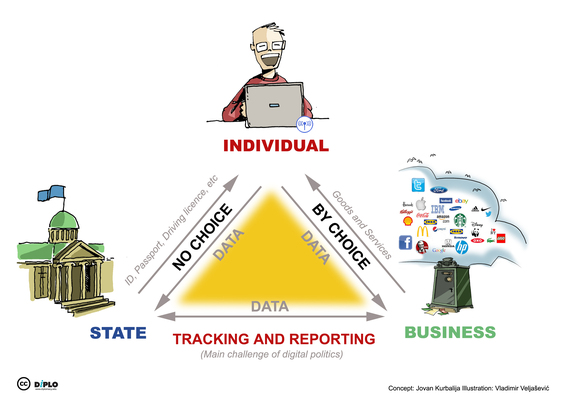
The first triangle is the most fundamental. It’s the invisible contract you’ve signed without ever reading the terms. It maps the flow of your most personal information between the three dominant powers of your life: You, the State, and the Corporation.

2015-04-13-1428958236-247845-prvitrougao.webp

Think about it. The relationship with the state is non-negotiable. To get a driver’s license, to pay taxes, to exist as a citizen, you hand over your data. Name, address, birthdate, social security number. You have no choice. The only way to opt out is to go off the grid entirely, to cease to be a part of society. You are an open book to the government, by decree.

Then there’s the corporation. Here, they tell you it’s a choice. A free exchange. But is it? Really?

Deep Dive: The Illusion of Choice

Every time you click “Accept All Cookies,” you’re not just agreeing to a smoother browsing experience. You’re activating a thousand tiny digital spies that follow you across the web. Every app you download, every smart speaker you talk to, every “free” service you sign up for comes at a price. The price is a piece of you.

Your location history.

Your search queries.

Your private messages.

The photos you take. The people you talk to. The things you whisper you might want to buy.

It’s all being harvested. Siphoned away. The corporations store this data in massive, untouchable server farms. The state stores its data in its own impenetrable databases. They both hold the keys to your digital identity. And what happens when these two titans decide to cooperate?

We’ve already seen the flashpoints. After major crises, governments immediately turn to Big Tech and demand access. They ask for the data. They demand backdoors. And sometimes, the tech giants push back. Remember when Apple fought the FBI over unlocking a phone? Or when the leaders of Google, Facebook, and Yahoo conspicuously skipped a major cybersecurity summit with President Obama years ago? That wasn’t just a scheduling conflict. It was a tremor. A sign of the coming earthquake.

It’s a turf war. A battle between state power and corporate power over who has ultimate control of the most valuable resource on Earth: your data.

Triangle Two: The Golden Loop of Control

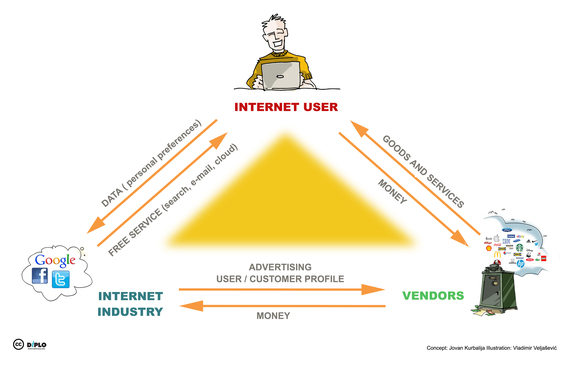
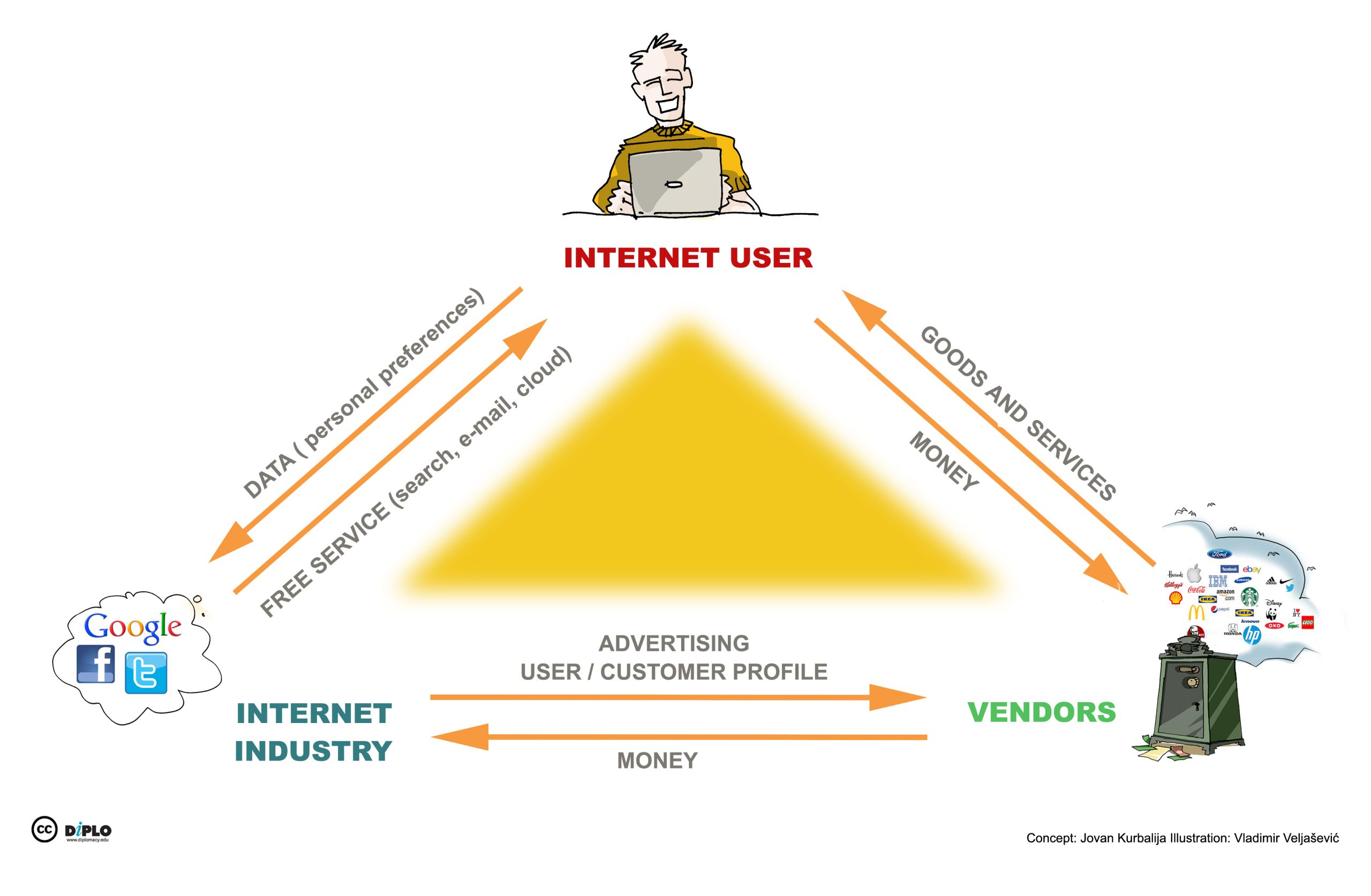
So why do they want your data so badly? It’s not just about knowing things. It’s about building an engine. An invisible machine that runs on your life and spits out trillions of dollars. The second triangle reveals the chillingly simple business model that powers the entire modern internet.

  • You get “free” services (social media, search engines, email). In exchange, you pay with your personal data.
  • The internet industry packages this data, creating a shockingly detailed profile of you—your hopes, fears, desires, and weaknesses. They sell this profile to the highest bidder.
  • Vendors (advertisers) use this profile to sell you things, influencing your decisions in ways you can’t even perceive.

This isn’t just a business model. It’s a perfect, self-perpetuating loop of control.

2015-04-13-1428958069-2583752-drugi_trougao.webp

Deep Dive: You Are The Product

Let’s be brutally honest. When a service is free, you aren’t the customer. You are the product being sold. That “digital profile” of you isn’t just a list of your interests. It’s a psychological model. A data-driven voodoo doll. It knows if you’re feeling lonely, if you’re prone to impulse buys, what political messages will make you angry, and what content will keep you scrolling just a few seconds longer.

This is why your phone feels like it’s listening to you. It doesn’t have to. It already knows what you’re going to think before you do.

This is the engine that creates echo chambers. It’s the machine that allows for surgical-precision political messaging, the kind that can sway elections and tear societies apart. Remember Cambridge Analytica? That wasn’t a bug in the system. That *was* the system, working as intended.

And this explains Big Tech’s greatest fear. It’s not a government subpoena. It’s you. It’s the user losing trust. If enough people realize the true nature of this bargain and start to pull away, the entire golden loop collapses. The machine grinds to a halt. That’s why they fight so hard to maintain the illusion. Their very existence depends on us continuing to believe their services are “free.”

The moment the government demands they share our data on a massive scale, it shatters that trust. It exposes the game. And that’s bad for business. Terribly bad.

Triangle Three: The Shadow War for the Internet’s Soul

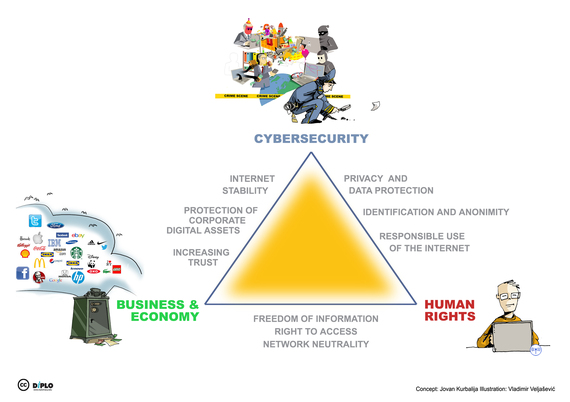
This brings us to the final, most dangerous triangle. This is the battlefield. The arena where the fate of the internet is being decided right now, in secret meetings, in closed-door negotiations, and in the dark corners of cyberspace. It is a three-way cold war between Security, Human Rights, and Profit.

2015-04-13-1428958350-4439360-trecitrougao.webp

Every single digital policy debate, every new law, every headline about privacy or hacking boils down to the clash between these three forces. A new Digital Magna Carta is being written, and each side wants to hold the pen.

Faction One: The State and the Religion of Security

Their mantra is simple: “We must keep you safe.” In the name of fighting terrorism, crime, and foreign influence, governments around the world are pushing for more access, more surveillance, more control. They want backdoors in encrypted messaging apps. They want the ability to track dissidents. They want to know what everyone is saying, all the time. The rule of law, they argue, must extend to the digital realm. But where does security end and total surveillance begin? It’s a line that keeps moving, always in one direction.

Faction Two: The People and the Fading Dream of Freedom

This is us. This is the fight for basic human rights in a digital age. The right to privacy. The right to free expression. The right to exist without being constantly monitored and profiled. This faction is powered by activists, whistleblowers, and everyday citizens who use tools like encryption, VPNs, and secure browsers to carve out small pockets of freedom. But for every step forward, like Europe’s landmark GDPR privacy law, there are ten steps back as the walls of the digital prison grow higher.

Faction Three: The Corporation and the Supremacy of Profit

And then there’s the wild card. Big Tech. They are not on our side. They are not on the government’s side. They are on their own side. Their goal is to protect the “Golden Loop” described in the second triangle. They will champion privacy when it suits them (like when they resist government backdoors, which would erode user trust). But they will lobby ferociously against any privacy laws that threaten their ability to harvest and sell our data. They are the unpredictable third power, siding with whomever best serves their bottom line in the moment.

This three-way war has no clear winner. It’s a constant, grinding conflict. A digital stalemate. And with no grand global agreement in sight, the battlefield is shifting to a new, chaotic arena.

The Glitch in the Matrix: When The System Fails, They Go To Court

What happens when these global power struggles can’t be resolved in secret summits and conferences? The system breaks down. And individuals, companies, and even nations fall back on the oldest tool they have: the law.

Courts around the world are now flooded with digital dilemmas they were never designed to handle. It’s a sign of total system failure. A global policy void.

We’ve seen landmark cases that sent shockwaves through the system. The European Court of Justice’s ruling on the “right to be forgotten” gave individuals a sliver of power to erase their past from search engines. A huge win for human rights, a massive headache for Google’s business model. In the U.S., Microsoft famously challenged a court order demanding it hand over data stored on a server in Ireland, a direct clash between a corporation’s global infrastructure and a nation’s legal reach.

Most recently, the “Safe Harbour” agreement for data exchange between the US and the EU was torn down by the courts, not once, but twice (in its newer “Privacy Shield” form). Why? Because European courts decided that American surveillance practices meant their citizens’ data wasn’t truly safe in the hands of US tech companies. This is not just a legal dispute; it’s a digital declaration of no confidence.

But this is a messy, unpredictable way to build a future. It’s like trying to fix a planetary computer network by suing one broken transistor at a time. The lack of clear, global solutions means the chaos will only get worse.

The Brink of the Triangle

So where does this leave us? Staring into the abyss. The three triangles map out a system in conflict, a machine teetering on the brink of collapse or, perhaps worse, on the verge of a terrifying new form of synthesis.

A grand design won’t save us. The problem is too complex, too messy. Every proposed “solution” seems to create three new problems. But we can’t do nothing.

We must recognize the internet for what it is: a global public resource, like the oceans or the air we breathe. It belongs to all of us. And right now, it’s being polluted by surveillance, strip-mined for profit, and carved up by national interests.

The dynamics mapped in these three triangles are pushing us toward the event horizon of the Digital Bermuda Triangle. A place of fragmentation, where the open, innovative web is shattered into a thousand walled gardens. A place where digital authoritarianism wins. A place where your online self, your data, your history, can be locked away or simply deleted by forces you can’t see and don’t control.

The battle lines are drawn. The pillars of control are in place.

The only question left is: when the world you know goes digital for good, whose rules will you be living by?

Arindam Mukherjee
Arindam Mukherjee
Arindam loves aliens, mysteries and pursing his interest in the area of hacking as a technical writer at 'Planet wank'. You can catch him at his social profiles anytime.
RELATED ARTICLES
- Advertisment -

Most Popular

Recent Comments

Warren Pan Abbott on The legend of the Devil Monkey !
chris davies on The McPherson Tape Mystery
Reed Reedly on ET has Internet!
Bea Houseoffashion on Proof Of Time Travellers – Gallery
Marcus2012 on ET has Internet!
Reed Reedly on ET has Internet!
LaughsAtConspiracyNuts on The 9/11 Conspiracy – Myths and Facts
Alex Sliverman on Did the ancients fly?
Doctor Wholigan on Time Traveler in 1938 film
chris davies on The McPherson Tape Mystery
Archie1954 on 10 secret UFO hideouts
chris davies on Ghosts of flight 401
Marcus2012 on ET has Internet!
jason Macdonald on Proof of Time Travel? – China
chris davies on Long-Lost Pyramids Found?
Reed Reedly on ET has Internet!
Milkman on Connected Universe
Tenmiles on Baigong Pipes Mystery
Simon Foster on Sirius – The Documentary
From the 1st April on 2013 – Alien Contact date ?
SkyWatcher on Is ET ignoring us?
I Come From The Future on Obama to make UFO Alien disclouser soon ?
Just another person on 2013 – Alien Contact date ?
Malcolm Windowcleaner on The strange case of Rudolph Fentz
Mason Servio on Strange Things on Mars
Marke Wisdom Seeker on What will we find as arctic melts?
Andrea A Elisabeth Levyne on Aliens Captured in Varginha, Brazil
Mitch Grouyeki on Amazing Space Shuttle pictures