The Giant’s Footprint: Is This the Smoking Gun for Bigfoot’s Existence?
It always starts with a footprint.
Imagine it. You’re deep in the misty forests of the Pacific Northwest, miles from any road. The air is thick with the scent of pine and damp earth. And then you see it. Stamped into the mud is a depression so large, so impossibly human-like, that your mind struggles to process it. It’s not a bear. It’s not a prank. It’s a footprint. A giant’s footprint.
For decades, these massive tracks have been the calling card of North America’s greatest mystery: Sasquatch. They are the most common, most tangible, and most hotly debated pieces of evidence in the entire cryptozoological world. To believers, they are the undeniable proof of a hidden species of upright-walking ape. To skeptics, they are nothing more than a collection of elaborate hoaxes and misidentifications.
But the story is so much more complicated than that. Some of these prints contain anatomical details so specific, so biomechanically sound, that faking them would require a level of scientific genius far beyond a simple wooden foot-stomper. So what’s the real story? Are we looking at the footprints of a ghost? Or the last lingering traces of a flesh-and-blood giant hiding just beyond the treeline?
Let’s follow the tracks.
How a Single Set of Tracks Created a Legend
The name itself says it all. “Bigfoot.”
It wasn’t always the creature’s name. For centuries, indigenous peoples told stories of wild giants in the woods—Sasquatch, the “Wild Man of the Woods.” But the modern legend, the one that captured the world’s imagination, was born in 1958 in Humboldt County, California.
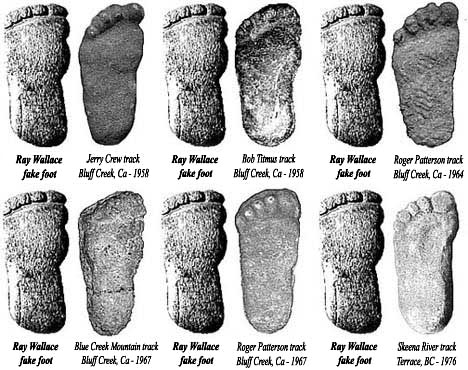
A bulldozer operator named Jerry Crew was working on a remote logging road when he stumbled upon a set of enormous, 16-inch human-like footprints pressed deep into the dirt around his worksite. They were everywhere. The tracks seemed to belong to a creature of immense weight that walked on two legs. The workers were spooked. Equipment was being moved around at night. They felt watched.
Crew, more curious than scared, made a plaster cast of one of the prints. He took it to the local newspaper, the Humboldt Times. The editor, Andrew Genzoli, looking for a catchy headline, jokingly scribbled a new name for the mysterious creature. Bigfoot. The story went viral. It was picked up by the Associated Press and blasted across the country. An American legend was born, not from a sighting, but from the simple, undeniable evidence of a footstep.
“It’s Just a Bear!” …Or Is It?
The most common dismissal you’ll hear is simple. It’s a bear track. Bears have big feet. They can even walk on two legs for short distances. Case closed, right?
Wrong. Not even close.
While a black bear’s rear paw can look vaguely human-like, the differences become glaringly obvious when you know what to look for. A bear track is widest at the toes, tapering back toward a narrow heel. A classic Bigfoot track, however, is shaped much like a massive human foot—blocky, with a defined ball and a broad, robust heel. The weight distribution is completely different.
But the real giveaway is the gait. When a bear walks, its rear foot often partially overlaps the print of its front foot, creating a messy, confusing track that can sometimes look like one giant foot. This is called “over-stepping.” But a true Sasquatch trackway shows a clear, bipedal stride—a left foot, then a right foot, then a left foot, in a straight line. The stride, the distance between the prints, can be staggering. Four, five, even six feet apart. This suggests a creature with incredibly long legs, walking with an efficient, powerful gait that a bear simply cannot replicate.
Deep Dive: The Impossible Anatomy in the Mud
This is where things get truly strange. Serious researchers, like Dr. Jeff Meldrum, a professor of anatomy and anthropology at Idaho State University, don’t just look at the shape of a print. They look for signs of a living, breathing, functioning foot. And what they’ve found in some of these casts is mind-blowing.
Two key features stand out:
- The Midtarsal Break: This is the big one. Your foot has a rigid arch, designed to act like a spring when you walk. Apes, however, have a flexible joint in the middle of their foot—a “midtarsal break”—that allows them to grab onto tree branches. In several of the most compelling Bigfoot casts, there is clear evidence of this flexible joint. You can see a pressure ridge in the middle of the print, showing where the foot bent as the creature pushed off the ground. This isn’t something a hoaxer with a wooden foot would even think to include. It’s a subtle, functional anatomical detail that points to a non-human primate foot.
- Dermal Ridges: These are the “fingerprints” of the foot. The tiny ridges and sweat pores that cover the soles of our feet and hands. Under magnification, some of the best-preserved casts show evidence of dermal ridges. They flow across the sole in patterns consistent with a primate foot, not a carved fake. Critics claim these could be artifacts from the plaster or sand grains, but proponents argue the detail is too fine, too organized, to be anything but the real deal. Faking dermal ridges on a 17-inch foot would be a monumental undertaking.
When you find a trackway showing a five-foot stride, with prints sunk deep into the soil implying a weight of over 600 pounds, and those prints contain evidence of a midtarsal break and dermal ridges… you are no longer in the realm of a simple hoax.
The Patterson-Gimlin Film: Footprints in Motion
You can’t talk about Bigfoot without talking about the Patterson-Gimlin film. That grainy, 60-second clip from 1967 shows a large, hairy, bipedal creature striding across a sandbar in Bluff Creek, California. It’s the most-analyzed piece of supposed Bigfoot evidence in history.
But what often gets lost in the debate over the creature in the film—”Patty,” as she’s affectionately known—is what Roger Patterson and Bob Gimlin did immediately after filming. They cast the footprints she left behind.
Those casts are now considered the “gold standard” by many researchers. They are the Rosetta Stone of Bigfoot tracks. Why? Because they perfectly match the subject in the film. The proportions, the stride, and the unique way the creature walks—a fluid, bent-knee “compliant gait”—all line up with the physical impressions left in the sand.
The Bluff Creek casts show the anatomical details we just discussed. A pronounced double-ball of the foot, indicative of that midtarsal flexibility. The depth of the prints confirmed the massive weight needed to match the creature’s muscular build seen on film. It’s a closed loop of evidence: the film shows the creature making the tracks, and the tracks confirm the strange anatomy of the creature in the film. For believers, this is as close to a smoking gun as it gets.
The Chaos of Fakes and Freaks
So, are all tracks this perfect? Absolutely not. And that’s a huge problem.
For every compelling cast like the ones from Bluff Creek, there are a hundred others that are… weird. The original post was right. The field is littered with inconsistencies. Some alleged Bigfoot tracks have five toes, but others show two, three, four, or even six toes. Some are perfectly flat-footed; others have arches that would make a podiatrist weep. The toes can be splayed wide or squished together.
What does this mean? One of two things.
One: The vast majority of tracks are fakes. It’s an unfortunate truth. Ever since Jerry Crew’s story broke, pranksters have been stomping around the woods with giant wooden feet, muddying the waters for serious investigators. The sheer volume of obvious hoaxes makes it easy for skeptics to dismiss everything.
Two: We could be looking at more than one type of creature. Is it possible that the six-toed prints from one region belong to a different subspecies than the five-toed creatures from another? It’s a fringe idea, but in a world where we’re already discussing giant undiscovered apes, is it really that much of a stretch? Or maybe we’re just seeing the natural variation within a species, like how human feet come in all shapes and sizes. The problem is, without a type specimen—a body—it’s all just speculation.
The Skookum Body Cast: A Creature’s Clever Mistake?
Not all prints are from feet. In September 2000, something truly bizarre was found. An expedition team from the Bigfoot Field Research Organization (BFRO) was in the Skookum Meadows area of Washington’s Gifford Pinchot National Forest. They had set out a pile of fruit as bait, hoping to lure in a creature.
They didn’t get footprints. They got something far stranger.
Next to the bait station was a massive impression in the mud. It wasn’t a footprint. It was a body print. It appeared as though a huge animal had laid down on its right side, propping itself up on its forearm and elbow, to reach over and delicately pick fruit from the pile. The resulting cast, known as the Skookum Body Cast, is enormous—roughly 3.5 feet by 5 feet—and shows the clear impression of a forearm, a hip, a thigh, and part of a buttock. Even hair impressions were found in the cast.
The logic proposed by the team was fascinating. The creature was intelligent. It knew that leaving footprints was risky. So, to avoid stepping in the soft mud and leaving behind its tell-tale tracks, it laid down on the more solid bank to reach the food.
But this explanation immediately raises a huge red flag, as the original post correctly pointed out. If the creature was so smart and so careful about not leaving footprints, why would it then leave a gigantic, fifteen-square-foot full-body impression? It’s like a burglar wearing gloves to avoid leaving fingerprints, but then leaving behind his driver’s license.
Skeptics were quick to pounce. The most common counter-theory is that the impression is nothing more than an elk wallow—a muddy pit where an elk laid down and rolled around. The “body parts” are just a form of pareidolia, our brain’s tendency to see patterns (like faces in clouds) where none exist. The hair samples, upon analysis, were identified as belonging to known animals like elk and bear. Yet, Dr. Meldrum and others who have studied the cast maintain that the contours are too anatomically specific to be a random animal wallow.
The Skookum Cast remains one of the most controversial artifacts in Bigfoot history. Is it the single greatest piece of evidence ever found, revealing the size, anatomy, and intelligence of Sasquatch? Or is it just a muddy hole that looks a bit like a monster?
The Hunt in the 21st Century
The search for Bigfoot’s tracks has gone high-tech. The days of simply stumbling across a print are being supplemented by new methods. Researchers are now using drone technology to survey remote areas for trackways that would be invisible from the ground. Environmental DNA (eDNA) is another exciting frontier. The idea is to take soil samples from deep within a suspected track and test it for unknown primate DNA. If a creature left a track, it likely left skin cells behind, too.
Internet forums like Reddit and countless YouTube channels are now filled with amateur researchers sharing their latest finds. This has brought more eyes into the woods than ever before, but it has also led to a new wave of digital trickery and misidentification. It’s harder than ever to separate the signal from the noise.
The fundamental mystery, however, hasn’t changed. The tracks are still out there. In the mud, in the snow, in the soft earth of the deep woods. They are silent, profound, and deeply unsettling. They ask a simple question that science has yet to answer.
What made them?
Each print is a puzzle. A challenge to our understanding of the world. It’s a whisper from the wilderness that maybe, just maybe, we are not as alone as we think we are. The evidence is right there, at our feet. The only question is whether we’re willing to look down and see it.