The Astronaut, The Tweet, and The ‘Alien’ Hiding in Plain Sight
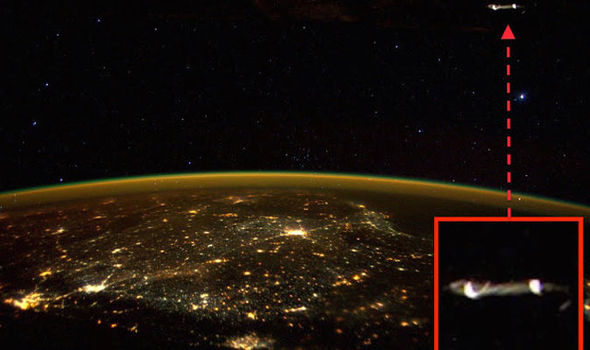
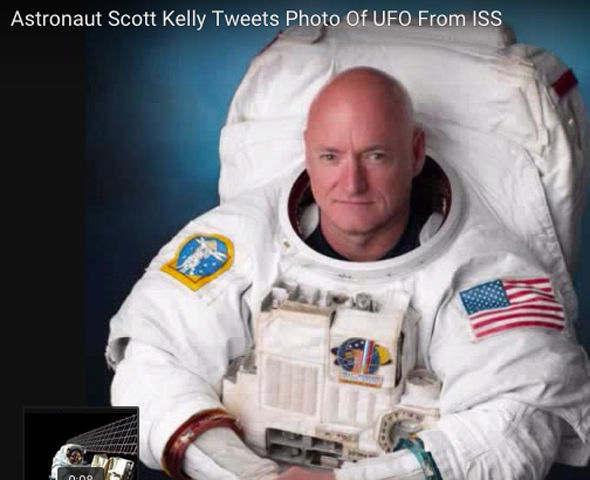
It starts with a simple click. A moment frozen in time, 250 miles above the Earth. The world sleeps below, a tapestry of glittering lights against the velvet black of the Indian subcontinent. Aboard the International Space Station, a lone figure floats by the window, camera in hand. That man is Scott Kelly, a veteran NASA astronaut on Day 233 of a mission that would shatter American records for endurance in space.
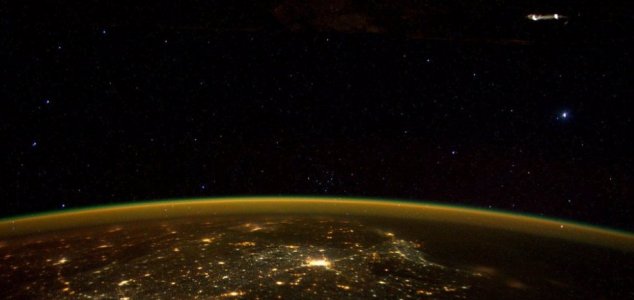
He raises the camera. Snaps a picture. A breathtaking view of Southern India from orbit. He taps out a quick, poetic message for the millions following his journey back on the ground: “Day 233. Once upon a #star over Southern India. #GoodNight from @space_station! #YearInSpace”
And then he hits “send.”
In that instant, a simple goodnight message became a firestorm. A puzzle. A piece of evidence in a cosmic trial that has been raging for decades. Because tucked away in the upper right-hand corner of that beautiful photograph was something else. Something that didn’t belong. Something long, structured, and lit. Something that, to thousands of eager eyes, looked undeniably… alien.
Anatomy of an Anomaly
At first, no one saw it. The tweet, posted on November 15, 2015, was flooded with replies praising the stunning photography. But then, the internet did what it does best. It looked closer.
Somebody zoomed in. And there it was.
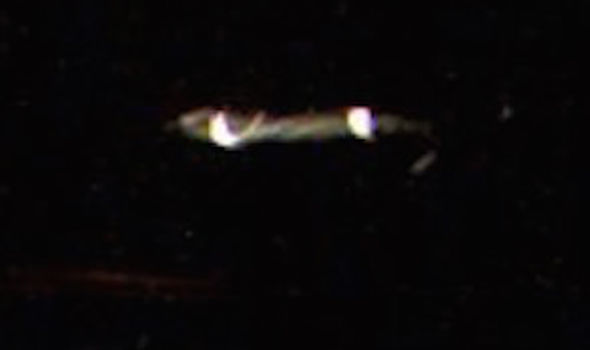
Hanging in the black void of space, far above the planet’s atmospheric haze, was a distinct object. It wasn’t a star. It wasn’t a satellite. It was a cigar-shaped form, seemingly metallic, with what appeared to be two bright, distinct lights on either end. It was so clear. So obvious. How could anyone miss it?
The question wasn’t just *what* it was. The question was, did Scott Kelly know it was there?
Immediately, the digital world fractured into two camps. On one side, the skeptics armed with logic and physics. On the other, the believers, fueled by a deep-seated conviction that we are not alone, and that this was the proof they’d been waiting for.
A Coded Message From Orbit?
For the UFO community, this was no accident. This was a message. A calculated leak from a man on the inside. They claimed Scott Kelly, a decorated astronaut bound by oaths of secrecy, was using the plausible deniability of a simple photograph to tell the world what he couldn’t say out loud: They are here.
Think about it. An astronaut of his experience would know every inch of his view. He would recognize a piece of the space station, a reflection, a camera flare. So for him to post *this* specific photo, with *that* object so prominent? It felt deliberate.
Online forums lit up. YouTube channels dedicated to extraterrestrial phenomena went into overdrive. They grabbed the image, blew it up, and ran it through every filter imaginable.

The analysis was meticulous. The object appeared to be huge, possibly hundreds of feet long. Its construction seemed artificial, not a random piece of space junk or a meteorite. The two lights were perfectly spaced, suggesting a powered, controlled craft. This wasn’t some blurry blob; it was a machine.
YouTube channel Sonofmabarker was one of the first to break it down, his narration echoing the thoughts of thousands. “In the upper right of the photo you can clearly see a large object with two lights on each end,” he explained. “It also appears to be very large and constructed. I would find it hard to believe that Scott Kelly did not notice this when he tweeted this out. It really sticks out like a sore thumb.”
He ended with a direct thank you to the astronaut, as if acknowledging a secret correspondence. “Scott Kelly thank you for sending this photo down to Earth.”
This wasn’t just about one photo. It was about a pattern. Believers pointed to a long history of astronauts reporting strange sightings, from Gordon Cooper’s claims of seeing a green orb during the Mercury program to Edgar Mitchell’s adamant post-career statements about an alien presence and a government cover-up. Was Kelly just the latest in a long line of cosmic whistleblowers?

The argument was powerful. The photo was real. The man who took it was unimpeachable. The object was, to put it mildly, weird. For many, the case was closed.
The Skeptic’s Corner: A Trick of Light and Glass
But hold on. Let’s not call for a planetary welcome wagon just yet. As the believers celebrated their bombshell evidence, the debunkers and skeptics were already hard at work, picking apart the narrative with cold, hard science.
Their explanation wasn’t as exciting. It wasn’t as cinematic. But it was, they argued, far more likely.
DEEP DIVE: The Cupola and its Ghosts
The International Space Station’s Cupola is the window to the world for astronauts. It’s a marvel of engineering, a seven-sided dome providing a 360-degree view. But it’s not a simple piece of glass. It’s made of multiple, thick panes of fused-silica and borosilicate glass to protect against micrometeoroids and the extreme temperatures of space. And where you have multiple layers of glass, you have reflections.
The number one theory from the skeptical side is simply this: the “UFO” is a reflection of something *inside* the ISS, caught on the windowpane.
What could it be? The lights and shape are oddly consistent with a part of the station itself, perhaps a piece of equipment or even a panel with two small LED indicator lights. Astronauts are surrounded by complex machinery, all of it with its own lights, screens, and reflective surfaces. A high-contrast photo—the bright lights of India against the pitch-black of space—is the perfect environment to capture a faint, out-of-focus reflection on the glass.
Another, even more specific theory emerged. Some experts suggested the object was a reflection of the High-Definition Earth Viewing (HDEV) experiment, which is mounted on the exterior of the station. Its shape and the placement of its components could, from the right angle and under the right lighting, create a reflection that looks suspiciously like a “cigar-shaped craft.”
So, was it a visitor from another world? Or was it just the ghost of a nearby instrument caught in the glass? The answer is far less romantic, but potentially the truth.
The Official Story (And Why It Doesn’t Matter)
Eventually, the noise grew so loud that Scott Kelly himself had to respond. In a subsequent interview, he was asked directly about the “UFO” in his photo. His answer was quick, simple, and for believers, entirely unsatisfying.
He said it was likely a reflection from the window shutters of the Cupola, which he often kept partially closed to block out the sun’s glare.
Case closed, right? The man who took the photo explained it away. Nothing to see here, folks. Move along.

Wrong. For the conspiracy-minded, this was the final piece of the puzzle. Of *course* he would deny it. What else could he say? He’s a government employee, a military man, and a public figure. Admitting he photographed an alien ship would cause global panic and end his career. His denial, in a strange way, was seen as confirmation. It was the “official story” meant to placate the masses while the truth remained hidden.
This is the fundamental disconnect. One side sees a simple, logical explanation. The other sees a textbook move from the global cover-up playbook. The evidence becomes whatever you want it to be.
This incident also plays into a much larger, more troubling pattern for UFO researchers: the infamous NASA live feed cuts.
The Bigger Picture: NASA’s Trigger Finger
For years, citizen sky-watchers have monitored the live video feeds from the International Space Station, hoping to catch a glimpse of something extraordinary. And time and time again, just as a strange light or an unexplainable object drifts into view, the feed mysteriously cuts out. A blue screen appears. “Signal Lost.”
Coincidence? Or censorship?

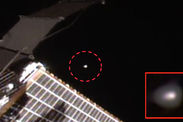
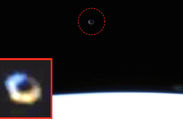
Cases are legendary in the community. The STS-75 “Tether Incident” in 1996, where a broken satellite tether was suddenly swarmed by dozens of glowing discs. The STS-48 mission, where a flash of light appears to divert an object moving at incredible speed. More recently, countless clips show small, metallic orbs moving in formation or “donut-shaped” anomalies hovering near the station before the feed conveniently dies.

NASA’s official explanation is always mundane. Signal handovers between satellites. Loss of connection. Equipment malfunction. But the timing is always… perfect. Too perfect. It has created a deep and abiding mistrust. The perception is that NASA isn’t just a scientific organization; it’s a gatekeeper, hiding the most profound secret in human history.
Scott Kelly’s photo doesn’t exist in a vacuum. It exists in this context of cut feeds, historic sightings, and official denials. It’s another log on a fire that has been burning for over 70 years.
What If They’re Right?
Let’s play devil’s advocate for a moment. Let’s ignore the reflections and the official denials. What if the believers are 100% correct?
What if, on Day 233 of his mission, Scott Kelly looked out the window and saw a massive, artificially constructed vehicle from another star system hovering in orbit? What would that mean?
It means they are here, and they are bold. To park a craft that large so close to the ISS isn’t stealthy. It’s a statement. It’s like a foreign submarine surfacing next to an aircraft carrier. It implies a level of technology so far beyond our own that they have no fear of our detection or our response.
The cigar shape is a classic in Ufology, reported for decades. Is it a standard design for an interstellar scout ship? A transport? A drone? The lights on either end could be propulsion systems, navigation markers, or something we can’t even comprehend.
And if Kelly *did* knowingly photograph it, what was his motive? Was it a planned moment of soft disclosure, coordinated with elements within the government tired of the secrecy? Or was it a spontaneous act of defiance, a man so moved by what he saw that he had to share it, consequences be damned?
The implications are staggering. It changes everything we know about our place in the universe. It re-frames human history. It’s the biggest story of all time, hidden in plain sight in a single tweet.
A Mystery That Endures
In the end, the photograph remains. It is a Rorschach test in orbit. A digital inkblot where one person sees a reflection and another sees a revelation.
The truth is, we will likely never know for certain what was floating in the dark that day. There will be no definitive proof, no government confession stemming from this single image. The story of Scott Kelly’s UFO has now passed into legend, a favorite piece of evidence for some, and a classic example of misidentification for others.
But the mystery is what keeps us looking up. It’s what drives us to question the official story and to search for answers on our own.
So, take another look at the photo. Zoom in. Stare into the blackness above the glittering lights of a sleeping world. What do you see? A trick of light and glass? A digital ghost in the machine?
Or do you see a silent visitor, watching us from the void, captured for one fleeting moment by an astronaut’s camera before it slipped back into the shadows?