Sunday, May 10, 2026
HomeUnexplained MysteriesAncient MysteriesAncient cave paintings show unexplained knowledge of solar system

Ancient cave paintings show unexplained knowledge of solar system

The Tennessee Time-Capsule: Did Ancient Americans Map Other Dimensions on Cave Walls?

Forget everything you think you know about “caveman art.”

We’re taught to imagine crude stick figures, simple hunting scenes scrawled with charcoal by primitive people. A charming, but ultimately simple, record of a forgotten time. But what if that’s a lie? What if some of the oldest art in North America isn’t a diary, but a map? Not a map of the land, but a map of reality itself.

Deep within the rugged, unassuming landscape of Tennessee’s Cumberland Plateau, a secret history is written in stone. It’s a story not of hunts and harvests, but of multiple dimensions, of celestial beings and underworld monsters, of life and death, and of the fragile human world caught in between. A team of researchers, hacking their way through academic dogma, has stumbled upon a vast, interconnected system of art that suggests ancient Native Americans didn’t just live on the earth—they understood its place in a layered, multi-dimensional cosmos.

This isn’t just art. It’s a cosmic instruction manual. And we’re only now beginning to turn the first page.

A Secret Language Etched in Stone

The breakthrough didn’t happen in a single, dramatic moment. It was a slow burn. The result of years of painstaking work by people like Jan Simek, an archaeologist at the University of Tennessee, who refused to accept the easy answers. For decades, experts had seen these drawings. They’d cataloged them. They’d noted the strange bird-men and the swirling suns. But they were seen as isolated pieces of a forgotten puzzle.

Simek and his team did something different. They looked at the *entire system*. They analyzed 44 open-air locations and 50 cave sites, treating them not as separate galleries, but as chapters in the same epic story. And a shocking pattern began to emerge.

The placement wasn’t random. Not at all. It was deliberate. Meticulous. The art was organized by a single, powerful idea: the universe is not one thing, but three. An Upper World. A Lower World. And our world, the Middle World, sandwiched right in the middle.

“The subject matter of this artwork, what they were drawing pictures of, we knew all along was mythological, cosmological,” Simek explained. “They draw pictures of bird men that are important characters in their origin stories and in their hero legends, and so we knew it was a religious thing.” But the connection to the physical landscape itself? That was the game-changer. They realized the ancient artists were using the very geography of the plateau—its high, sun-beaten cliffs and its deep, lightless caves—as a canvas to paint their understanding of existence.

Some of these spiritual blueprints date back a staggering 6,000 years. But the bulk of this incredible library of stone-etched knowledge comes from a more recent, and profoundly sophisticated, period between the 11th and 17th centuries.

Journey to the Upper World: The Sun-Drenched Realm of Gods

Imagine being an artist or a shaman a thousand years ago. To commune with the gods, you had to go to their home. You had to climb.

The art of the Upper World is found exclusively in high, open-air places. Sun-drenched bluffs, cliff faces that touch the sky, places where you feel closer to the heavens than to the earth below. These were not casual galleries. They were sacred spaces, altars open to the elements. Here, the artists depicted the forces that governed their lives from above. Swirling patterns could represent the winds and the unseen powers of the air. Zig-zags might be lightning, the raw power of the storm gods. And everywhere, there are suns.

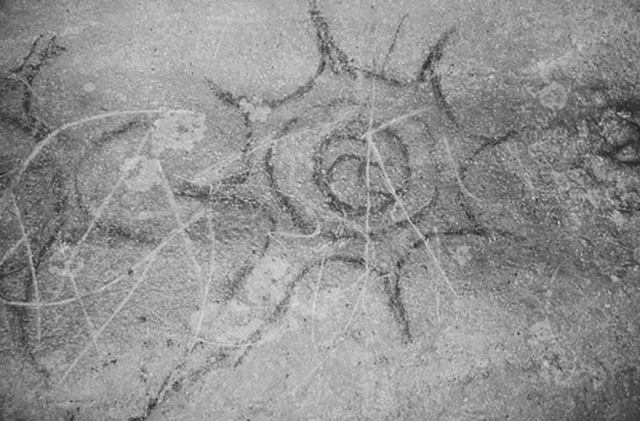
20130707-145613.webp

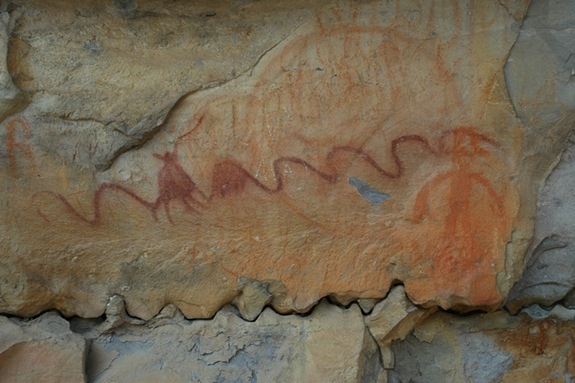
Look at the image above. Is it just a sun? Or is it a being? A conscious entity, watching over the world of mortals. This is the kind of art you find in the Upper World—powerful, celestial, and teeming with life. This is the domain of the Thunderers, the great bird-spirits who brought the rain, and other characters who could influence the human world with fortune or famine.

And these celestial beings were almost always painted in one color. Red.

Why red? Think about it. Red is the color of blood. The color of life itself. It’s the color of the rising and setting sun, the moments when the sky seems to bleed with divine fire. The pigment itself, red ochre, was ground from iron-rich earth—the very lifeblood of the land. By using red, the artists weren’t just drawing a picture; they were infusing the rock with the very concept of vitality, power, and celestial energy.

The Underworld Beckons: Into the Caves of Perpetual Night

For every world of light, there is a world of shadow. And to find it, the ancient people of Tennessee knew you had to go down. Deep down.

The art of the Lower World is found in the one place the sun can never touch: the absolute, silent, chilling darkness of a cave. Step inside one of these portals and the world you know vanishes. The temperature drops. All sound is muffled. The air grows heavy. You have left the land of the living. You are an intruder in another reality.

Here, the art changes dramatically. Gone are the suns and the life-giving birds. In their place are creatures of darkness, death, and danger. Winding serpents, a symbol of the underworld in many cultures. Strange, skeletal figures. Creatures that defy categorization—monsters from a collective nightmare, given form on the damp cave walls. This was the realm associated with chaos, the night, and the spirits of the dead.

And the color? Black.

The black pigment came from charcoal from long-dead fires or from manganese scraped from the earth. It is the color of the void. The color of finality. The color of the unknown. Characters drawn in black were figures of immense power, but a different kind of power. One to be feared, respected, and kept at a distance. These were not gods you prayed to for a good harvest. These were the things that lurked just beyond the firelight.

Our Reality: The Middle World, Caught Between Two Fires

So where did humanity fit into this grand cosmic scheme? We were in the Middle World. The art representing our reality is the most diverse, found at mid-level elevations on the plateau, both on open rock faces and just inside the mouths of caves. It existed on the boundary, a reflection of our own existence, forever caught between the powers of the sky and the dangers of the deep.

Here we see depictions of animals that shared the land with humans—deer, birds, fish. But we also see something else. We see the travelers. The boundary-walkers.

“The dominant things we see all together are human images, what we call anthropomorphs,” Simek observed. “They’re not all human; some of them are clearly mythological people or people who blend animal and human characteristics.”

This is the key. The Middle World was a stage, as Simek says, for “heroes, monsters and creatures that could cross between the levels.” Shamans with bird-like heads, suggesting their ability to fly into the Upper World in a trance state. Figures with serpentine features, hinting at a journey into the dark below. These weren’t just people. They were intermediaries. Messengers. Souls in a state of transformation.

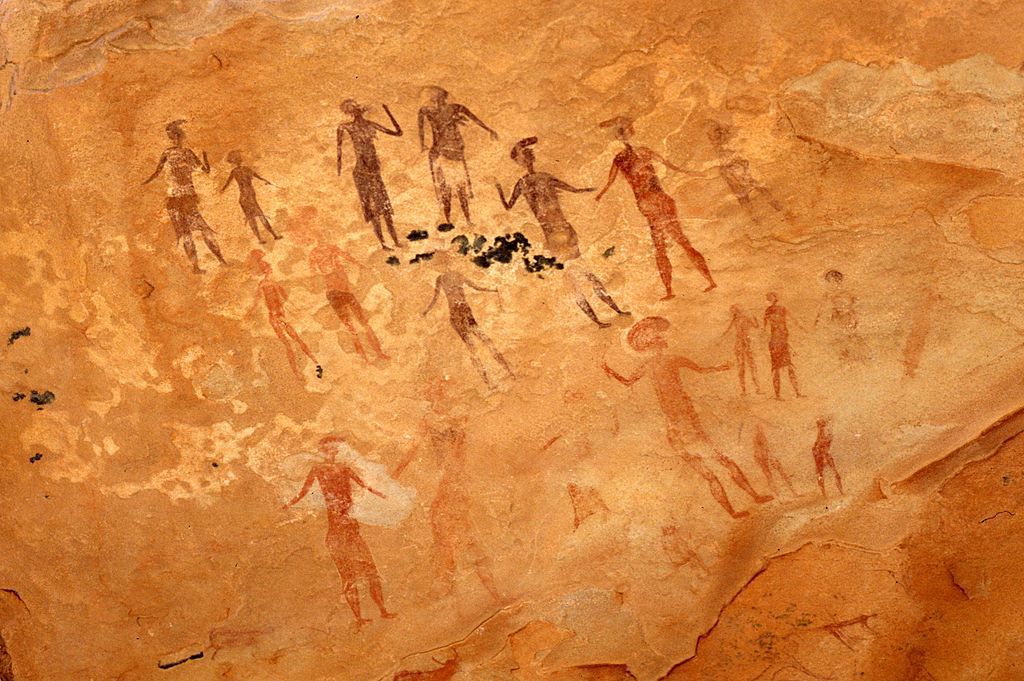
20130707-145813.webp

The figures in the image above could be heroes from a forgotten epic, warriors preparing for a spiritual battle, or shamans enacting a sacred ritual. They exist in our world, the Middle World, but their actions have consequences that ripple across all three layers of reality. They are the living bridge between the heavens and the abyss.

Deep Dive: Unmasking the Mississippian Masters

So who were these master artists, these cosmic cartographers? The timeline, particularly from the 11th to 17th centuries, points directly to the incredible and often overlooked Mississippian Culture.

This wasn’t a single tribe, but a sprawling network of societies that flourished across the American Southeast. They were master farmers, brilliant engineers who built massive earthen mounds like the legendary city of Cahokia, and they were bound together by a complex and powerful belief system. Academics call this the Southeastern Ceremonial Complex (SECC). Think of it as a shared religious framework, a common language of symbols and myths that everyone understood.

And at the very heart of the SECC was the concept of a three-tiered cosmos. The art on the Cumberland Plateau isn’t some isolated, local belief. It’s a regional masterpiece, a perfect expression of the core philosophy that guided millions of people for centuries. Famous SECC symbols, like the Forked Eye Motif (representing the keen sight of a bird of prey) or the Hand-and-Eye, were all part of this visual language. These weren’t just random decorations; they were glyphs loaded with meaning, all pointing back to the fundamental structure of the universe: Upper, Middle, and Lower.

Modern Theories: Are These More Than Just Maps?

This is where the story takes a turn, leaving the halls of academia and diving headfirst into the world of modern mystery. The evidence for a cosmological map is compelling. But what if it’s more than that?

Internet forums and alternative history circles are buzzing with a more radical idea. What if these sites aren’t just *depicting* different worlds? What if they are marking the locations of actual *portals* to them?

Think about it. The symbolism is too perfect. The Upper World art is at the highest points, closest to the sky. The Lower World art is deep within the earth, in places that feel like gateways to another place entirely. Could the ancient shamans have been doing more than just drawing? Could they have been practicing a form of ritual magic, using these sacred locations to literally project their consciousness—or even their physical bodies—into these other realms?

This idea connects directly to the concept of the shamanic journey, a practice found in indigenous cultures all over the world. Through drumming, chanting, or the use of psychoactive plants, a shaman enters an altered state of consciousness to travel to other realities, to bargain with spirits, heal the sick, and retrieve lost souls. The creatures depicted in the art—the bird-men, the serpent-people—could be representations of the shaman’s spirit animal or the form they take during these otherworldly travels.

Are we looking at a religious text? Or a travel guide for interdimensional explorers? The line begins to blur.

The most fascinating part is that this worldview isn’t unique. The Norse had Yggdrasil, the world tree connecting the Nine Realms. Mayan cosmology is famously complex, with its own upper and lower worlds. This three-tiered structure appears again and again in human belief systems, separated by thousands of miles and thousands of years. Is it a coincidence? Or are all these ancient cultures describing a fundamental truth about the nature of reality that our modern, materialistic society has forgotten?

The rocks on the Cumberland Plateau don’t speak in words, but their message is becoming clearer. They show us a world that was once alive with magic, a world where the veil between realities was thin, and where certain people had the keys to walk between them.

What we see as simple art may be the faint echo of a lost science. A technology of the soul. These drawings aren’t just pictures of gods and monsters. They are a challenge. A whisper from the past, daring us to consider that the world is far stranger, far older, and far more complex than we can possibly imagine. They ask us a simple, terrifying question: If other worlds exist right alongside our own, separated only by a veil of perception… what happens when that veil is torn?

Amit Ghosh
Amit Ghoshhttps://coolinterestingnews.com
Aloha, I'm Amit Ghosh, a web entrepreneur and avid blogger. Bitten by entrepreneurial bug, I got kicked out from college and ended up being millionaire and running a digital media company named Aeron7 headquartered at Lithuania.
RELATED ARTICLES
- Advertisment -

Most Popular

Recent Comments

Warren Pan Abbott on The legend of the Devil Monkey !
chris davies on The McPherson Tape Mystery
Reed Reedly on ET has Internet!
Bea Houseoffashion on Proof Of Time Travellers – Gallery
Marcus2012 on ET has Internet!
Reed Reedly on ET has Internet!
LaughsAtConspiracyNuts on The 9/11 Conspiracy – Myths and Facts
Alex Sliverman on Did the ancients fly?
Doctor Wholigan on Time Traveler in 1938 film
chris davies on The McPherson Tape Mystery
Archie1954 on 10 secret UFO hideouts
chris davies on Ghosts of flight 401
Marcus2012 on ET has Internet!
jason Macdonald on Proof of Time Travel? – China
chris davies on Long-Lost Pyramids Found?
Reed Reedly on ET has Internet!
Milkman on Connected Universe
Tenmiles on Baigong Pipes Mystery
Simon Foster on Sirius – The Documentary
From the 1st April on 2013 – Alien Contact date ?
SkyWatcher on Is ET ignoring us?
I Come From The Future on Obama to make UFO Alien disclouser soon ?
Just another person on 2013 – Alien Contact date ?
Malcolm Windowcleaner on The strange case of Rudolph Fentz
Mason Servio on Strange Things on Mars
Marke Wisdom Seeker on What will we find as arctic melts?
Andrea A Elisabeth Levyne on Aliens Captured in Varginha, Brazil
Mitch Grouyeki on Amazing Space Shuttle pictures