Mars Isn’t What They Told You: The Hidden History of a Lost World
Forget the textbooks. Forget the dry, sanitized documentaries you watched in school. The story of Mars they’ve been feeding us for decades is, at best, a half-truth. A lie of omission.
They paint a picture of a simple, dead world. A rusty globe spinning silently through the void.
They call it the “Red Planet.”
A fitting name, they say, for a world named after the Roman god of war. Its surface is just iron oxide—rust, basically. A planet that died billions of years ago. It has a thin atmosphere, they explain, and a few craters and valleys. Nothing to see here, folks. Just a cold, empty desert.
They’ll even throw some geology at you to make it sound official. They’ll talk about its dense metallic core of iron and nickel, a silicate mantle that’s now dormant, and a crust thicker than Earth’s. It’s all designed to sound incredibly thorough. Incredibly… final. The case is closed. Mars is dead.
But what if it isn’t?
What if the story is infinitely more complex, more shocking, and more profound than we’ve ever been led to believe? What if the clues to a lost chapter of solar system history are hiding in plain sight, buried under that red dust? The truth has been trickling out, bit by bit, for years. And it all starts with one simple, life-giving substance.
Water.
Hidden Water, Hidden Life? The Day the Official Story Broke
For decades, the official line was firm: Mars is bone dry. Any water that might have once existed was ancient history, locked away in frozen polar ice caps. The planet’s thin atmosphere and freezing temperatures made liquid water on the surface impossible. Period. End of story.
Then, in 2015, the official story began to unravel.
NASA, almost reluctantly, held a press conference. The announcement was stunning. They had found evidence of modern, flowing liquid water on the surface of Mars. Not ancient water. Not ice. Liquid water. *Now*.
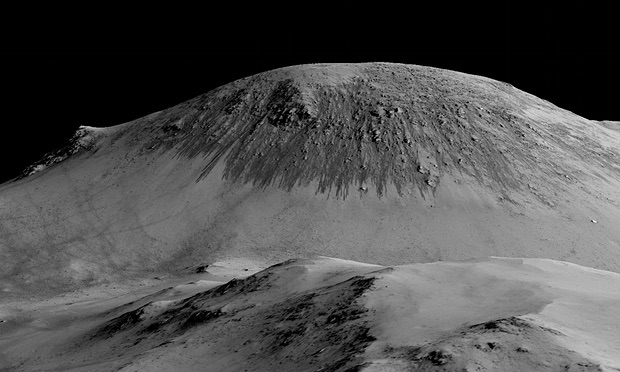
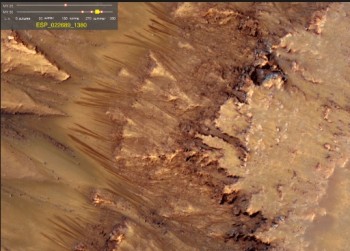
They called them “Recurring Slope Lineae” (RSL). That’s the fancy scientific term for dark streaks that appear on the sides of craters and canyons during the Martian summer. These streaks would flow downhill, sometimes for hundreds of meters, and then fade away as the temperatures dropped in the autumn. They were seasonal. They were dynamic. They were wet.

“There is liquid water today on the surface of Mars,” said Michael Meyer, the lead scientist for NASA’s Mars program at the time. The implications were earth-shattering. Suddenly, the possibility of life on Mars wasn’t a question of ancient history. It was a question of *today*.
But where was this water coming from? The thin Martian air didn’t seem to hold enough moisture. The leading theories were almost as wild as the discovery itself. Was it seeping up from vast, underground salty aquifers? Or was it melting from buried ice deposits just below the surface? Or could it be condensing directly out of the atmosphere in some unknown chemical process?
The water, scientists determined, had to be incredibly salty—a brine. This is the only way it could stay liquid in the thin air and frigid temperatures. But this discovery opened a Pandora’s box of questions. If there are underground aquifers, how big are they? Could they be vast, subterranean oceans, protected from the harsh surface radiation? The kind of place where life could not only survive, but thrive?
The official narrative had cracked. And through that crack, a torrent of other, older mysteries began to pour.
The Cydonia Cover-Up: A Face in the Sand
The clues were there long before 2015. Decades before. To find the first one, we have to travel back to 1976. The Cold War is raging. America is reeling from Watergate. And hundreds of millions of miles away, NASA’s Viking 1 orbiter is snapping pictures of the Martian surface, searching for a landing spot for its sister craft.
On July 25, 1976, it passed over a region called Cydonia. It took a photo. And on that photo, staring back at the camera from across the cosmic abyss, was a face.
It was unmistakable. A massive, humanoid face, nearly two miles long, looking up into the Martian sky. It had eyes, a nose, a mouth. It was weathered and ancient, but it was undeniably a face. NASA quietly released the image, captioning it as a trick of light and shadow, a geological formation that just *happened* to look like a face when the sun hit it at a certain angle. A fluke.
But others weren’t so sure.
Researchers like Richard C. Hoagland saw something more. They saw a monument. An artificial structure built on a scale so grand it defied imagination. They pointed out its apparent symmetry. They noted other strange, geometric objects nearby—including a massive, five-sided structure they called the “D&M Pyramid” and a cluster of objects that looked like a ruined city.
Was this the smoking gun? The ruins of a lost Martian civilization?
For over 20 years, the debate raged. NASA dismissed it as pseudoscience, a classic case of pareidolia—the human brain’s tendency to see patterns, like faces, in random shapes. Think of seeing a rabbit in the clouds. That’s all it was, they insisted.
Then, in 1998 and 2001, the Mars Global Surveyor took new, much higher-resolution photos of the Face. The space agency triumphantly presented the images to the world. See? It’s just a mesa. A big, lumpy, natural rock formation. No eyes. No mouth. No mystery. The case was, once again, closed.
Deep Dive: Was It Really Just a Rock?
The debunking seemed absolute. But the conspiracy-minded were not convinced. They argued that the new photos were taken under different lighting conditions, at a different angle, and may have even been digitally altered to obscure the face’s features. They claimed that NASA deliberately chose to re-image the Cydonia region when the sun was high in the Martian sky, a condition known to wash out surface details and shadows.
Why would they do that? Why spend millions of dollars to specifically re-photograph a “worthless pile of rocks” just to prove a point? Unless the point was to actively create a cover-up.
The question remains: was the Face on Mars just a cosmic coincidence? Or was it the first hint that we are not, and have never been, alone?
A Blueprint in the Dust: Pyramids, Tubes, and Domes
A face is one thing. But what about a city? The anomalies on Mars go far beyond a single, controversial mesa in Cydonia. As our cameras have gotten better, the list of unexplained structures has only grown longer.
There are the so-called “glass tubes.” In multiple images from Mars orbiters, we see long, semi-transparent, tube-like structures crisscrossing the terrain. Some stretch for miles, perfectly straight or with gentle, deliberate curves. Geologists try to explain them away as lava tubes—natural tunnels left behind by ancient lava flows. But many of these tubes are on the surface, not below it. And they appear to be segmented and ribbed, almost like a giant, artificial pipeline or transit system.
Could these be the remnants of a planetary transportation network? Or massive aqueducts to carry water across the dying planet?
Then there are the domes. In certain regions, most notably near the pole, we see strange, circular mounds that look suspiciously like artificial domes. They are often clustered together and appear to have a metallic sheen in certain light. Could these be the collapsed remains of Martian habitats, built to protect the inhabitants from the thinning atmosphere and deadly radiation?
And of course, there are the pyramids.
Not just the D&M Pyramid in Cydonia. All over the planet, rovers and orbiters have spotted formations with sharp, geometric angles and three or four distinct sides, uncannily similar to the pyramids at Giza. The Curiosity rover famously photographed a small, car-sized pyramid that was so perfectly shaped it sent the internet into a frenzy. NASA’s explanation? Wind erosion. A coincidental rock cleavage.
How many coincidences are we supposed to accept?
One pyramid is a coincidence. A cluster of them, next to a giant face, near what looks like a ruined city? That starts to look like a pattern. A blueprint buried in the dust.
Evidence on the Ground: The Curious Case of the Rover Photos
With rovers like Spirit, Opportunity, Curiosity, and Perseverance on the ground, the evidence has gotten smaller, stranger, and much harder to dismiss. We are no longer looking at blurry, miles-wide formations from orbit. We are looking at objects mere feet away from the camera.
And what we’re finding is… weird.
- The Martian “Spoon”: An image from the Curiosity rover showed what appeared to be a perfectly formed spoon, hovering slightly above the ground.
- The “Woman” Watching the Rover: A photo from Spirit seemed to show a small, cloaked figure, seemingly a woman with her arm outstretched, standing on a rock ledge and watching the rover.
- The “Thigh Bone”: Curiosity photographed an object on the ground that looked exactly like a fossilized femur bone. NASA quickly issued a statement clarifying that it was just a rock shaped by erosion.
- Metal Debris: Rovers have found multiple pieces of shiny, metallic-looking debris that seem out of place in the natural environment. Some of it is explained as wreckage from the rovers’ own landing gear. But not all of it.
- The “Traffic Light”: Another photo showed a rock with three perfectly circular, vertically-aligned holes, looking for all the world like a fossilized traffic light.
The list goes on and on. Strange spheres, perfectly cut blocks, objects that look like machine parts or statues. The official explanation is always the same: pareidolia, combined with wind and water erosion. And to be fair, that might explain 99% of these anomalies. The human mind is an incredible pattern-recognition machine.
But what if just one of them—just one—is not a rock?
What if, buried amongst all the illusions, is a single, genuine artifact? A piece of pottery, a fossil, a tool. That one object would change human history forever. It would prove that Mars was once home to an intelligent, tool-making civilization.
What If? A Scenario for a Lost Martian Civilization
Let’s connect the dots. Let’s stop accepting the endless stream of “coincidences” and “tricks of light” and ask the big question. What if Mars once had a thriving civilization?
The story could have gone something like this:
Billions of years ago, Mars was much like Earth. It had a thick atmosphere, vast oceans, and a stable climate. Life emerged and evolved. In time, an intelligent species arose. They built cities, created art, and erected massive monuments to gaze at the stars—monuments like the Face and pyramids at Cydonia.
But something went wrong. Terribly wrong.
Perhaps their planet’s core cooled down. The magnetic field that protected them from solar radiation flickered and died. The solar wind then began its relentless assault, stripping away the Martian atmosphere, molecule by molecule. The oceans boiled away into space. The air grew thin and unbreathable. The planet began to die.
This civilization would have seen the end coming. They would have fought desperately to survive. Maybe they built the domes and glass tubes as last-ditch efforts to create enclosed habitats. Maybe they moved underground, into the vast lava tubes and aquifers we now suspect are there.
Or maybe… they looked to the stars. Maybe they saw a vibrant, blue-green world teeming with life just one planet over. Earth. Could they have launched a desperate, final mission to escape their dying world and seed a new one? Is it possible that the legends of gods who came from the sky, common to so many ancient human cultures, are not legends at all? Are they a distorted memory of Martian refugees arriving on Earth?
It sounds like science fiction. But every piece of the puzzle—the ancient water, the strange structures, the atmospheric anomalies like unexplained methane spikes that could be signs of biological activity—fits this narrative.
The Truth Is Out There… And They’re Looking For It
The rovers keep rolling. The orbiters keep snapping pictures. Every mission to Mars, we are told, is a search for signs of ancient microbial life. But are they really just looking for fossilized bacteria?
Or are they conducting the largest archaeological survey in human history, all under a veil of secrecy?
Think about it. We only see the images they choose to release. There are hours of data, thousands of photos, that we will never see. The rovers have drills. They are analyzing soil and rock samples. What would happen if Perseverance drilled into a rock and found not just organic molecules, but the fossil of a complex organism? Or a metallic alloy that could not occur in nature? Do you think they would announce it to the world on a Tuesday morning?
Of course not. The revelation of an extinct (or perhaps not-so-extinct) alien civilization would shatter every religion, every government, every sense of our own place in the universe. The powers that be would want to control that information. To study it in secret.
The story they tell us about Mars is safe. It’s a story of rocks, dust, and ice. It’s a story of a planet that died long ago. But the anomalies, the inconsistencies, and the sheer number of “coincidences” tell a different story. They speak of a world that was once alive. A world that may have been our neighbor, or even our ancestor.
The truth is up there, buried under the red dust. The only question is: will we find it before they manage to erase it for good?
Originally posted 2015-10-19 12:41:58. Republished by Blog Post Promoter