Monday, June 8, 2026
HomeUnexplained MysteriesAncient MysteriesAluminium Wedge of Aiud Mystery

Aluminium Wedge of Aiud Mystery

The Aluminum Wedge of Aiud: The 11,000-Year-Old Mistake That Shouldn’t Exist

History is comfortable. It’s a straight line. Stone Age, Bronze Age, Iron Age, Industrial Revolution. Simple. We learn it in school, we memorize the dates, and we move on. But what happens when something dug out of the earth takes that straight line and snaps it in half?

Enter the Aluminum Wedge of Aiud.

This isn’t just a rusty trinket. This is a glitch in the matrix. A physical paradox. We are talking about a manufactured, complex metal alloy found buried alongside creatures that went extinct before the first city was ever built. If this object is what it appears to be, our entire understanding of human history—or who visited this planet before humans were civilized—is wrong. Dead wrong.

The Discovery: A Cold War Mystery

Let’s rewind. The year is 1974. The location? Communist Romania. A place where secrets were currency and the government watched everything. A construction crew is working on the banks of the Mures River, near the town of Aiud. They are digging for sand. Just a routine job.

But 35 feet down, the routine stops.

At a depth of roughly 10 meters, deep into the geological strata, the workers hit a pocket of fossils. They find huge bones. Massive, petrified remains. These weren’t cow bones. They belonged to a Mastodon.

Let that sink in. Mastodons. Large, tusked, hairy cousins of the elephant. These giants roamed Europe during the Pleistocene epoch. They vanished roughly 11,000 years ago. Finding the bones was a win for paleontology. But it was the third object in that hole that terrified the experts.

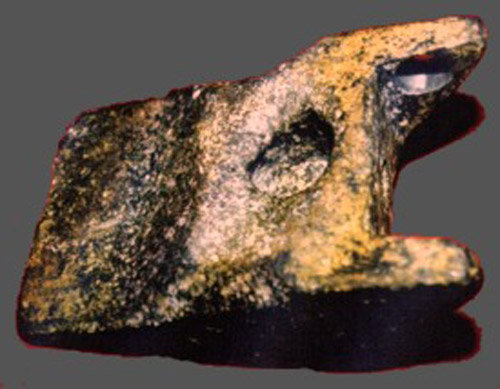
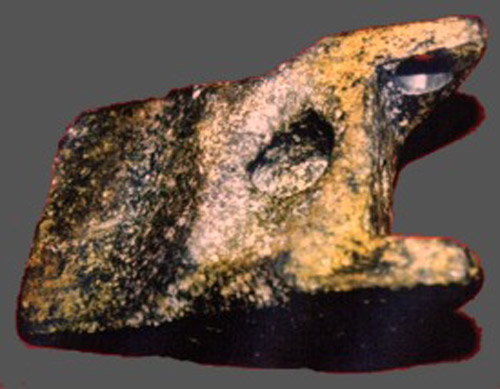
Nestled in the same sediment layer, encased in the same ancient earth as those prehistoric bones, was a grey, heavy, wedge-shaped object. It looked like a hammer head. It looked manufactured. And it absolutely did not belong there.

The Impossible Metallurgy: Why Aluminum Changes Everything

Here is where the story gets wild. The workers, assuming it was a stone axe or some primitive tool, handed it over to the Museum of History of Transylvania. But when the crust and dirt were cleaned off, the archaeologists realized they weren’t looking at stone. They were looking at metal. And not just any metal.

It was light. Too light.

The artifact was sent to the Archeological Institute of Cluj-Napoca for analysis. The results were so baffling they checked them again. And again.

The object was composed of an alloy consisting principally of aluminum (89%). The remaining 11% was a complex cocktail of 12 other elements, including copper, silicon, zinc, lead, tin, zirconium, cadmium, nickel, cobalt, bismuth, silver, and gallium.

Why is this a big deal?

Because aluminum doesn’t exist in nature like gold or silver. You can’t pan for it in a river. You can’t dig a nugget of aluminum out of a rock.

Aluminum is found in bauxite ore. To get the metal out, you need a massive industrial process called electrolysis. This requires smelting temperatures of over 1,800 degrees Fahrenheit (1,000 degrees Celsius) and colossal amounts of electricity.

Humanity did not discover metallic aluminum until 1808. We didn’t figure out how to produce it in mass quantities until 1885. Before the mid-19th century, aluminum was more valuable than gold because it was so impossibly hard to create. Emperor Napoleon III famously served his most honored guests on aluminum plates, while the “regular” nobility had to eat off gold.

So, we have a math problem.

Fact A: The object is made of industrial-grade aluminum.

Fact B: The object was buried under 35 feet of sand alongside Mastodon bones.

Fact C: Mastodons have been dead for 11,000 years.

If you put these facts together, you are left with an impossibility. Who was running an industrial smelter in the Stone Age? Who had electricity 10,000 years before Benjamin Franklin flew his kite?

The Aging Evidence: The Oxide Layer

Skeptics immediately jumped on the “hoax” bandwagon. They claimed a worker must have dropped a tool down the hole. A bucket tooth from a modern excavator, perhaps? It makes sense. It’s safe. It explains away the mystery.

But science fought back.

The experts at Cluj-Napoca noticed something strange about the surface of the wedge. Aluminum oxidizes, but usually, it forms a thin, protective layer that stops the corrosion. This object, however, was covered in an unusually thick layer of aluminum oxide.

This wasn’t a week’s worth of rust. It wasn’t a decade’s worth. The metallurgical analysis suggested that for the oxide layer to be that thick, the object had to have been exposed to the elements for hundreds, if not thousands, of years.

Even the most conservative estimates placed the age of the oxidation at a minimum of 300 to 400 years. Even that is impossible. 400 years ago, aluminum was unknown to science. 400 years ago, we were burning witches, not smelting complex alloys with zirconium and cadmium.

Theory #1: The Ancient Alien Landing Gear

This is the theory that sets the internet on fire. And honestly? It fits the visual evidence disturbingly well.

Look at the shape of the Aiud Wedge. It isn’t a hammer. It isn’t a weapon. It has two holes—one round, one oval-shaped—that look like mounting points. The shape is aerodynamic. It looks engineered for stress.

Aeronautical engineers who have viewed the images and the technical drawings have pointed out a striking similarity to the feet of landing gear used on VTOL (Vertical Take-Off and Landing) aircraft. Or space exploration probes.

Consider the Viking probes sent to Mars. Consider the Lunar Lander. They all use wide, wedge-shaped feet to stabilize on uneven, unknown terrain. If a craft touched down on the banks of the river Mures 11,000 years ago, and one of the landing struts snapped off or was discarded, it would sink into the mud.

Thousands of years pass. Floods come and go. Sediment piles up. Mastodons die nearby. The earth swallows it all. Until 1974.

If this is a piece of a starship, the alloy mix makes sense. You would want a lightweight metal (aluminum) reinforced with other elements (silicon, zirconium) to handle the extreme heat of re-entry or the stress of landing.

Theory #2: The Time Traveler’s Trash

Let’s get weird for a second. What if it is human? Just not from the past.

Some alternative history theorists suggest that if time travel is ever invented, the geological record should be littered with “future trash.” Anachronisms dropped by tourists or researchers from the year 3000 visiting the Pleistocene.

It sounds crazy. But is it crazier than a caveman smelting aluminum?

If a temporal vehicle had a mechanical failure while observing a herd of Mastodons, and a piece fell off, it would remain there, waiting to be found by us. It creates a loop. We find the tech that we haven’t invented yet, which we eventually invent to go back and drop it.

Theory #3: The WW2 Explanation (And Why It Fails)

We have to look at the skeptic’s best argument. During World War II, the Germans were operating in Romania. The Luftwaffe flew Messerschmitt planes. The Wehrmacht used Junkers aircraft.

A popular debunking theory is that the wedge is actually a piece of a German airplane, perhaps a cowl latch or a landing gear support, that crashed or was buried during the war.

It’s a solid guess. German engineering used aluminum alloys.

But here is why that theory crumbles:

  • The Depth: The object was found 35 feet down. A plane crash creates a crater, sure, but it disturbs the soil layers. The reports from the 1974 excavation stated the strata were intact. The object was in the layer, not smashed through it.
  • The Bones: Why were the Mastodon bones there? If a WW2 plane crashed, did it magically summon prehistoric fossils? The association with the bones suggests they were deposited at the same time.
  • The Oxide: Aluminum form the 1940s does not develop the thick, ancient oxide crust found on the Aiud object. 30 years (from WWII to 1974) is not enough time for that level of chemical aging.

The Cover-Up: Where is it Now?

This is where the story turns into a thriller. In the 1990s, a Romanian UFOlogy magazine ran a piece on the wedge. They managed to get fresh tests done. The results confirmed the complex alloy. But since then? Silence.

The Aluminum Wedge of Aiud is not sitting in a glass case for you to visit. You can’t buy a ticket to see it at the National Museum in Bucharest. It is reportedly kept in an “undisclosed location.”

Why hide it?

If it’s just a bucket tooth from a digger, put it on a shelf and label it “Modern Junk.” The fact that it is hidden suggests that the authorities don’t know what to do with it. It represents a dangerous idea. It challenges the timeline. Museums hate things that don’t fit the narrative. If you admit this object is old, you have to rewrite the textbooks.

Modern Internet Theories & The “Deep State” of Archaeology

Head over to the dark corners of Reddit or the deep-dive threads on 4chan, and the theories regarding the Aiud Wedge are evolving. Modern sleuths are comparing the alloy composition to the mysterious “metamaterials” reportedly recovered from UAP (Unidentified Aerial Phenomena) crash sites in the US.

Recently, whistleblowers in the US intelligence community have hinted that “non-human biologics” and “exotic materials” have been recovered for decades. Is the Aiud Wedge an early piece of this puzzle? Was it an early crash retrieval that happened before the government knew how to cover it up effectively?

Some users point to the element Gallium found in the wedge. Gallium is used today in semiconductors and high-tech electronics. Why would a simple structural wedge—if it was just a piece of a 1940s plane—need Gallium?

The Verdict

So, what are we looking at?

Is it a hoax? A piece of a German bomber that miraculously burrowed 35 feet underground and aged 500 years in a few decades? Or is it exactly what it looks like: a piece of high-tech machinery left behind on a primitive Earth.

The Aluminum Wedge of Aiud remains one of the most frustrating, compelling, and mind-bending Out-of-Place Artifacts (OOPArts) in the world. It sits in a box somewhere in Romania, gathering dust, while the rest of us are left guessing.

We might never know the truth. But one thing is certain: 11,000 years ago, something happened on the banks of that river. And it wasn’t just Mastodons walking around.

Amit Ghosh
Amit Ghoshhttps://coolinterestingnews.com
Aloha, I'm Amit Ghosh, a web entrepreneur and avid blogger. Bitten by entrepreneurial bug, I got kicked out from college and ended up being millionaire and running a digital media company named Aeron7 headquartered at Lithuania.
RELATED ARTICLES
- Advertisment -

Most Popular

Recent Comments

Warren Pan Abbott on The legend of the Devil Monkey !
chris davies on The McPherson Tape Mystery
Reed Reedly on ET has Internet!
Bea Houseoffashion on Proof Of Time Travellers – Gallery
Marcus2012 on ET has Internet!
Reed Reedly on ET has Internet!
LaughsAtConspiracyNuts on The 9/11 Conspiracy – Myths and Facts
Alex Sliverman on Did the ancients fly?
Doctor Wholigan on Time Traveler in 1938 film
chris davies on The McPherson Tape Mystery
Archie1954 on 10 secret UFO hideouts
chris davies on Ghosts of flight 401
Marcus2012 on ET has Internet!
jason Macdonald on Proof of Time Travel? – China
chris davies on Long-Lost Pyramids Found?
Reed Reedly on ET has Internet!
Milkman on Connected Universe
Tenmiles on Baigong Pipes Mystery
Simon Foster on Sirius – The Documentary
From the 1st April on 2013 – Alien Contact date ?
SkyWatcher on Is ET ignoring us?
I Come From The Future on Obama to make UFO Alien disclouser soon ?
ÛñK?øWn on 2013 – Alien Contact date ?
Just another person on 2013 – Alien Contact date ?
Malcolm Windowcleaner on The strange case of Rudolph Fentz
Mason Servio on Strange Things on Mars
Marke Wisdom Seeker on What will we find as arctic melts?
Andrea A Elisabeth Levyne on Aliens Captured in Varginha, Brazil
Mitch Grouyeki on Amazing Space Shuttle pictures