Is the World’s BIGGEST Pyramid Hiding in Plain Sight?
Forget everything you think you know about ancient wonders. Push the sun-scorched sands of Egypt from your mind. Because the greatest pyramid on Earth might not be in Giza. It might be a silent, colossal giant hidden for decades behind a wall of official denial and military patrols, deep in the heart of China.
They say it’s a legend. A pilot’s tall tale. A ghost story whispered among aviators and conspiracy forums.
But the evidence points to something incredible. Something world-changing.
A pyramid so massive it makes the Great Pyramid of Giza look like a foothill. A structure shrouded in so much secrecy, you have to ask one terrifying question: What are they trying to hide?
A Sputtering Engine and a World-Changing Discovery
The year is 1945. The Second World War is in its final, chaotic throes. U.S. Air Force pilot James Gaussman is flying a transport plane, the “Hump” route over the Himalayas, a treacherous lifeline to aid the Chinese army. His mission is done. He’s heading back to his base in Assam, India.
Then, trouble.
His engine sputters, coughs, and threatens to die. He’s forced to drop to a dangerously low altitude, flying over the flat, ancient plains near the city of Xi’an. And that’s when he saw it.
Off in the distance, a shape that didn’t belong. Not a mountain. It was too perfect. Too symmetrical. A massive, four-sided pyramid piercing the haze. But this was unlike anything he’d ever seen or read about. It was colossal. And it was, according to his report, a shimmering, otherworldly white.
Gaussman, stunned, circled the structure. He snapped photos, his mind racing. This wasn’t in any history book. It wasn’t on any map. It was a giant, silent mystery in the middle of a warzone. He flew on, eventually landing safely, his engine somehow holding out. He filed a report, submitted his photographs, and told his story to anyone who would listen. The legend of the “Great White Pyramid of Xi’an” was born.
But then? Silence. The report vanished into the labyrinth of U.S. intelligence. The photos were classified. The story became a whisper.
Until 1947. Another U.S. pilot, Colonel Maurice Sheahan, was flying over the same region. He’d heard the rumors. He was looking for it. And he found it. His estimates were staggering. He pegged the pyramid at an unbelievable 1,500 feet tall. Let that sink in. The Great Pyramid of Giza, the largest in Egypt, stands at a mere 480 feet. This Chinese behemoth was more than three times its height. A true wonder of the ancient world, completely unknown to the public.

China’s Pyramid-Sized Secret: The Great Wall of Silence
You’d think the discovery of a 1,500-foot-tall pyramid would be front-page news. A global event. Archaeologists from around the world would flock to see it. But the opposite happened.
Nothing.
For decades, the Chinese government flatly denied the existence of any pyramids. They called it a Western fantasy. When pressed, they’d claim the structures were just simple burial mounds from the Han Dynasty. Nothing to see here. Move along. The area around Xi’an became a restricted military zone. The airspace was heavily patrolled. Getting close was impossible.
Why the secrecy? Why build a wall of silence around your own history? Were they simply protecting their cultural heritage from foreign interference? Or was the secret buried beneath these man-made mountains so profound it had to be guarded at all costs?
The Daredevil Who Pierced the Veil
The mystery festered for nearly 50 years. Then, one man decided to find the truth for himself. German researcher and author Hartwig Hausdorf wasn’t one to take “no” for an answer. In the early 1990s, he embarked on a series of daring trips into the forbidden zone.
He dodged military patrols. He navigated the complex and often intimidating Chinese bureaucracy. He was on a mission to find Gaussman’s legendary Great White Pyramid.
He never found it.
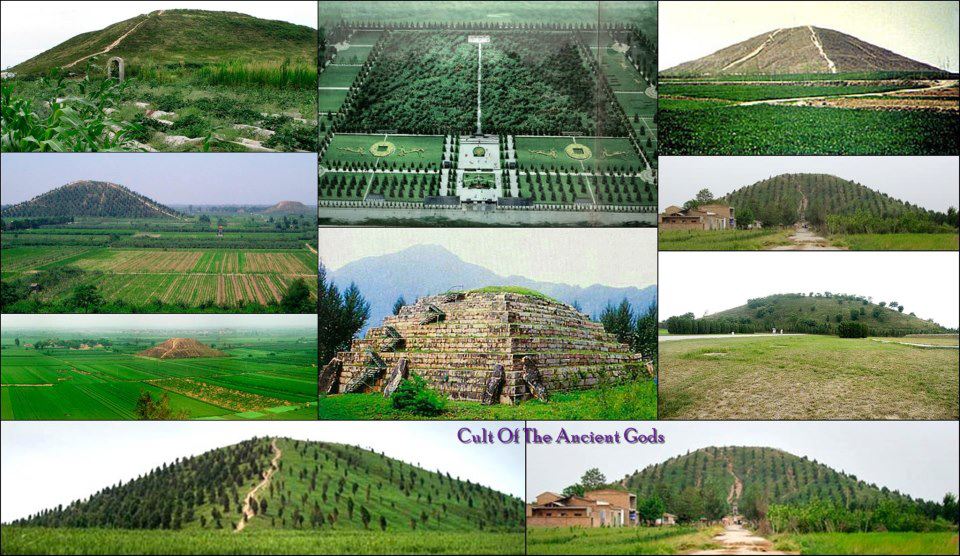
But what he did find was arguably even more mind-blowing. Not one pyramid, but dozens. Scores of them. An entire field of earthen pyramids, some rivaling the size of the Egyptian structures, stretching for miles across the plains. They were covered in grass and trees, expertly camouflaged to look like natural hills. Some speculate the trees were planted centuries ago for that very purpose. To hide.
Hausdorf took photos and video, smuggling his findings back to the West. In 1994, he published his book, “Die Weisse Pyramide” (The White Pyramid), and the story exploded. The secret was out. China could no longer deny it. By the year 2000, they officially acknowledged the existence of some 400 “pyramidal tomb mounds” in the Shaanxi province.
But the story was just getting started.
Deep Dive: Are They Tombs, or Something Else Entirely?
The official story is simple. These are burial mounds for ancient emperors and their courts. But the more you look, the less sense that makes. Sure, some of them are tombs. The most famous one certainly is. But all 400 of them? Scattered in specific, geometric layouts?
Something else is going on here.
Mountains by Human Hands
Unlike the stone pyramids of Egypt or Mesoamerica, the Chinese pyramids are made of earth. Soil and clay, pounded and compacted layer by layer over years, sometimes decades, by armies of laborers. This construction method, known as “rammed earth,” is incredibly durable. But over two millennia, it’s susceptible to erosion. Wind and rain have softened their sharp edges, and the deliberate planting of vegetation has made them blend into the landscape.
They are, in effect, man-made mountains. And they are everywhere. An entire complex of silent, green sentinels watching the sky. Why go to such an incredible effort to build hundreds of these structures? It suggests a tradition, a technology, and a purpose that spanned multiple dynasties and thousands of years. A purpose that may go far beyond just burying the dead.

The 12,000-Year-Old Star Map on the Ground
This is where the story takes a sharp turn from archaeology into the mind-bending. Ancient civilizations researcher Graham Hancock, known for his theories about a lost global civilization, turned his attention to these pyramids. Looking at an aerial photograph of a cluster of pyramids east of Xi’an, he noticed something familiar.
Their layout wasn’t random.
He believed they matched the stars in the constellation Gemini. But not the Gemini we see in the sky today. Using computer analysis, he determined the layout on the ground was a perfect mirror of how Gemini would have appeared to an observer on the spring equinox in the year 10,500 BC.
10,500 BC.
That’s more than 8,000 years before the first Chinese dynasty. It’s a time period archaeologists tell us was populated by simple hunter-gatherers living in caves. It’s a date that pops up again and again in alternative history. It’s the same timeframe proponents of the Sphinx water erosion hypothesis point to. It’s the dawn of a new age after a cataclysmic global event known as the Younger Dryas. It suggests a civilization far older, far more advanced, and with a deep understanding of astronomy, was building massive monuments in China. A civilization history has completely forgotten.
Whispers of an Ancient Alien Connection
Hartwig Hausdorf went even further. During his expeditions, he wasn’t just looking for pyramids; he was looking for answers. He spoke of local legends and ancient texts that hinted at “sky people” who descended from the heavens. He even asserted that these structures might have an extraterrestrial origin. Could they be power plants? Navigational aids for ancient spacecraft? A welcome mat for visitors from the stars?
It sounds like science fiction. But when you’re looking at a field of 400 pyramids, perfectly aligned to a star map from 12,000 years ago, and hidden by a government for half a century… you have to start asking unconventional questions.
The Dragon Emperor’s Forbidden Fortress: A Tomb Too Dangerous to Open
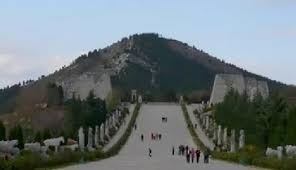
Of all the pyramids in the Xi’an complex, one stands alone. It is not the legendary 1,500-foot-tall “White Pyramid,” but it is the most famous and perhaps the most important archaeological site on the planet. The Mausoleum of Qin Shi Huang, the first Emperor of China.
Qin Shi Huang was a figure of immense power and paranoia. He unified China, started the Great Wall, and was pathologically obsessed with finding the elixir of immortality. In his quest for eternal life, he constructed the most elaborate final resting place ever conceived. A tomb so vast and so complex, it makes Tutankhamun’s look like a broom closet.
In 1974, a group of farmers digging a well stumbled upon a life-sized clay head. They had accidentally discovered the emperor’s protection detail: the Terracotta Army. An entire legion of over 8,000 unique, life-sized soldiers, plus chariots and horses, buried for 2,200 years to guard their emperor in the afterlife. It was one of the greatest discoveries in history.
But the army is just the beginning. They are the outer guards. The real prize, the emperor’s body and the untold treasures buried with him, lies sealed inside the main chamber, directly beneath the center of his massive, 250-foot-tall pyramid.
And no one has ever been inside.
A Subterranean Kingdom of Liquid Mercury
Ancient Chinese texts, written by the historian Sima Qian a century after the emperor’s death, describe the tomb in fantastical detail. The same texts that led archaeologists to the Terracotta Army also tell us what’s inside the pyramid.
They describe a complete replica of the emperor’s domain. The ceiling of the main vault is a map of the heavens, with pearls and jewels representing the sun, moon, and stars. The floor is a topographic map of China. And, most incredibly, the great rivers of China—the Yangtze and the Yellow River—are represented by channels of flowing, liquid mercury, mechanically circulated to mimic their flow to the sea.
Crazy, right? A myth. Except it’s not. Scientific probes of the soil around and on top of the pyramid have revealed astronomically high concentrations of mercury. The levels are so far beyond natural background radiation that scientists have concluded there must be a massive amount of liquid mercury pooled deep within the mound. The ancient texts were true.
Why Are They So Afraid to Look Inside?
So, we know where it is. We have ancient maps. We know about the mercury. We have the technology to excavate. Why hasn’t the Chinese government opened the tomb?
The official reason is preservation. They claim that current technology is insufficient to protect the priceless artifacts within. Once exposed to air, ancient silks, texts, and lacquered items could disintegrate in minutes. They are waiting, they say, for a better time.
But there are other reasons whispered in the dark. The ancient texts also speak of deadly booby traps. Crossbows rigged to fire on anyone who enters. A curse upon those who disturb the emperor’s slumber.
And then there’s the biggest fear of all. The unknown. What if the tomb contains something that could fundamentally rewrite Chinese, and even world, history? What if the Emperor, obsessed with immortality, found something? What if the secrets he took to his grave are secrets humanity is not yet ready for? Perhaps the tomb remains sealed not to protect what’s inside, but to protect us from it.

The Final Verdict on the Great White Pyramid
This brings us back to the beginning. Back to James Gaussman and his sputtering plane. What did he really see?
Lost Legend or Mistaken Identity?
Many modern researchers now believe that the legendary Great White Pyramid and the tomb of Qin Shi Huang are one and the same. The Emperor’s mausoleum is enormous, and under the right atmospheric conditions—a low sun reflecting off frost or quartz-rich soil—it could easily appear as a “shimmering white” giant. The 1,500-foot height estimate from 1947 was likely just an exaggeration, a pilot’s tale growing with each telling.
But that explanation feels too easy. Too neat.
Internet sleuths, pouring over satellite images on Google Earth, continue the hunt. They point to other, larger anomalies in the landscape, some in more remote, mountainous regions, that fit the description. Some argue the original Great White Pyramid was so old that it has since been completely eroded, or was even dismantled by the Chinese government to keep its true nature a secret.
The truth remains elusive, buried under layers of earth and decades of official misdirection. The pyramids of Xi’an are a silent testament to a past far more complex and mysterious than we can imagine. They are a fleet of sleeping giants.
One day, the tomb of the Dragon Emperor will be opened. One day, the secrets of the pyramid fields will be known. What will they tell us? Will they confirm our history books, or will they tear them to shreds, revealing a past so ancient and fantastic that it will change the very definition of what it means to be human?