
Tuesday, June 9, 2026
HomeWeird WorldParanormalThe Freddy Jackson Ghost!

The Freddy Jackson Ghost!

The Ghost in the Machine: A Chilling Deep Dive into the Freddy Jackson Photograph

Some images are more than just pictures. They’re windows. Windows into a moment, a memory, a feeling. But what if a window opened onto something else entirely? Something that shouldn’t be there. Something impossible.

We’ve all seen them. The blurry shapes in the background, the strange orbs of light, the figures that feel… off. Most are easily dismissed. A trick of the light. A smudge on the lens. Wishful thinking.

But this one is different.

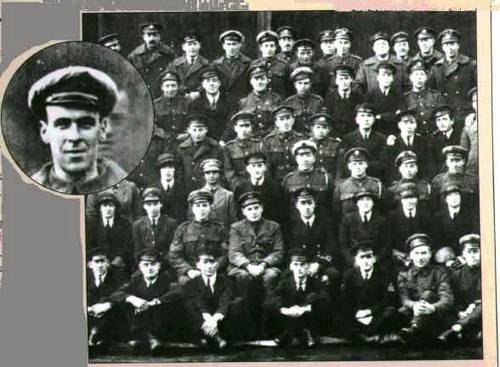
This photograph refuses to be dismissed. For over a century, it has stared back at us, presenting a quiet, chilling mystery that logic struggles to explain away. It’s a group portrait of heroes, men who survived the Great War. But it seems one of them didn’t let a little thing like death stop him from showing up for the final picture.

This is the haunting story of the ghost of Goddard’s Squadron.

A Picture of Survivors

Let your eyes adjust to the black and white. The year is 1919. The war to end all wars is finally over. The air, once thick with the drone of biplanes and the specter of death, is now filled with a tentative peace. The men you see are members of the Royal Air Force, stationed at the HMS Daedalus training facility, a place once buzzing with the tension of combat readiness.

They look tired. Stoic. Survivors. Look at their faces, lined with experiences we can only imagine. They are posing for a formal group portrait, a memento of their time together, a testament to the bonds forged in the crucible of war.

Everything seems normal. Standard military procedure. But now, I want you to do something.

Look closer. Focus on the top row of men. Count four heads in from the left. Behind that fourth airman, peeking over his shoulder, is another face. A partial face. It’s pale, almost translucent, and it doesn’t seem to have a body. It’s a face that has no business being in this photograph.

When the photo was developed and passed around, a ripple of shock and disbelief went through the squadron. It wasn’t just a random smudge or a bizarre shadow. Many of the men instantly recognized the ghostly face. They knew exactly who it was.

It was Freddy Jackson.

The Tragic Story of Freddy Jackson

Freddy Jackson wasn’t an officer or a hotshot pilot. He was an air mechanic, one of the unsung heroes who kept the primitive, yet powerful, war birds in the sky. His days were filled with the smell of oil and grease, the clang of metal, and the constant roar of engines. It was a dangerous job. The technology was new, the machines unforgiving.

Just two days before this photograph was taken, that danger became horribly real. Jackson was working on an aircraft on the tarmac when he walked into a moving propeller. The accident was instant and catastrophic.

He was gone.

The entire squadron was shaken. Jackson was a well-liked member of the team, a familiar face, a friend. His funeral was held on the very day the men gathered for this group portrait. Imagine the emotional weight of that day. A morning spent burying a comrade, an afternoon spent forcing a smile for the camera, trying to capture a moment of unity while a piece of their unit was forever missing.

Or was he?

The men who saw the developed photograph were certain. The ghostly face, with its distinct features peeking out from behind another man’s head, was undoubtedly Freddy Jackson. Their friend, killed 48 hours earlier, had seemingly decided to show up for the final roll call.

Sir Victor Goddard: The High-Ranking Officer Who Believed

This story might have faded into a local legend, a strange tale told over drinks in a pub, if not for one man: Sir Victor Goddard. He wasn’t some tabloid journalist or a paranormal enthusiast looking for fame. When this photograph was taken, he was the commander of the squadron. He would later rise to the rank of Air Marshal in the R.A.F., a respected and decorated leader.

He didn’t publish the photo until 1975, long after his retirement. Why wait so long? Perhaps he knew the ridicule a man in his position might face. But he never wavered in his belief that the photograph was genuine and showed the apparition of his deceased mechanic.

Goddard was a man of logic, strategy, and military precision. He wasn’t prone to flights of fancy. Yet, his life was touched by the unexplained on more than one occasion, which makes this story even more compelling.

A Man Prone to Strange Visions?

One of Goddard’s most famous experiences occurred in 1935. While flying his biplane in heavy rain and wind, he got lost and decided to fly over a derelict, abandoned airfield at Drem, Scotland. As he passed over, the storm clouds suddenly vanished, replaced by brilliant sunshine. Below him, the airfield was no longer derelict. It was bustling with activity.

He saw mechanics in bright blue overalls working on planes painted a strange yellow color—aircraft he didn’t recognize. He saw everything in vivid detail before flying back into the storm. It was a bizarre, disorienting experience. Four years later, in 1939, Goddard found himself stationed at the now-reopened Drem airfield. The R.A.F. had begun painting their training planes the same bright yellow he had seen, and the mechanics wore the same blue overalls. He had apparently experienced a “time slip,” a vision of the future.

Does this make his claim about the Freddy Jackson photo more or less believable? Skeptics might say he was predisposed to seeing things that weren’t there. Believers would argue that he was simply more attuned to phenomena that exist just outside our normal perception. Whatever the case, the man vouching for the ghostly photo was no ordinary witness.

The Case for a Ghost: Arguments from the Other Side

So, let’s assume for a moment that what we’re seeing is real. How do we even begin to explain it? Paranormal investigators and believers have put forth several compelling theories over the decades.

The Unmistakable Recognition

The single most powerful piece of evidence for the paranormal here is the human element. This wasn’t a case of one person seeing a face in the clouds. An entire squadron of men, Freddy Jackson’s friends and colleagues, looked at this image and said, “That’s him.” They knew his face, his hairline, the shape of his eyes. They were grieving his recent, violent death. To them, it wasn’t a smudge or a flaw; it was a final, impossible farewell from a friend.

The “Last Roll Call” Theory

One of the most popular ideas is that Freddy Jackson, in the confusion immediately following his sudden death, was simply unaware that he had passed on. His spirit, still attached to the men and the place he knew, followed his old routine. When the call went out for the squadron to assemble for a photograph, he simply fell in line with his mates, wanting to be part of the group, not realizing he was no longer part of the physical world.

It’s a heart-breaking and poignant thought. An echo of a man, a soul on autopilot, just trying to stick with his friends.

An Emotional Imprint on Reality?

Another theory dips into the idea of a “residual haunting” or what some call the “Stone Tape Theory.” The concept suggests that intense emotional events can be “recorded” onto a location, like audio onto a tape. These recordings can then be “played back” under certain conditions.

Could the immense grief and shock of Jackson’s death, combined with the emotional farewell of his funeral happening on the same day, have created an psychic energy powerful enough to imprint his image onto the sensitive photographic plate? A moment of collective thought, of shared memory, literally burning its way onto the film. It sounds like science fiction, but it’s an attempt to explain the inexplicable.

The Skeptic’s Toolkit: Debunking the Daedalus Ghost

Now, we have to put our emotions aside and look at this with a cold, rational eye. As amazing as the story is, there are several very plausible, non-supernatural explanations for the face in the photo.

The Double Exposure Hypothesis

This is the most common and scientifically sound explanation. Photography in 1919 was a complex process involving large, cumbersome cameras and glass plate negatives, not simple film. A double exposure occurs when a single plate is exposed to light twice before being developed. The result is two images layered on top of each other.

Could the photographer have accidentally used a plate that already had another portrait on it? Perhaps a faint image of another airman? If that previous image was slightly misaligned, it could create the exact effect we see—a ghostly, see-through face floating behind the main subject. In the early days of photography, this was a surprisingly common mistake.

The only counter-argument is: what are the chances that the face from a random, forgotten exposure would be a dead ringer for a man who had just died? Coincidence? Or something more?

Pareidolia: Our Brains Are Playing Tricks on Us

Ever seen a face in a slice of toast or a shape in the clouds? That’s pareidolia. It’s the human brain’s hardwired tendency to find meaningful patterns, especially faces, in random data. We are social creatures, and recognizing faces is a key survival instinct.

Is it possible that the “face” is nothing more than a coincidental combination of a chemical smudge on the negative, a shadow, and the texture of the backdrop? The squadron, already grieving and thinking about their lost friend, might have been psychologically primed to see his face in that random pattern. They saw what they wanted, or perhaps what they feared, to see.

A Deliberate Hoax?

Could this have been a prank? It’s possible a photographer with a morbid sense of humor used darkroom techniques to superimpose an image of Jackson onto the group shot. While technically possible, this feels like the least likely scenario. It would have been a cruel and difficult trick to pull off, and for what purpose? To fool a squadron of grieving soldiers? It seems out of step with the somber mood of the time.

A Century of Chills: Why We Can’t Look Away

So, what are we left with? A trick of the light? A chemical accident? A grieving mind’s illusion? Or a genuine ghost, caught on camera?

The Freddy Jackson photograph has endured for over 100 years not because it’s a perfect, undeniable piece of evidence, but precisely because it isn’t. It lives in that perfect gray area between what we know and what we believe. It’s just clear enough to be terrifying, but just vague enough to be deniable.

In the age of the internet, the photo has found a new life. Online forums and Reddit threads have dissected every pixel. Users have sharpened, enlarged, and colorized the image, all in an attempt to find a definitive answer that has remained elusive for a century. Each new analysis just adds another layer to the mystery.

The story’s power also comes from its context. The backdrop of World War I, a conflict that saw death on an industrial scale, created a generation grappling with loss. Spiritualism and the search for contact with the dead were rampant. People were desperate for proof that their loved ones weren’t truly gone. The Freddy Jackson photo was, for many, that proof.

It’s more than a ghost story. It’s a human story. A story about loss, memory, and the powerful bonds of friendship that might just be strong enough to persist, even after the machine has stopped.

Look at the photo one last time. Look at the faces of the living, and the face of the one who supposedly wasn’t. Was it a simple mistake, a coincidence of chemistry and light?

Or did Freddy Jackson, for one fleeting moment on a day clouded by grief, simply refuse to be forgotten?

Amit Ghosh
Amit Ghoshhttps://coolinterestingnews.com
Aloha, I'm Amit Ghosh, a web entrepreneur and avid blogger. Bitten by entrepreneurial bug, I got kicked out from college and ended up being millionaire and running a digital media company named Aeron7 headquartered at Lithuania.
RELATED ARTICLES
- Advertisment -

Most Popular

Recent Comments

Warren Pan Abbott on The legend of the Devil Monkey !
chris davies on The McPherson Tape Mystery
Reed Reedly on ET has Internet!
Bea Houseoffashion on Proof Of Time Travellers – Gallery
Marcus2012 on ET has Internet!
Reed Reedly on ET has Internet!
LaughsAtConspiracyNuts on The 9/11 Conspiracy – Myths and Facts
Alex Sliverman on Did the ancients fly?
Doctor Wholigan on Time Traveler in 1938 film
chris davies on The McPherson Tape Mystery
Archie1954 on 10 secret UFO hideouts
chris davies on Ghosts of flight 401
Marcus2012 on ET has Internet!
jason Macdonald on Proof of Time Travel? – China
chris davies on Long-Lost Pyramids Found?
Reed Reedly on ET has Internet!
Milkman on Connected Universe
Tenmiles on Baigong Pipes Mystery
Simon Foster on Sirius – The Documentary
From the 1st April on 2013 – Alien Contact date ?
SkyWatcher on Is ET ignoring us?
I Come From The Future on Obama to make UFO Alien disclouser soon ?
ÛñK?øWn on 2013 – Alien Contact date ?
Just another person on 2013 – Alien Contact date ?
Malcolm Windowcleaner on The strange case of Rudolph Fentz
Mason Servio on Strange Things on Mars
Marke Wisdom Seeker on What will we find as arctic melts?
Andrea A Elisabeth Levyne on Aliens Captured in Varginha, Brazil
Mitch Grouyeki on Amazing Space Shuttle pictures









