Sunday, April 19, 2026
HomeUnexplained MysteriesCrime MysteriesWho Put Bella in the Wych Elm? strange crime mystery

Who Put Bella in the Wych Elm? strange crime mystery

Who Put Bella In The Wych Elm? The 80-Year-Old Murder That Still Haunts England

Some stories don’t fade. They fester. They burrow deep into the soil of a place, twisting around the roots of old trees, their whispers carried on the wind. This is one of those stories.

It’s a tale that begins in the darkest days of World War II, not on the battlefields of Europe, but in a quiet, misty wood in the heart of England. It’s a story of four boys, a hollow tree, and a gruesome discovery that would echo for generations. It’s a murder mystery that remains utterly, maddeningly unsolved.

And it all starts with a single, haunting question scrawled in chalk: Who put Bella in the Wych Elm?

A Day of Mischief, A Discovery of Horror

April 18, 1943. Britain was at war. Rationing was a way of life, and for four boys from Hagley, a village in Worcestershire, poaching was a forbidden thrill. A way to escape the grim realities of the world. Their names were Bob Farmer, Fred Payne, Bob Hart, and Thomas Willetts.

They snuck into Hagley Wood, a private estate belonging to Lord Cobham. The air was thick with the smell of damp earth and decaying leaves. Their target? Bird’s nests. Eggs were a prize.

Their search led them to a particularly large and gnarled tree. A witch-hazel, though many would later call it a wych elm. Its tangled branches seemed to claw at the sky. It looked ancient. Secretive. Bob Farmer, being the climber of the group, decided it was the perfect spot.

He scaled the trunk. And he saw it.

A hollow. A dark, gaping maw in the wood.

Curiosity won. He peered inside. Something pale gleamed back at him from the darkness. He thought it was an animal skull at first. A badger, maybe a fox. He reached in, his fingers closing around the smooth, cold bone.

He pulled it out into the daylight.

20131118-233313.webp

Two empty eye sockets stared back. A patch of rotting skin clung to the forehead, with a few strands of mousy brown hair. And the teeth. They were crooked. Unmistakably human.

Panic. Pure, cold panic. He dropped the skull back into the tree’s dark throat. The boys scrambled down, their adventure shattered. They ran. They fled the woods as if the devil himself was at their heels, and they made a pact.

Silence. Absolute silence.

They were poaching. Trespassing. They’d be in a world of trouble. But the secret was too heavy for the youngest, Thomas Willetts. The image of that skull, of those teeth, was burned into his mind. He couldn’t eat. He couldn’t sleep. The haunting face from the tree followed him into his dreams. Finally, he broke. He confessed everything to his father.

The secret was out. And the real nightmare was just beginning.

Unearthing the Secrets of the Tree

When the police arrived at the ancient witch-hazel, they expected to find a skull. They found so much more. The tree wasn’t just a hiding place; it was a makeshift coffin.

Carefully, they excavated the contents of the hollow trunk. Out came a nearly complete human skeleton, folded and crammed into the tight space. With the bones came other pathetic remnants of a life. A single crepe-soled shoe. A cheap, gold wedding ring. Scraps of rotting clothing.

But the scene got stranger. And darker.

A search of the area around the tree’s roots uncovered something else. A collection of bones, buried in the soil. It was the victim’s severed left hand, laid to rest separately from the rest of her body. Why? Why would a killer take the time for such a bizarre act?

Deep Dive: The Forensic File of a Ghost

The remains were sent to Professor James Webster, a pioneer in the then-emerging field of forensic science. In his laboratory, the bones began to tell their story.

The victim was female. She was about 35 years old and stood roughly five feet tall. Her most distinguishing feature was her teeth—a lower jaw with a pronounced, crowded snaggletooth arrangement. Surely someone would recognize that? Police hoped so. The analysis also revealed she had given birth at least once in her life. A mother. Someone’s mother.

But it was what they found in her mouth that screamed murder. A wad of taffeta, a type of silk-like fabric, had been stuffed deep into her throat. She had been asphyxiated. Gagged and silenced forever.

Webster determined she had been dead for at least 18 months, placing her time of death around October 1941. And here’s the chilling part: he concluded that her body must have been placed inside the tree “while still warm,” before rigor mortis had a chance to set in and stiffen her limbs. This was no random dumping of a body. The killer knew this tree. The placement was deliberate. Intimate, even.

The police launched a massive investigation. They checked the dental records of every single missing person in the country. Nothing. They circulated a description of the woman, her clothes, her ring. Silence. It was as if she had simply materialized in that wood, with no past, no family, and no name.

From Spies to Sorcery: The Hunt for an Identity

With no leads, the void was soon filled with whispers and theories. Each one darker and more fantastic than the last.

Theory #1: The Nazi Spy Ring

This is the theory that has captured the public imagination for decades. Remember the timeframe? October 1941. The heart of the Blitz. The Midlands region, with its heavy industry and munitions factories, was a prime target for both German bombers and their spies.

Could “Bella” have been a German agent? A member of a spy ring who knew too much and was silenced by her own handlers? Or perhaps she was caught by British intelligence and disposed of in a way that would never be traced back to them?

Years later, declassified MI5 files gave this theory a shocking boost. The files spoke of a German spy named Josef Jakobs, who was captured after parachuting into Cambridgeshire in 1941. Under interrogation, he mentioned his lover, a German cabaret singer and actress named Clara Bauerle. He claimed she was also a spy and was supposed to be parachuted into the Midlands after him. She was never heard from again.

Could Clara be Bella? The timeline fits. The location fits. Her pre-war pictures show a woman who could pass for 35. But the connection remains purely circumstantial. No concrete evidence has ever linked the skeleton in the tree to the missing German spy.

Theory #2: Black Magic in the Black Country

This theory spirals into far stranger territory. It focuses on two key elements: the severed hand and the type of tree.

Why was her hand buried separately? Some researchers pointed to a gruesome occult ritual involving something called the “Hand of Glory.” Traditionally, this was the pickled and dried hand of a hanged man, often with a candle made from his fat placed in its grip. Witches and thieves believed it held immense power—to paralyze, to unlock any door, to render its holder invisible.

While the victim was female, not a hanged man, proponents of this theory suggest it was part of a black magic execution. A ritual sacrifice.

Then there’s the tree. A Wych Elm, or Witch-Hazel. Both trees are deeply embedded in European folklore and pagan traditions. They are seen as portals, as places of power, often associated with witchcraft. Was Bella placed inside the tree not just to hide her body, but to trap her spirit? Was this a ritual killing by a local coven?

It sounds like something out of a horror movie. But in 1940s England, with the chaos of war and a resurgence of interest in folklore and the occult, it wasn’t as far-fetched as it might seem to us today.

The Ghost Who Learned to Write

The case might have faded into obscure local history. A grim footnote of the war. But then, something happened that cemented its place in legend. The graffiti started appearing.

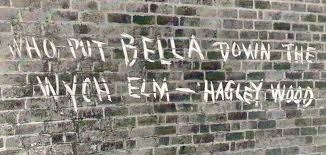
Around Christmas 1943, scrawled in white chalk on a wall in Birmingham, a message appeared: “Who put Luebbella down the wych-elm?”

Soon, more messages followed, the spelling simplified, the phrasing honed into its iconic form. They appeared on walls and buildings across the region, always seeming to be written by the same hand.

20131118-233527.webp

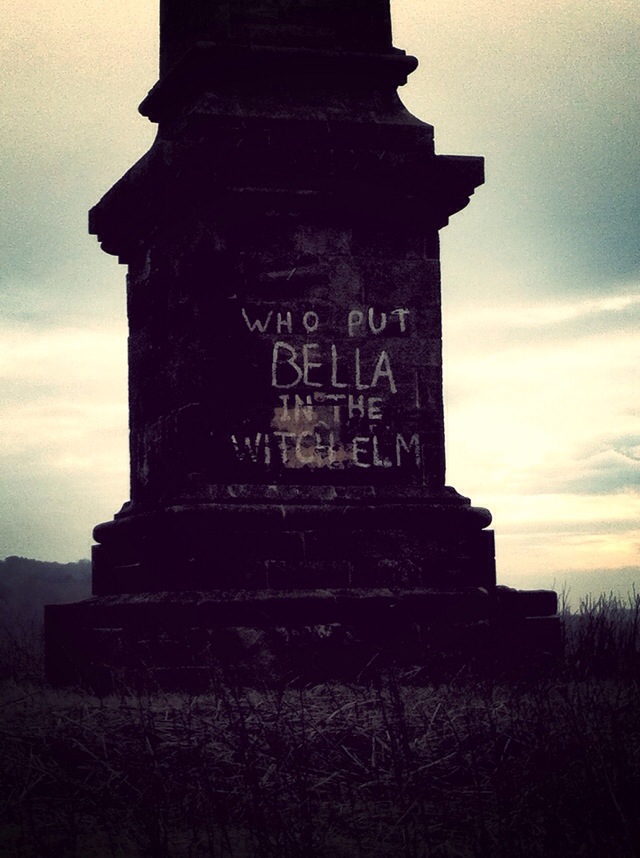
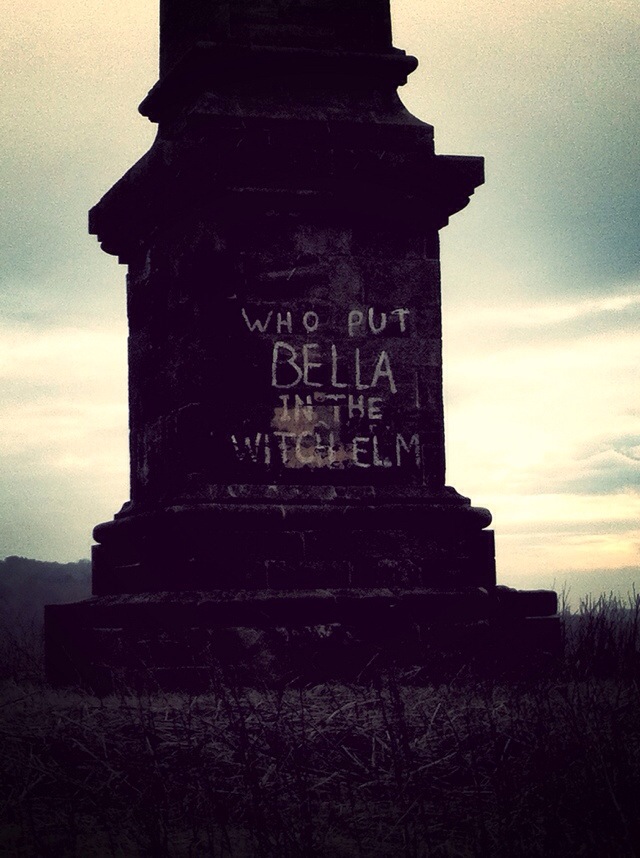
Eventually, the graffiti found its most famous canvas: the Wychbury Obelisk, a towering monument on a hill overlooking Hagley Wood. For decades, the question would appear, get cleaned off, and then mysteriously reappear overnight.

“WHO PUT BELLA IN THE WYCH ELM?”

A Guilty Conscience or a Cruel Prank?

Who was writing it? The question is as profound as the one in the graffiti itself.

Was it the killer, taunting the police, unable to live with their secret but too cowardly to confess? Was it an accomplice, eaten alive by guilt, trying to force the truth into the light?

Or was it someone who knew Bella? A friend? A family member? Someone who knew a piece of the puzzle and was desperately crying out for justice in the only way they could?

The name “Bella” itself is a mystery. Was it her real name? A nickname? Or a symbolic choice? “Belladonna,” the deadly nightshade plant, has long been associated with witchcraft. Or maybe it was simply a reference to her being “bella”—beautiful.

Whoever the original writer was, they have long since passed into history. But their message took on a life of its own. It became a tradition, a piece of local folklore. The question became more famous than the victim herself.

Modern Sleuths and the Unending Quest

The 20th century ended, but the mystery of Bella didn’t. In the age of the internet, her case has been rediscovered by a new generation of armchair detectives and true crime fanatics. Podcasts dissect the evidence. Reddit forums buzz with new theories. Authors have penned books attempting to finally crack the case.

A facial reconstruction was done using photos of the skull, giving us a haunting, tangible face for the nameless woman. She looks at us from across the decades, her expression calm, her eyes seeming to hold the secret of her own demise.

New leads, however thin, have emerged. One theory points to a Dutch woman named Anna-Jane De Rijk, who had connections to a British officer and a spy ring. Her family claimed she was murdered, though her death was officially ruled a suicide. Another focuses on a local prostitute who vanished around the same time. But every lead eventually hits the same brick wall. No proof. No positive identification.

Tragically, the bones of Bella herself—the only real evidence—have been lost. Sometime after the investigation, they vanished from the police archives, making any future DNA analysis impossible.

The Silence of Hagley Wood

Today, the witch-hazel tree is gone. The four boys who found the skull have all passed away, taking their memories of that terrifying day with them. The original graffiti writer is a ghost.

All that remains is the story. A story of a woman who died violently and was sealed inside a tree. A woman who lost her life, and then lost her name.

Hagley Wood keeps its secrets locked tight. The wind rustles through the leaves, but it offers no answers. Yet, somewhere out there, the question still echoes, a stain on the landscape, a chilling reminder of a life erased. The woods are silent. But for 80 years, the ghost of Bella has been screaming her name. Who will finally listen?

Amit Ghosh
Amit Ghoshhttps://coolinterestingnews.com
Aloha, I'm Amit Ghosh, a web entrepreneur and avid blogger. Bitten by entrepreneurial bug, I got kicked out from college and ended up being millionaire and running a digital media company named Aeron7 headquartered at Lithuania.
RELATED ARTICLES
- Advertisment -

Most Popular

Recent Comments

Warren Pan Abbott on The legend of the Devil Monkey !
chris davies on The McPherson Tape Mystery
Reed Reedly on ET has Internet!
Bea Houseoffashion on Proof Of Time Travellers – Gallery
Marcus2012 on ET has Internet!
Reed Reedly on ET has Internet!
LaughsAtConspiracyNuts on The 9/11 Conspiracy – Myths and Facts
Alex Sliverman on Did the ancients fly?
Doctor Wholigan on Time Traveler in 1938 film
chris davies on The McPherson Tape Mystery
Archie1954 on 10 secret UFO hideouts
chris davies on Ghosts of flight 401
Marcus2012 on ET has Internet!
jason Macdonald on Proof of Time Travel? – China
chris davies on Long-Lost Pyramids Found?
Reed Reedly on ET has Internet!
Milkman on Connected Universe
Tenmiles on Baigong Pipes Mystery
Simon Foster on Sirius – The Documentary
From the 1st April on 2013 – Alien Contact date ?
SkyWatcher on Is ET ignoring us?
I Come From The Future on Obama to make UFO Alien disclouser soon ?
ÛñK?øWn on 2013 – Alien Contact date ?
Just another person on 2013 – Alien Contact date ?
Malcolm Windowcleaner on The strange case of Rudolph Fentz
Mason Servio on Strange Things on Mars
Marke Wisdom Seeker on What will we find as arctic melts?
Andrea A Elisabeth Levyne on Aliens Captured in Varginha, Brazil
Mitch Grouyeki on Amazing Space Shuttle pictures