Space is supposed to be silent. That’s the golden rule of the cosmos. No air means no vibration, and no vibration means no sound. It is a vacuum. A void. An endless stretch of nothingness where no one can hear you scream, let alone sing.
But in 1969, three men floating in a metal tin can on the backside of the Moon heard something that broke the rules.

They weren’t supposed to hear anything. They were cut off from Earth. Radio dead zone. Total blackout. And yet, filling their headsets wasn’t silence. It wasn’t just static, either. It was music.
The Apollo 10 Mystery: A Dress Rehearsal for the Strange
Before Neil Armstrong took his giant leap, Apollo 10 paved the road. This was the final dress rehearsal. The mission? Fly all the way to the Moon, swoop down to within 50,000 feet of the surface, scout the landing zones, and get the heck out of there. It was a test of nerves, engineering, and sanity.
On board were Commander Tom Stafford, Command Module Pilot John Young, and Lunar Module Pilot Eugene Cernan. These were not guys who got spooked easily. They were test pilots. Engineers. The toughest men America could find.
But as they slipped behind the grey curvature of the Moon, entering the “lunar far side,” something bizarre happened.
When you are behind the Moon, the mass of the rock blocks all radio signals from Houston. You are, quite literally, the loneliest humans in existence. For about an hour, you are completely on your own. No tracking. No voice from Mission Control. Just the hum of the ship.
Then the whistling started.
“Space Music” in the Key of Terror
It started low. A strange, oscillating, mechanical whine. It didn’t sound like thrusters. It didn’t sound like a fan belt slipping. It sounded… organized.
NASA kept the transcripts buried for nearly four decades. They sat in a vault, gathering dust, classified and hidden from the public eye. Why? Because unexplained phenomena freak people out. But in 2008, the files were finally cracked open. The audio tapes were digitized. And what we hear on those tapes is genuine confusion.
Listen to the raw panic masked as casual banter between Cernan and Young:
“Did you hear that whistling sound too?”
“Sounds like — you know, outer-space type music.”
“I wonder what it is.”
This wasn’t a fleeting second of interference. This went on. It persisted. It got under their skin.
“You hear that? That whistling sound? Whoooooo,” Cernan says on the recording, mocking the noise but clearly unsettled by it.
“That sure is weird music,” comes the reply.
Imagine the scene. You are 240,000 miles from home. You are looking down at a cratered, dead world. The radio to Earth is dead. And your headset is singing to you.
The Decision to Stay Silent
Here is where the story gets darker. The astronauts didn’t just hear the noise; they debated hiding it. This is the part that gives conspiracy theorists chills. On the tapes, you can hear them whispering, discussing whether they should even tell Mission Control once they re-acquired the signal.
Why would they hide it? Fear.
In the 1960s, NASA flight surgeons were looking for any reason to ground a pilot. If you admitted to hearing strange voices or “music” where there should be silence, you risked being labeled mentally unstable. You’d be scrubbed from future missions. You’d never fly again.
According to the Science Channel series NASA’s Unexplained Files, the crew was genuinely torn. Do we report the “space ghosts” and risk our careers? Or do we swallow the secret and hope we aren’t going crazy?
They chose to downplay it. They made jokes. But the recording proves they were rattled.
The Physics of the Impossible: What Was It?
Let’s look at the “official” explanation. Because, of course, NASA has one. They always do.
The standard line is that the “music” was nothing more than radio interference. Specifically, they claim it was the result of two radios—the one in the Command Module and the one in the Lunar Module—creating a feedback loop. When the two craft were close together and both radios were on, they created a heterodyne frequency. A screech. A whistle.
Case closed? Not quite.
Al Worden, the command module pilot for Apollo 15, has gone on record challenging this dismissal. In interviews, he’s stated that the Apollo 10 crew was used to the sounds of their ship. They knew what interference sounded like. They knew what static sounded like.
“The logic is that if there was something recorded on there, then there was something there,” Worden said. He implies that dismissing it as simple feedback is lazy. Astronauts are trained to recognize every beep, click, and hum of their vessel. If they called it “weird music,” it’s because it didn’t sound like a broken radio.
Furthermore, the sound had a distinct “woo-woo” quality—a sliding tone, almost like a sci-fi Theremin. Static is chaotic. This had a shape.
Apollo 11: The Mystery Returns
If this was just a one-time glitch on Apollo 10, we might be able to write it off. Maybe Cernan and Young were just tired. Maybe a wire was loose.
But then came the big one. Apollo 11.
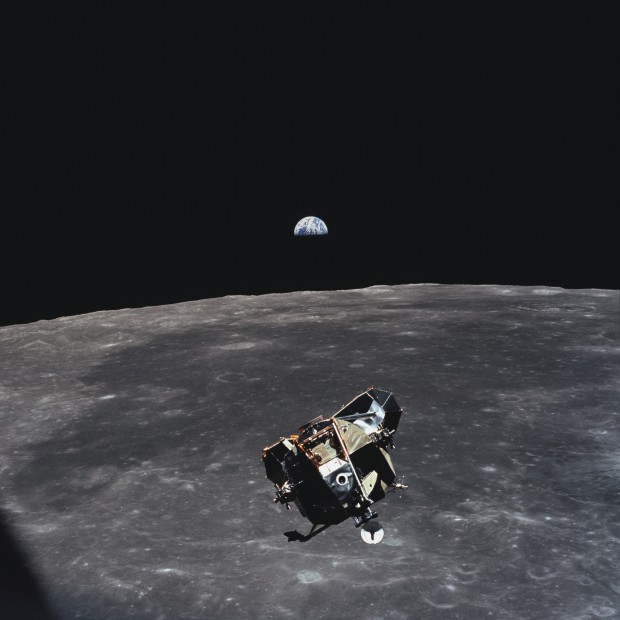
While Neil Armstrong and Buzz Aldrin were making history on the surface, kicking up grey dust and planting flags, Michael Collins was orbiting above. He was the getaway driver. He was the man who stayed behind.
When Collins flew around to the far side of the Moon, he was more isolated than any human had ever been in history. He was cut off from Armstrong and Aldrin. Cut off from Earth. Alone in the dark.
And then, the sound came back.
“There is a strange noise in my headset now, an eerie woo-woo sound,” Collins wrote in his autobiography, Carrying the Fire. He didn’t panic, but he noticed it immediately. It was the same sound the Apollo 10 crew heard.
Collins, being the pragmatist, accepted the interference explanation later provided by NASA engineers. “Had I not been warned about it, it would have scared the hell out of me,” he admitted. He was lucky. The Apollo 10 crew hadn’t been warned. They went in blind—and deaf—to the phenomenon.
Deep Dive: The Theories That Won’t Die
Since these transcripts were released, the internet has gone wild. If it wasn’t a radio glitch, what could it have been? Let’s look at the theories that keep people up at night.
1. The Alien Beacon Theory
This is the big one. The “Far Side” of the Moon is the perfect place to hide. We never see it from Earth. It’s shielded from our noisy radio broadcasts. If an extraterrestrial intelligence wanted to observe us without being detected, they’d set up shop there. Was the “music” a coded transmission? A scanning signal? Or perhaps a warning?
2. The Hollow Moon Resonance
Another wild theory involves the structure of the Moon itself. During Apollo 12, NASA intentionally crashed a lunar module into the surface to test seismic sensors. The Moon “rang like a bell” for nearly an hour. This shocked scientists. It suggested the Moon might not be a solid rock all the way through, or at least, it’s far less dense than Earth. Could the “music” be a natural resonance? The Moon itself singing as it reacts to the gravitational pull of the Earth or the solar wind?
3. Atmospheric Plasma Waves
We know planets with atmospheres, like Saturn and Jupiter, make incredible “sounds” when their radio emissions are converted to audio. But the Moon has no atmosphere. It has no magnetic field to speak of. So, how could it generate radio waves? Some theorists suggest there might be localized magnetic anomalies or interaction with the solar wind on the dark side that we still don’t understand.
Why This Still Matters Today
We are going back. The Artemis missions are gearing up. We aren’t just visiting this time; we are planning to build a base. And where are the most interesting landing sites? The South Pole and the shadowed regions.
China has already landed a rover, Chang’e 4, on the far side of the Moon—the first time humanity has touched that hidden face. Did their rover pick up the same whistling? The Chinese space agency is notoriously tight-lipped.
The “space music” of 1969 reminds us that for all our technology, space is still a place of unknowns. We think we have the map, but we’re just coloring in the edges. When astronauts go back, will they hear the song again? And if they do, will they finally figure out who—or what—is singing?
For now, the tapes remain a chilling reminder of the limits of human knowledge. Three men, alone in the void, listening to a tune that shouldn’t exist.
Next time you look up at the Moon, remember: silence is just a matter of perspective.
Originally posted 2016-03-02 13:18:01. Republished by Blog Post Promoter