
Saturday, June 6, 2026
HomeAlien LifeAsteroid in solar system could REALLY be ‘alien spacecraft’

Asteroid in solar system could REALLY be ‘alien spacecraft’

Will We Find More Than Just Space Rocks in the Asteroid Belt? The Terrifying and Thrilling Truth

Look up. Go ahead, do it tonight. Look at the darkness between the stars. It feels empty, doesn’t it? Silent. Dead.

But what if that silence is a trick? What if the “junk” floating around our solar system isn’t just dead rock and frozen ice? What if we are staring directly at a parking lot for alien spacecraft, and we are just too primitive to notice?

Here is the reality check that keeps astronomers awake at night: We assume the asteroid belt is a graveyard of failed planets. Debris left over from the violent birth of the solar system. But Duncan Forgan, a visionary astrobiologist from the University of St Andrews, dropped a bombshell theory that changes everything. He suggests that some of those “rocks” we track, catalogue, and ignore might actually be massive UFOs. Alien megastructures. Probes.

Waiting.

This isn’t sci-fi. This is a legitimate scientific hypothesis that asks a terrifying question: Are we alone, or are we just blind?

The Great Silence: Why Haven’t We Found Them?

For decades, the narrative has been depressing. “We’ve looked,” the skeptics say. “We listened. There’s nothing out there.”

They call it the Fermi Paradox. If the universe is teeming with life, where is everybody? Why hasn’t ET phoned home? Because of this silence, a growing faction of astronomers has become convinced that Earth is a fluke. They believe intelligent life is so rare that we will never, ever make contact. They think we are screaming into a void that doesn’t scream back.

Duncan Forgan says that is absolute nonsense.

His argument? We haven’t failed. We haven’t even started. To say we’ve searched the galaxy is like dipping a teaspoon into the Pacific Ocean, looking at the clear water in the spoon, and declaring, “There are no whales in the ocean.”

We are barely scratching the surface. Actually, we haven’t even scratched it. We’re just looking at it from a distance.

image

Take a good, hard look at the image above. This is the visual representation of our arrogance. Mr. Forgan revealed this comparison to illustrate the “search space.”

See that football pitch? Imagine that represents the entire galaxy. All the billions of stars, planets, nebulas, and dark corners where life could hide. Now, look for the tiny ant on the grass. That is the area we have scanned for radio signals.

We are judging the entire galaxy based on a sample size of almost zero.

Mr. Forgan insists: “We have not failed yet, because we have not carried out all the tests and we do have the means to test the hypothesis.”

Beyond Radio: The Hunt for “Alien Smog” and Space Trash

For the last sixty years, SETI (Search for Extraterrestrial Intelligence) has been obsessed with one thing: Radio waves. We point big dish antennas at stars and listen for a beep. A pattern. A sequence of prime numbers.

But ask yourself this: Why would an advanced civilization use radio?

We’ve only been using radio for a little over a hundred years, and we are already moving past it toward fiber optics, lasers, and quantum entanglement. A civilization a million years older than us wouldn’t be blasting radio waves into the void. That’s like trying to communicate with a caveman using smoke signals while he’s trying to text you on an iPhone.

Forgan wants to rip up the rulebook. He wants to stop listening and start looking. He calls for a shift toward “Technosignatures.”

What does that mean? It means looking for the physical garbage of an industrial civilization.

1. Alien Pollution

We are destroying our own atmosphere with chlorofluorocarbons (CFCs) and greenhouse gases. If we do it, they might do it too. A powerful enough telescope (like the James Webb Space Telescope) could analyze the light passing through the atmosphere of a distant exoplanet. If we see unnatural chemicals? Boom. Civilization.

2. Asteroid Mining

Any sufficiently advanced society needs resources. They need metal. Where is the best place to get metal without fighting gravity? Asteroids. We should be looking for dust clouds, unnatural heat signatures, and rectangular bite marks taken out of space rocks.

3. The Ruins of Dead Worlds

Civilizations die. They nuke themselves. They succumb to plagues. They overheat their planets. We might not find aliens, but we might find their graveyards. Ruins on deserted planets. Cities turned to dust. The silent monuments of a species that didn’t make it.

The “Lurker” Hypothesis: Hiding in Plain Sight

This brings us back to our own backyard. The asteroid belt.

Why would aliens travel light-years across the galaxy just to announce themselves to us? If you were a zoologist studying a dangerous animal (us), would you walk right up to it and poke it? No. You’d set up a camera trap. You’d hide in the bushes. You’d use camouflage.

This is where the “Space Rock UFO” theory gets truly chilling.

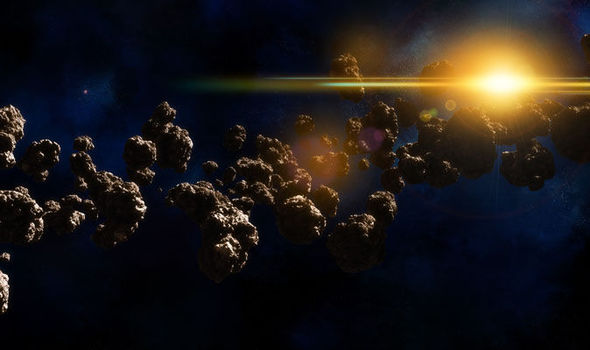
The asteroid belt, located between Mars and Jupiter, is millions of miles of drifting debris. It is the perfect camouflage. If you wanted to park a probe to monitor Earth for a few thousand years, where would you put it? You wouldn’t put it in orbit where we’d see it immediately. You’d park it in the belt. You’d paint it matte black. You’d shape it like a jagged rock. You would turn the lights off and wait.

Astronomers call these potential objects “Lurkers.”

We are constantly discovering new asteroids. Sometimes, we lose them. Sometimes, their orbits are weird. Too stable. Or too erratic. Forgan suggests that what we think is a chunk of iron might be a dormant probe with a hollow interior, watching our TV broadcasts, monitoring our nuclear tests, and sending data back home.

The ‘Oumuamua Incident: Did It Already Happen?

Since Forgan first floated these ideas, reality has started to catch up with theory. Remember 2017?

An object entered our solar system. Astronomers named it ‘Oumuamua (Hawaiian for “Scout”). It was weird. It wasn’t round like a planet or a normal asteroid. It was long. Cigar-shaped. Or maybe flat like a pancake. It tumbled through space.

But here is the kicker: It accelerated.

As it moved away from the sun, it sped up. Comets do that when they off-gas (shoot out steam), but ‘Oumuamua had no tail. No gas. No dust. Physics says it should have slowed down due to the Sun’s gravity. Instead, it pushed the pedal to the metal.

Harvard astronomer Avi Loeb risked his reputation to say what many were thinking: That wasn’t a rock. That was technology. Maybe a solar sail. Maybe a defunct buoy drifting through the stars. It passed right by us, and because we weren’t ready, we missed our chance to catch it.

If ‘Oumuamua was a piece of alien trash drifting through, imagine what could be intentionally hiding in the asteroid belt. Stationary. Active.

The Von Neumann Probe Nightmare

Let’s go deeper. There is a concept in physics called the Von Neumann probe. Imagine a machine that can mine an asteroid, refine the metal, and build a copy of itself. One probe becomes two. Two become four. Four become eight.

In a few million years—a blink of an eye in cosmic time—a single civilization could flood the entire galaxy with these self-replicating drones. They would be everywhere. On every moon. In every asteroid belt.

If this technology is possible (and we are close to doing it ourselves), then the asteroid belt shouldn’t just have one UFO. It should be swarming with them.

So why don’t we see them? Maybe they are programmed to be stealthy. Maybe they are waiting for a specific trigger. A technological milestone. Maybe when we invent warp drive, or when we figure out zero-point energy, the “rocks” in the asteroid belt will suddenly wake up and say hello.

Or maybe they will shut us down.

We Have the Technology (Finally)

The frustration for scientists like Duncan Forgan is that we aren’t helpless anymore. In the past, we were blind. Now, we have eyes.

We have the means to test these hypotheses. We have the Large Synoptic Survey Telescope coming online. We have deep-space radar. We have AI algorithms that can sift through petabytes of data to find “anomalies” that human eyes would miss.

We can look for the heat signatures of engines in the cold belt. We can look for rocks that move against the flow of gravity. We can look for the glint of refined artificial alloys.

Mr. Forgan wants the scientific community to stop being embarrassed. Stop fearing the “giggle factor.” For years, hunting for aliens was seen as career suicide for a serious astronomer. It was for the tin-foil hat crowd.

But as we find thousands of planets orbiting other stars, the math is changing. It is statistically impossible that we are the only ones here. The universe is too old. Too big. Too filled with chemical ingredients.

The Verdict: Keep Your Eyes Open

The claim that “we’ve looked and found nothing” is a lie. It’s a lazy assumption based on a lack of data. We are like a person who walks into a library, reads the title of one book, and declares, “I know everything in this building.”

The asteroid belt is the ultimate frontier for this search. It’s close. It’s accessible. And it is the perfect hiding spot.

Maybe the aliens aren’t little green men. Maybe they are machines. Maybe they are ancient AI left behind by a civilization that died a billion years ago. Or maybe, just maybe, they are the galactic zookeepers, and they are sitting in their camouflaged jeeps in the asteroid belt, watching us monkeys play with nuclear matches, waiting to see if we burn the jungle down.

So, the next time you hear about a “near-Earth asteroid” skimming past our planet, don’t just think of it as a rock. Wonder.

Is it watching?

The search is just beginning. The tip of the iceberg is all we see, but the thing about icebergs? The part that sinks you is the part you never saw coming.

Arindam Mukherjee
Arindam Mukherjee
Arindam loves aliens, mysteries and pursing his interest in the area of hacking as a technical writer at 'Planet wank'. You can catch him at his social profiles anytime.
RELATED ARTICLES
- Advertisment -

Most Popular

Recent Comments

Warren Pan Abbott on The legend of the Devil Monkey !
chris davies on The McPherson Tape Mystery
Reed Reedly on ET has Internet!
Bea Houseoffashion on Proof Of Time Travellers – Gallery
Marcus2012 on ET has Internet!
Reed Reedly on ET has Internet!
LaughsAtConspiracyNuts on The 9/11 Conspiracy – Myths and Facts
Alex Sliverman on Did the ancients fly?
Doctor Wholigan on Time Traveler in 1938 film
chris davies on The McPherson Tape Mystery
Archie1954 on 10 secret UFO hideouts
chris davies on Ghosts of flight 401
Marcus2012 on ET has Internet!
jason Macdonald on Proof of Time Travel? – China
chris davies on Long-Lost Pyramids Found?
Reed Reedly on ET has Internet!
Milkman on Connected Universe
Tenmiles on Baigong Pipes Mystery
Simon Foster on Sirius – The Documentary
From the 1st April on 2013 – Alien Contact date ?
SkyWatcher on Is ET ignoring us?
I Come From The Future on Obama to make UFO Alien disclouser soon ?
Just another person on 2013 – Alien Contact date ?
Malcolm Windowcleaner on The strange case of Rudolph Fentz
Mason Servio on Strange Things on Mars
Marke Wisdom Seeker on What will we find as arctic melts?
Andrea A Elisabeth Levyne on Aliens Captured in Varginha, Brazil
Mitch Grouyeki on Amazing Space Shuttle pictures