The Cosmic Lie: Why the Night Sky is Terrifying
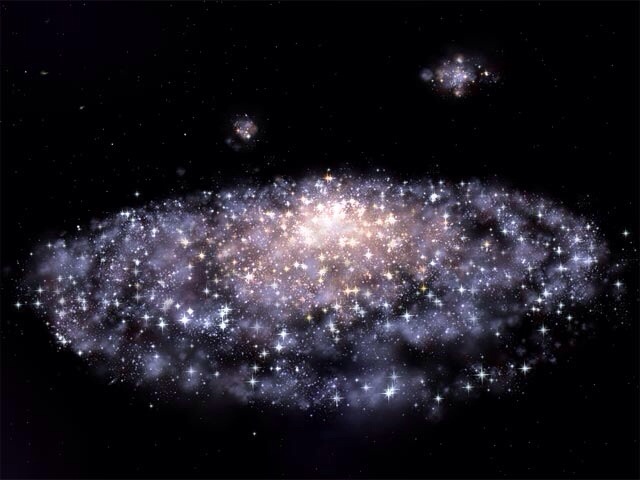
Look at that image above. Really look at it. Does it make you feel small? It should.
But that feeling of insignificance is just the beginning. The story you were told in science class—that space is just a quiet, empty vacuum filled with pretty lights—is a cover for something much more chaotic. Much more violent. And frankly, much stranger.
We are drifting on a tiny raft in a violent ocean of gravity, radiation, and invisible monsters.
So, let’s rip the lid off. What exactly is a galaxy? Why does the math not add up? And what is hiding in the darkness between the stars?
What is a Galaxy? (The Official Story vs. The Reality)
Textbooks will give you the safe answer. They say galaxies are large systems of stars, dust, and gas bound together by gravitational force. They tell you they are elliptical, spiral, or irregular in shape.
That sounds nice. Organized. Tidy.
But think about what “gravitational force” actually implies here. It’s a tug-of-war. A galaxy is a swirling drain. It is a massive structure fighting against the expansion of the universe itself, trying to hold itself together while spinning at mind-numbing speeds.
Our Sun isn’t just sitting there. It is part of a spiral galaxy called the Milky Way. We are located about two-thirds of the way out from the center to the edge. We live in the suburbs. The boondocks. And that’s a good thing. Because the center? You don’t want to be near the center. That’s where the chaos lives.
The Numbers Game: A Math Problem That Breaks Your Brain
We need to talk about scale. The human brain is not wired to understand numbers this big. We can visualize a hundred people. Maybe a stadium of fifty thousand. But a galaxy?
How many stars are in a single galaxy?
The best estimates suggest that the Milky Way contains about 500 thousand million stars.
Read that again. 500. Billion. Stars.
And the mass? It is equivalent to 1.9 million million Suns. That is a number so large it becomes meaningless to us. It’s just noise.
But here is where it gets weird. Galaxies vary in size considerably. It’s not a one-size-fits-all manufacturing line. There are monsters out there.
- The Giants: Giant elliptical galaxies make our Milky Way look like a speck of dust. Some have up to 100 times the mass of our galaxy. That is the equivalent of 1900 million million Suns. Imagine a system so large it consumes everything around it.
- The Ghosts: On the other end of the spectrum, we have the recently discovered Ultra-Compact Dwarf galaxies. These little oddities may have just a few tens of millions of stars. Are they fragments of dead galaxies? Leftovers from a cosmic war? We don’t know for sure.
The Universal Census: Are We Alone?
Here is the question that keeps astronomers awake at night. If our galaxy has 500 billion stars, and there are other galaxies out there… what is the total count?
How many stars and galaxies are in the universe?
Get ready for this.
The best estimates suggest that there are at least 70 thousand million million million stars in the Universe.
That is 70 sextillion. Written out, it looks like this: 70,000,000,000,000,000,000,000.
Think about grains of sand. Go to a beach. Pick up a handful. Now imagine every beach on Earth. Every desert. Every sandbox. The number of stars in the universe is greater than all the grains of sand on our entire planet.
The Universe probably contains more than 100 thousand million (100 billion) galaxies. And those are just the ones we can see. The ones whose light has had time to reach us. What lies beyond the edge of the observable universe? Infinite darkness? Or something else entirely?
If you believe we are the only living things in a space that big, you aren’t thinking logically. The odds against us being alone are astronomical.
Inside the Beast: The Milky Way System
Let’s bring it back home. What does it look like from the inside?
On a dark night, far away from city lights, we can often see a band of light stretching across the sky. The ancients called it a river of milk, or a path of souls. If we look at this band with binoculars or a small telescope, the illusion shatters. We see that it is partially resolved into stars.
This band we call the Milky Way. It is composed of a band of stars, most of which are too faint to be resolved with the naked eye, so we see their combined light as a faint, ghostly glow.
This isn’t just a painting on the ceiling. This band is the plane of the disk of our galaxy.
The Galactic Disc: A Pizza Made of Fire
Imagine a pizza. A pizza made of fire and vacuum. That is our home.
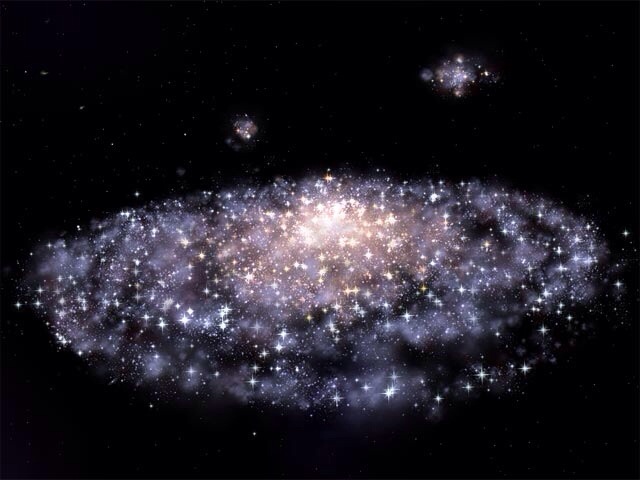
The Sun is one, rather faint, example of approximately 200,000,000,000 stars that make up our galaxy. These stars are mostly grouped into a flattened disk which has a bulge at its center.
Why a bulge? Because gravity pulls everything toward the middle. And what is in the middle? A Supermassive Black Hole called Sagittarius A*. A monster that eats stars for breakfast. We orbit this drain.
The Sun sits in this disk about two-thirds of the way from its center to its edge. This is why our view changes depending on where we look:
- Looking In: When we look at the night sky along the plane of this disk, we see the thick band of the Milky Way. We are looking through the crowded downtown of the galaxy.
- Looking Out: When we look in other directions, out of the plane, we see far fewer stars. We are looking out the window into the void of intergalactic space.
The Old Ones: Population 2 Stars
Not all stars are created equal. The galaxy has a caste system.
There is a spherical component to our galaxy which contains very old stars and spherical clusters of old stars. These are often referred to as Population 2 objects. These are the ancients. The first generation. They are metal-poor and dying.
Population 1 objects are found in the disk. That’s us. We are the new kids on the block, rich in heavy metals like iron and gold—the stuff you need to build planets and people.
The size of our galaxy is huge; light would take about 100,000 years to cross the Galaxy.
Think about that. If you look at a star on the other side of the Milky Way, you are seeing it as it was when humans were just learning to use stone tools. You aren’t looking at space. You are looking at time.
The Missing Mass Conspiracy: What Are They Hiding?
This is where things get spooky. This is where standard physics starts to fall apart.
There are many clusters of galaxies. Members of some of the closest can be seen with a small telescope in the constellations Virgo and Coma Berenices. We can trace clusters of galaxies out to the furthest distances that we can reach. Some of these clusters contain thousands of galaxies.
Near their centers, giant ellipticals are often found. It is thought that these arise from the collision of several galaxies which have combined. A cosmic pile-up.
X-ray studies have shown that there is very hot gas between the galaxies in a cluster. But here is the kicker.
The math doesn’t work.
This gas does not solve one of the great puzzles in astronomy. These clusters require a certain total mass to explain how they are held together. Gravity depends on mass. The more stuff you have, the more gravity you have.
But when scientists count up all the stars, all the gas, all the dust, and all the planets… we can only account for one-tenth of the necessary mass.
90% of the universe is missing.
This is known as the ‘missing mass problem’. You might know it by its modern marketing name: Dark Matter.
But “Dark Matter” is just a placeholder name. It’s a label for “we have no idea what this is.” There is an invisible skeleton holding the universe together. It passes right through you. It is everywhere. And we cannot see it, touch it, or interact with it. Is it a shadow dimension? Is it the ether? Or is our understanding of gravity completely wrong?
The Neighbors: Friends or Enemies?
We are not floating in isolation. We have neighbors. And some of them are getting too close for comfort.
The Satellites
Unfortunately, those of us who live in the northern hemisphere cannot see the two closest galaxies, called the Magellanic Clouds. They are rather like two satellite galaxies to the Milky Way.
Think of them as moons, but instead of rock, they are made of billions of burning stars. They can easily be seen by the naked eye in the Southern Hemisphere, and their brightest stars can be seen with binoculars. These two galaxies are much smaller than the Milky Way and are about 200,000 light-years away.
Recent theories suggest these clouds are being ripped apart by our galaxy’s gravity. We are slowly eating them.
The Andromeda Threat
In the northern sky, we can see two galaxies with the naked eye. The most famous is the Andromeda galaxy, M31. To the eye, it is a faint fuzzy patch. With binoculars, it appears as a lens-shaped object.
It is a galaxy rather like ours at a distance of about 2 million light-years. It has two dwarf elliptical satellites which can be seen with a small telescope.
But here is what the textbooks often gloss over: Andromeda is coming for us.
While the rest of the universe is expanding and moving away, Andromeda is locked onto us. It is hurtling toward the Milky Way at 250,000 miles per hour. One day, billions of years from now, the sky will change. Andromeda will grow larger and larger until it consumes the night.
We will collide. The two galaxies will merge into a deformed giant often nicknamed “Milkomeda.” Solar systems will be flung into the void. The central black holes will merge.
The other galaxy you can see is M33 in Triangulum. It is much harder to see, although it is at a similar distance to the Andromeda galaxy. This is because it is smaller and less bright intrinsically. It too is a spiral galaxy, watching the upcoming collision from the sidelines.
The Final Question
So, we return to the start. What is a galaxy?
It is a survival machine. It is an island of light in a universe that is mostly cold, dark, and dead. It is a mystery wrapped in a riddle, held together by invisible forces we can’t explain.
The next time you look up, remember: You aren’t just looking at pretty lights. You are looking at the evidence of things unseen. The missing mass. The black holes. The collisions.
The universe is busy. Pay attention.
![20131108-014155[1]](https://coolinterestingnews.com/wp-content/uploads/2013/11/20131108-0141551.webp)