We Are Being Watched: The Most Unsettling and Unexplained Anomalies on Google Earth
Stop what you are doing. Open your laptop. Zoom in. The world changed the day Google Earth went live. Suddenly, the entire planet was stripped naked, mapped out in high-definition pixels for anyone with a Wi-Fi connection to see. We used to think the government held all the secrets. We thought only the guys with top-secret clearance and black badges got to see what was really happening on the surface of our blue marble. We were wrong.
The playing field has leveled out. Now, a kid in a basement in Ohio can find something that a frantic scientist at the Pentagon missed. And they are finding things. Weird things. Impossible things.
The digital treasure hunt is on. Millions of “armchair archaeologists” are scouring every square inch of the desert, the ocean floor, and the highest peaks. They are hunting for glitches, hidden bases, ancient ruins, and things that simply should not exist. Is it a trick of the light? A government cover-up? Or proof that our history is a lie?
We are going to dig deep. We aren’t just looking at pretty pictures today. We are ripping the lid off the strangest coordinates ever plugged into a GPS. Buckle up.
The Face in the Clay: A Geological Glitch or Ancient Message?

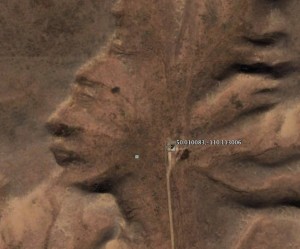
The Badlands Guardian.
Coordinates: 50° 0’36.30”N, 110° 6’46.82”W
Look at that image. Seriously, stare at it. Your brain immediately screams: “That’s a face.” Not just a blob, but a detailed, side-profile of a human head. It’s uncanny. It’s disturbing.
This massive anomaly was spotted by a woman named Lynn Hickox. She wasn’t an explorer. She wasn’t a geologist. She was just scrolling through Google Earth. And there it was. Staring back at her from the arid, cracked earth of southwest Alberta, Canada.
This isn’t a small doodle in the sand. This thing is enormous. The sheer scale forces you to ask questions. If you were standing on the ground right in the middle of it, you wouldn’t see a thing. It’s just hills and valleys. Just dirt. But from the sky? It’s perfect.
The “Earbuds” Conspiracy
Here is where it gets funny. And weird. Look closer at the “ear.” It looks exactly like the figure is wearing a modern Apple AirPod or an old-school wired earphone. The wire trails off down the neck.
Internet sleuths went wild when this broke. Time travel? Ancient prophecy predicting the iPod? The reality is a heavy dose of irony. That “earphone” is actually a road built by humans leading directly to an oil well. The oil well forms the earbud.
Think about that. We drilled into this pristine, ancient formation, scarring the face of the earth, and in doing so, we accidentally gave it a modern accessory. It’s a complete accident. Or is it?
Pareidolia vs. Design
Scientists call this pareidolia. That’s the fancy term for when your brain tries to make sense of random noise—like seeing a dragon in a cloud or Jesus on a piece of toast. They say the Badlands Guardian is just wind and water erosion. A roll of the geological dice.
But the odds are staggering. The jawline. The nose. The brow. It looks distinctly like an Indigenous person wearing a full traditional headdress. And here is the kicker: this formation sits on land that has been home to Indigenous tribes for thousands of years. The land itself formed an image of the people who would one day walk upon it.
Is the Earth alive? Is this a message? Or just the coolest coincidence in Canadian history? You decide.
The Impossible City: How Did They Build This?

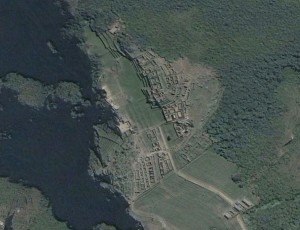
Machu Picchu.
Coordinates: 13° 9’49.69”S, 72°32’42.65”W
Let’s fly south. Way south. To the spine of the Andes mountains in Peru. You know the name. You’ve seen the postcards. But seeing it from a satellite view gives you a chill down your spine that a postcard never could.
Machu Picchu sits on a jagged ridge above the Urubamba Valley. It’s surrounded by straight drops and treacherous terrain. It was built around 1400 AD, right at the height of the Inca Empire. But here is the problem: The Incas didn’t have the wheel.
Read that again. No wheels. No iron tools. No massive cranes. No hydraulic lifts.
Yet, they hauled massive granite stones—some weighing over 50 tons—up the side of a mountain. And they fit them together so perfectly that you cannot fit a credit card between the cracks today, over 500 years later. They didn’t even use mortar. It’s just rock on rock, held together by gravity and terrifyingly precise engineering.
The “Virgins of the Sun” and Other Theories
Why build a city here? It makes no tactical sense. It’s a nightmare to get supplies up there. It’s isolated. It’s cold.
For decades, historians scratched their heads. Was it a military fortress? Unlikely. It’s too small. Was it a prison? Maybe, but the architecture is too beautiful for a jail.
One dark theory suggests it was the final resting place or a sanctuary for the “Virgins of the Sun,” an elite group of women chosen to serve the Inca gods (and the Emperor). Skeletons found at the site were initially thought to be mostly female, fueling this fire.
Newer science suggests a mix of male and female inhabitants. So, the leading theory shifts. Was it the royal estate of the Emperor Pachacuti? A winter getaway for the Inca elite? A place to escape the noise of Cusco?
The Lost Century
The creepiest part isn’t how it was built, but how quickly it died. The city thrived for maybe 100 years. That’s it. One human lifetime. Then, the Spanish Conquistadors arrived in South America, bringing war and smallpox.
But the Spanish never found Machu Picchu. It wasn’t on their maps. They burned other cities to the ground, but this one remained hidden in the clouds. The Incas abandoned it, leaving it to the jungle. It sat there, silent and empty, for centuries until Hiram Bingham “rediscovered” it in 1911 (even though locals knew it was there the whole time).
From space, it looks like a secret kept by the mountains themselves.
The Gobi Desert Code: What is China Hiding?

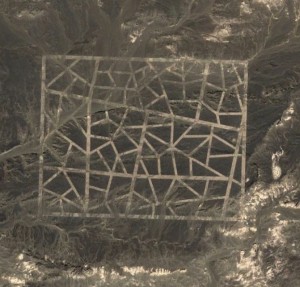
Strange Carved Lines in China.
Coordinates: 40°27’28.56”N, 93°23’34.42”E
Now things get sketchy. We are leaving the ancient world and jumping straight into modern espionage.
In the middle of nowhere, in the Gansu Sheng province of China, the desert floor is scarred with white lines. These aren’t roads. They don’t go anywhere. They are jagged, chaotic, and seemingly random. But when you zoom out? They form a massive, intricate grid.
This was discovered around 2011, and the internet exploded. It looks like a circuit board. Or a map. Or a target.
Target Practice or Alien Communication?
The conspiracy forums lit up instantly. Some people claimed it was a message to UFOs. (It’s always aliens, isn’t it?). Others thought it was a gigantic QR code for spacecraft.
But the real answer might be scarier than aliens. Look at the location. It’s near the Mogao Caves, but more importantly, it’s deep in military territory.
Military analysts have a different theory: Spy Satellite Calibration.
Satellites flying at thousands of miles per hour need to focus their cameras. To do that, they need large, high-contrast targets on the ground with specific geometric angles. These white lines against the brown desert are perfect for that. China puts a satellite in orbit, points it at this grid, and fine-tunes the lens until the jagged lines look sharp.
The “US City” Simulation
There is another theory that will keep you awake at night. Some of these grids in the Chinese desert don’t look random. They look like city streets.
Internet detectives overlayed maps of major American cities—like Washington D.C. or New York—over some of these desert structures. The match wasn’t perfect, but it was close enough to be terrifying. Is the Chinese military building full-scale mock-ups of western cities to practice airstrikes?
Is this a testing ground for missile kill probabilities? Are they simulating an EMP blast grid? The Chinese government isn’t talking. Google Earth is the only window we have, and what we see through it raises more questions than answers.
The Robot of the Desert: Ancient Aliens or Ancient Calendar?

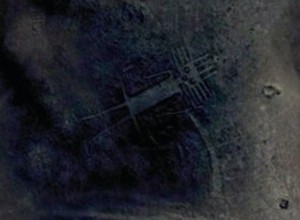
Atacama Giant.
Coordinates: 19°56’56.88”S, 69°38’1.87”W
If you thought the Badlands Guardian was strange, meet the Atacama Giant. Located in the driest desert on Earth—the Atacama in Chile—this guy is a monster. He is the largest prehistoric anthropomorphic (human-shaped) figure in the world. He stands a staggering 282 feet tall.
Look at him. He doesn’t look human. He looks like a child’s drawing of a robot. He has a square head, rigid limbs, and strange antennae sticking out of his skull.
The “Ancient Astronaut” Theory
You know where this is going. Shows like Ancient Aliens love this guy. They look at those “antennae” and say, “Space helmet.” They look at the stiff posture and say, “Space suit.”
The theory is that the local people, sometime between 1000 and 1400 CE, saw visitors from the stars. They didn’t have the vocabulary to explain technology, so they drew what they saw on the side of a hill to worship the “Sky Gods” hoping they would return.
The Time Machine in the Sand
But let’s look at the science, because it is actually way cooler than aliens. This isn’t a drawing of a spaceman. It is a calendar.
The Atacama people were masters of survival in a brutal environment. Knowing exactly when the seasons changed was a matter of life and death. If you planted your crops two weeks too late, your village starved.
Those “antennae” on the Giant’s head? They aren’t for radio signals. They are alignment points.
Researchers discovered that the setting Moon aligns perfectly with different points on the head and the side of the figure at specific times of the year. By watching where the Moon sank in relation to the Giant, the shamans knew exactly when the rainy season was coming (what little rain they got) and when to start the harvest.
It was a massive, landscape-sized tool. A computer made of dirt and stone. That requires a level of astronomical knowledge that rivals anything we have today.
The Global Phenomenon: Signs in the Fields
We can’t talk about aerial mysteries without talking about the granddaddy of them all.
Crop circles. They appear overnight. One evening, a farmer has a field of wheat. The next morning, that field has been flattened into a complex geometric pattern that is mathematically perfect.
Google Earth is littered with them. While many have been proven to be hoaxes—guys with planks of wood and rope stomping around in the dark—some defy explanation.
The Microwave Anomaly
In the “authentic” circles (the ones that aren’t obvious fakes), strange things happen. The stalks of the wheat aren’t broken. They are bent at the nodes.
Biophysicists have analyzed samples and found that the plant’s internal structure has been altered, as if it was subjected to an intense, split-second burst of microwave radiation. The water inside the stem boils and blows out the nodes, softening the plant so it falls over without snapping.
Guys with planks of wood can’t do that.
Furthermore, strange magnetic radiation has been detected inside fresh circles. Batteries die. Cameras fail. People get headaches.
Are these warnings? Art? Or is the Earth itself generating these patterns through some magnetic natural force we don’t understand yet?
Keep Watching the Skies
Google Earth updates constantly. Every day, new satellites snap new photos. The Badlands Guardian, the Atacama Giant, the secret bases in China—these are just the things we have found so far.
What is hiding in the Amazon rainforest, shielded by the canopy? What is buried under the ice of Antarctica, waiting for the thaw?
The truth is out there. And for the first time in history, you don’t need a spaceship to find it. You just need a mouse. Go look.