The Greatest Cover-Up You’ve Never Heard Of
Let’s play a game. When I say “Watergate,” what do you see? A shadowy garage. A paranoid President. Tapes. Lies. A disgraced leader fleeing Washington in a helicopter. It’s the political scandal that defined a generation, the gold standard for corruption. It’s the story we all think we know.
But what if it wasn’t the whole story? Not even close.
What if the break-in at the Democratic National Committee headquarters was just the loose thread they wanted you to pull? What if the real crime, the truly massive, history-altering cover-up, happened a year later, cloaked in smoke and flames, far from the prying eyes of Washington D.C.?
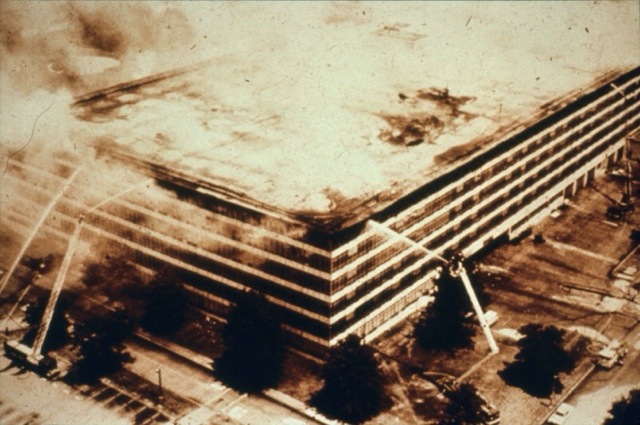
On July 12, 1973, as the Watergate hearings reached a fever pitch, a colossal fire erupted in a suburb of St. Louis, Missouri. The target? A six-story concrete fortress called the National Personnel Records Center (NPRC). Inside, millions upon millions of the nation’s most sensitive military records were stored. The official story is that it was a tragic accident. An unfortunate, poorly-timed disaster.
But when you dig deeper, when you look at the timing, the target, and the sheer convenience of it all… the official story begins to feel as thin as burnt ash. This wasn’t just a fire. This was, quite possibly, a surgical strike against American memory. A deliberate act of historical arson designed to bury secrets so dark they could have brought down more than just a presidency.
A Fortress of Paper, A Tinderbox by Design
First, you have to understand what the NPRC building was. It wasn’t just some warehouse. This was a purpose-built archive, constructed in 1956 for one reason: to hold the ghosts of America’s military past. It was a brutalist concrete monolith, a windowless behemoth covering the equivalent of one and a half football fields. It was meant to be impregnable. Permanent.
And yet, it was built with a fatal flaw. A flaw so obvious, so mind-bogglingly reckless, you have to wonder if it was intentional.
The entire facility, a structure holding nearly 50 million irreplaceable, one-of-a-kind personnel files, had no sprinkler system. None. It also had no heat or smoke detectors to automatically report a fire. The vast, cavernous floors, packed to the ceiling with dry, aging paper, were not separated by firewalls. It was, in essence, the world’s largest, best-stocked fireplace, just waiting for a match.
The fire started shortly after midnight on the sixth floor. This is critical. The sixth floor was where the U.S. Army and Air Force records were kept, specifically for personnel discharged between 1912 and 1963. We’re talking about the records for World War I, World War II, the Korean War, and the very beginnings of the Vietnam conflict. An estimated 16 to 18 million files. All of them original. No copies. No microfilm backups. When they were gone, they were gone forever.
The Blaze That Burned for Days
The fire raged uncontrollably. Firefighters arrived to a nightmare scenario. A concrete oven with no windows to vent the heat or direct their hoses through. They were forced to punch holes in the roof and concrete walls just to get water on the blaze. The heat was so intense it warped steel and buckled concrete. For four agonizing days, the building burned, spewing a thick black plume of incinerated history into the Missouri sky.
By the time it was over, the entire sixth floor was a catastrophic loss. A soggy, charred wasteland of what was once the documented lives of millions of American service members. A few records from the Navy and Marine Corps were also lost, simply because they had been temporarily moved to the sixth floor for processing. Just a case of being in the wrong place at the wrong time. Or was it?
Watergate’s Shadow: A Motive Hiding in Plain Sight
To understand why this “accident” seems so suspicious, you have to zoom back to Washington in July 1973. The Nixon administration wasn’t just in trouble; it was in a full-blown, five-alarm panic. The Watergate scandal was metastasizing daily. Key aides were turning on the President. The concept of “impeachment” was being whispered in the halls of Congress.
The pressure was immense. Unbearable. The White House was a fortress under siege, and Richard Nixon and his loyalists were desperately looking for ways to stop the bleeding, to control the narrative, to bury the evidence.
And what is the ultimate way to bury evidence? You don’t hide it. You don’t shred it piece by piece. You obliterate it. You turn it to ash and smoke, and then you blame the disaster on faulty wiring or a stray cigarette.
The Walls Are Closing In: July 1973
The timing is everything. The NPRC fire started on July 12th. Just days later, on July 16th, White House aide Alexander Butterfield would drop the bombshell that changed everything: he revealed the existence of Nixon’s secret White House taping system. This was the smoking gun. The moment the investigation went from a political scandal to a constitutional crisis.
Think about the mindset inside the White House at that precise moment. They knew the walls were closing in. They knew investigators were digging into every dark corner of their operations. Operations that went far beyond a simple B&E at the Watergate. We’re talking about the “Plumbers,” Nixon’s secret team of ex-CIA and FBI agents tasked with plugging leaks and playing political hardball. These were men who conducted illegal wiretaps, stole documents, and performed “black bag” jobs. Men like G. Gordon Liddy and E. Howard Hunt.
And where would you find the complete, unredacted service histories of men like that? Where would you find the official records of their training, their assignments, their connections? You’d find them at the National Personnel Records Center. On the sixth floor.
What Secrets Went Up in Smoke? The Billion-Dollar Question
This is where the story shifts from a political scandal to a deep, dark conspiracy. If the fire was arson, what was the target? What information was so dangerous that 18 million files had to be sacrificed to ensure its destruction?
Deep Dive: The E. Howard Hunt Connection
Let’s focus on E. Howard Hunt, one of the masterminds of the Watergate break-in. Hunt was not just some political operative; he was a career CIA officer, a veteran of the agency’s most notorious operations. He was involved in the 1954 Guatemalan coup. He helped plan the disastrous Bay of Pigs invasion. His name is consistently, and controversially, linked to investigations surrounding the assassination of President John F. Kennedy.
Hunt’s military and intelligence records would have been a treasure trove. A roadmap of the American deep state. They could have contained details of covert actions, names of other operatives, and evidence of illegal activities that made Watergate look like petty theft. By July 1973, Hunt was cooperating with prosecutors, but he was also blackmailing the White House, demanding hush money to keep quiet about the “seamier things” he had done for them.
Could his files—and the files of others like him—have contained information linking the Nixon administration not just to Watergate, but to the political assassinations and covert turmoil of the 1960s? Destroying those records wouldn’t just be about covering up Watergate. It would be about wiping the slate clean on a decade of darkness.
Deep Dive: The Ghosts of Vietnam and Dallas
The destroyed records covered the Army and Air Force from 1912 to 1963. That latter date is chilling. 1963. The year JFK was assassinated in Dallas. The records would have contained the files of Lee Harvey Oswald, who was a Marine, but also countless other military figures whose names have surfaced in the JFK investigation over the years. Was there something in those files that could have cracked open the biggest murder mystery in American history? Something that pointed to a conspiracy far larger than a lone gunman?
Furthermore, the records covered the early advisory years of the Vietnam War. This was a period rife with covert operations, secret escalations, and political maneuvering. The Pentagon Papers, leaked in 1971, had already revealed decades of government lies about the war. What other skeletons were hiding in the military archives? Evidence of illegal bombing campaigns? War crimes? The kind of information that, if revealed during the already-volatile Watergate crisis, could have completely shattered public trust in the entire U.S. government.
It’s a terrifying thought. That someone, facing exposure, would rather burn a library of American history than let a single, damning book be read.
The ‘Investigation’ That Found Nothing and Asked Little
So, what did the official investigation conclude? How did this catastrophic fire in a supposedly secure federal building start?
The answer is almost comical in its absurdity.
After a two-year investigation, officials couldn’t pinpoint a cause. They offered up a few weak possibilities. Maybe a lit cigarette was carelessly tossed into a trash can by a janitor. Or—and this is the truly wild one—the records may have spontaneously combusted. Yes, you read that right. The official report speculated that extreme heat and a lack of ventilation on the sixth floor could have created a pressure-cooker environment where the brittle, old paper just… caught fire on its own.
Spontaneous combustion. Of paper. It’s a convenient, blame-free explanation that requires no villain. No conspiracy. Just a freak accident of physics. It neatly closed the case, allowing everyone to move on. But it never sat right with anyone who looked closely. Arson was never seriously pursued, despite the incredibly convenient timing and the monumental stakes of the information that was lost.
No one was ever held accountable. Not for the fire, and not for the criminally negligent lack of safety systems in the building. It was just a tragedy. End of story. Move along.
Echoes in the Ashes: The Legacy of the Lost Records
Today, the fire of 1973 is more than a conspiracy theory. It’s a gaping hole in our nation’s history. For decades, millions of veterans and their families have been unable to access their records to claim medical benefits, military honors, or simply piece together their family history. The VA and the National Archives have spent millions of man-hours painstakingly trying to reconstruct files from other sources, but the vast majority of what was lost is gone for good.
The internet has kept the questions alive. On forums and message boards, amateur sleuths and historians continue to connect the dots, pointing to the inconsistencies in the official story and the overwhelming motive for a cover-up. They see the fire not as a footnote to Watergate, but as its explosive, terrifying climax.
Was it the perfect crime? An act of destruction so total that it left behind no evidence, only questions? We may never know for sure. The men who might have given the order are long gone. The paper trail they sought to destroy is now just ash and memory.
But the story serves as a chilling reminder. Sometimes the biggest conspiracies aren’t whispered in secret meetings; they are carried out in plain sight, under the cover of a disaster so huge and so tragic that no one dares to ask the right questions. The smoke over St. Louis cleared a long time ago. The smoke in the halls of power never has.