The Official Story is a Lie: Vesta Isn’t a Dead Asteroid, It’s the Painted Corpse of a Murdered World
Let’s get one thing straight. The story you were told is boring. It’s sterile. And it might just be a cover-up.
Back in 2011, NASA’s Dawn spacecraft sidled up to a giant in the asteroid belt. A rock named Vesta. For over a year, it sent back pictures. Thousands of them. And what did we see? A lumpy, gray, potato-shaped world. Pockmarked with craters. Dead. Dull. Another chunk of cosmic debris floating in the void. Case closed, right?
Wrong.
So, so wrong.
Because while the world was shown a monochrome graveyard, a team of scientists in Germany saw something else. They looked at the same data, the same raw information beamed back from Dawn, and they found a secret language hidden in the light. A story written in impossible colors. A story of unimaginable violence, strange materials, and the ghost of a world that was.
This isn’t just an asteroid. This is a crime scene. And the evidence has been hiding in plain sight all along.
The Gray Lie They Showed the World
First, you have to understand what Vesta is supposed to be. It’s not just any old asteroid. Scientists call it a “protoplanet.” A survivor. It’s a baby planet that never quite grew up. A fossil from the dawn of our solar system, over 4.5 billion years ago. It’s big enough that it has a differentiated core, mantle, and crust, just like Earth. It was on its way to becoming a full-fledged planet before Jupiter’s immense gravity threw a wrench in the works, scattering the building blocks and leaving Vesta an orphan.
So when the Dawn probe arrived, the expectation was to see a time capsule. A glimpse into the violent, chaotic birth of planets. And the initial images seemed to confirm just that. Gray, battered, and ancient. We saw craters inside of craters. We saw a surface that had been sandblasted by smaller impacts for billions of years. It fit the narrative perfectly. Nothing to see here, folks. Just old rocks.
Cracking the Code: The German Scientists Who Found the Truth
But the story doesn’t end there. It almost never does. Years after the initial media blitz, scientists at the Max Planck Institute for Solar System Research in Germany decided to take another look. They weren’t satisfied with the gray potato. They knew that the camera on Dawn didn’t just see in black and white. It captured light at different wavelengths, many of which are invisible to the human eye.
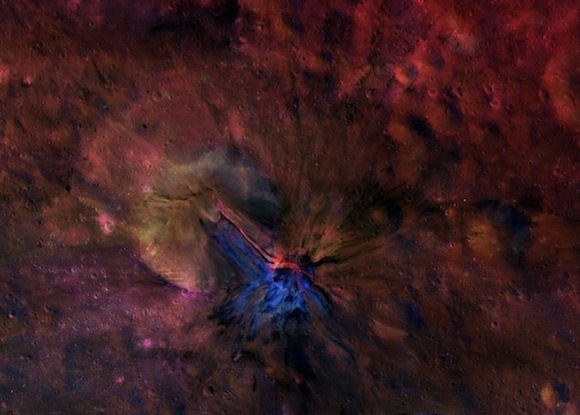
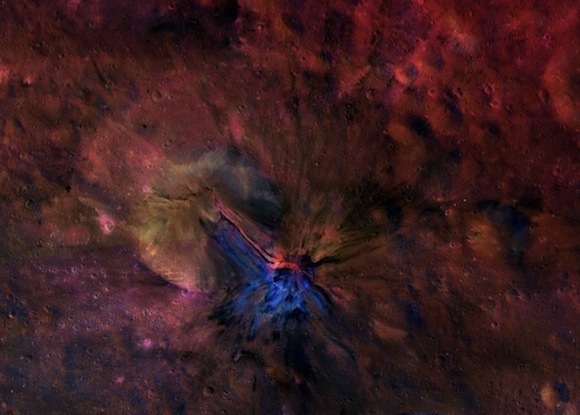
What did they do? They took that hidden data and assigned colors to it. Red, green, blue. A process called false-color imaging. This isn’t just about making a pretty picture. It’s a forensic technique. Different minerals reflect light in different ways. By assigning colors to these subtle variations, you can create a geological map that reveals the composition of the surface. It’s like putting on a pair of glasses that lets you see the chemical soul of a world.
And when they did… Vesta exploded into life.

A Psychedelic Rainbow on a Dead World
The result was staggering. The dead, gray rock was gone. In its place was a world painted in psychedelic swirls of green, yellow, orange, and blue. Craters glowed with alien hues. Vast plains were stained with materials that clearly didn’t belong. It was a Jackson Pollock painting stretched across 300 miles of rock.
Suddenly, the story wasn’t simple anymore. This wasn’t just random cratering. This was a complex history of geological activity, strange contamination, and cataclysmic events on a scale that boggles the mind.
Martin Hoffman, a member of the framing camera team at Max Planck, was left speechless by the revelation. “No artist could paint something like that,” he said. “Only nature can do this.”
Or was it something else?
Deep Dive: The Scars of an Ancient War?
Let’s talk about the craters. The “official” story says Vesta was battered by random asteroids over billions of years. Okay, fine. But look closer. Look at the south pole. Vesta isn’t just cratered. It has been almost completely obliterated by two of the largest impacts in the entire solar system.
The first, Veneneia, is a 250-mile-wide basin. The second, a monster named Rheasilvia, is over 310 miles wide and sits right on top of it. That’s wider than the entire asteroid itself! This impact was so powerful it gouged out a central peak that stands 14 miles high—more than twice the height of Mount Everest. It excavated one percent of the entire volume of Vesta and blasted millions of tons of its crust into space, creating an entire family of smaller asteroids that still orbit the sun today.
Think about the energy required for that. It’s not a fender bender. It’s a planetary kill shot.
The Double Tap That Nearly Shattered a World
This wasn’t a random peppering of small rocks. This was two distinct, colossal, world-ending impacts in the same location. First one, then another. A cosmic double tap. Does that sound like a coincidence to you?
What if this wasn’t an accident? What if something—or someone—was trying to destroy Vesta? In the chaotic early solar system, when planets were jockeying for position, was Vesta a competitor that needed to be eliminated? A budding world that posed a threat? The two giant impacts at the south pole look less like random chance and more like a targeted assault designed to crack the protoplanet open like an egg.
The false-color images make it even clearer. The area around Rheasilvia glows with a different composition. The deep green hues suggest exposed material from Vesta’s mantle. The impactor didn’t just leave a dent; it performed open-heart surgery on a planet, exposing its guts to the vacuum of space.
Are These Alien Trenches Girdling a Planet?
The strangeness doesn’t stop with the craters. The impact at the south pole was so violent that it sent shockwaves reverberating through the entire world. These shockwaves, according to the mainstream explanation, created a series of massive, parallel grooves and troughs that encircle Vesta’s equator.
Some of these trenches are over 12 miles wide and hundreds of miles long. They are unbelievably straight. Unnaturally straight.
Nature rarely draws in straight lines. Not on this scale. Fault lines on Earth meander. They crack and splinter. But the grooves on Vesta are different. They look almost… engineered. Like a massive, planet-spanning transportation system. Or the foundations of a shattered megastructure. Or defensive trenches dug in preparation for a war that was ultimately lost.
When you see the images, you can’t unsee it. The theory is that the Rheasilvia impact buckled the crust on the opposite side of the planet. But could it be that the impact didn’t *create* the trenches, but rather *revealed* them? Shattering a brittle outer shell to show the structured framework underneath? It’s a wild thought. But on a world that’s already defied expectations, what’s off the table?
The Smoking Gun: What is the “Foreign” Material Scattered Across Vesta?
This is where it gets really weird. The color images didn’t just show the native rock of Vesta. They revealed splotches and streaks of material that is chemically different. “Foreign material,” the scientists called it. The official explanation is that this is dark, carbon-rich dust from low-speed impacts of other, more primitive asteroids.
But the distribution is strange. It’s not uniform. It’s concentrated in specific areas, often associated with craters. The psychedelic images show these deposits as dark, almost black patches against the brighter greens and yellows of Vesta’s own soil.
So, what is this stuff?
Let’s entertain a different idea. If Vesta was the site of an ancient conflict, this “foreign material” could be debris. The shrapnel of whatever was used in the attack. The remnants of destroyed ships or weapons. When you’re looking at chemical signatures from 4 billion years ago, how could you tell the difference between a carbon-rich asteroid and the wreckage of a carbon-based technology?
Traces of the Visitors
Modern internet theories have jumped on this. Some analysts point to specific dark patches that seem to have a linear or geometric pattern, almost like a crash skid. Is it a stretch? Absolutely. But is it impossible? The universe is a very big, very old place.
To assume that our tiny corner of it has always been empty and quiet is the ultimate form of arrogance. The evidence on Vesta, now painted in glaring color, suggests a history far more complex and violent than a simple story of planetary formation. This dark material could be the smoking gun—the wreckage left behind by the “visitors” who nearly tore this world apart.
The Ultimate Secret: A Ghost of an Ocean on a Dead Protoplanet?
Perhaps the most shocking discovery of all, hinted at by the Dawn mission and supported by analysis of meteorites from Vesta that have crashed on Earth, is the presence of water.
Let that sink in. Water.
Not flowing oceans, but minerals that have water locked into their crystalline structure. Hydrated minerals. The leading theory is that this water was delivered to Vesta by the very same carbonaceous asteroids that left the dark material. It means that, in its ancient past, Vesta had all the ingredients for life: a heat source from its molten core, organic compounds from impacts, and water.
Was Vesta once a wet world? A small, habitable ocean world in the early solar system, before the great bombardment began? The colors tell the tale. Certain shades in the false-color maps correspond to these hydrated minerals. We can literally see the ghost of water on a world we thought was bone dry.
So what happened? If Vesta had water, where did it go? Maybe the cataclysmic impact that created Rheasilvia boiled it all away. Perhaps the “war” that scarred Vesta was a fight over resources. A fight over its water. The attack didn’t just break the planet; it sterilized it, boiling off its nascent oceans and turning a potential cradle of life into the tomb we see today.
Vesta Today: A Warning or a Blueprint?
Looking at the psychedelic, beautiful, and terrifying images from the Max Planck Institute, you have to ask yourself what you’re really seeing. Is it just the chaotic beauty of nature? Or is it a 4.5-billion-year-old warning?
Vesta is not a failure. It’s a survivor. It withstood an attack that would have vaporized a smaller body. It wears its scars like a badge of honor, now revealed in vibrant color for all to see.
The story of Vesta is a reminder that the solar system isn’t a quiet, clockwork mechanism. It was, and still is, a dangerous place. The secrets of our own origin, and perhaps the origin of others, are not buried in plain text. They are written in a hidden language of light, chemistry, and color on the scarred faces of worlds like Vesta.
NASA showed us a gray rock. But the truth is a masterpiece of cosmic violence. A story of a world that was, a world that was almost destroyed, and a mystery that is just now beginning to unfold. They aren’t just pretty pictures. They are clues. And they tell us we know a whole lot less about our own backyard than we think we do.
![20131219-010659[1]](https://coolinterestingnews.com/wp-content/uploads/2013/12/20131219-0106591.webp)