The Astronauts Who Knew Too Much: What NASA’s Heroes Saw in the Void
We’ve all seen the footage. The grainy, black-and-white images of Neil Armstrong taking that one small step. A monumental moment. A victory for all mankind. For a brief, shining instant, the entire world held its breath and watched as humanity touched another world. It was a story of courage, science, and the unbreakable human spirit.
But what if that’s not the whole story? What if, beyond the cheering crowds and the ticker-tape parades, there’s a darker, stranger narrative? A story whispered by the very men who strapped themselves into rockets and shot for the stars. A story of objects that weren’t supposed to be there. Of quiet conversations with Mission Control that hinted at something more. Of a reality so mind-bending that it had to be buried under decades of official denial.
Forget the history books for a moment. Forget the sanitized, NASA-approved version of events. We’re going deep into the personal logs and public confessions of America’s greatest astronauts. Because the men who walked on the moon and pioneered the final frontier saw things. And some of them are finally talking.
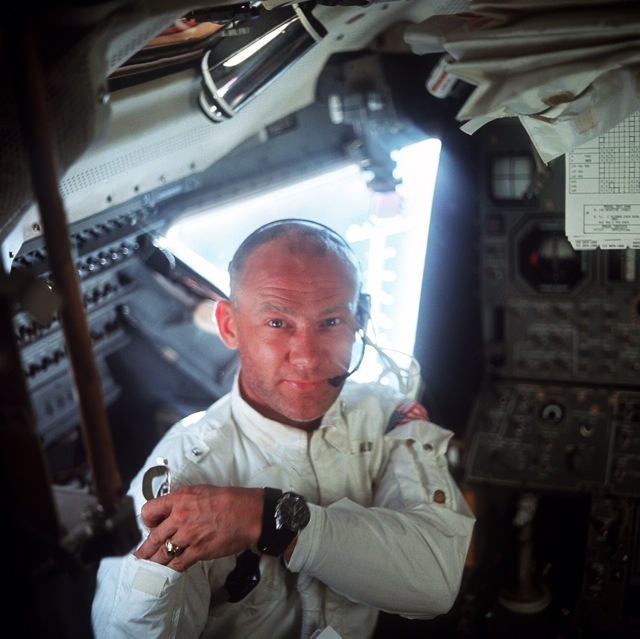
Buzz Aldrin and the L-Shaped Anomaly
Let’s start with the big one. Apollo 11. The main event. Neil Armstrong, Michael Collins, and Buzz Aldrin. Three men in a tiny command module, hurtling through the blackness on their way to the Moon. They were utterly, completely alone.
Or were they?
For years, a story simmered just below the surface. A rumor. A persistent piece of space lore. Then, in a 2005 interview, Buzz Aldrin—the second man to walk on the lunar surface—seemed to let it slip. He spoke of an object they saw pacing their craft on the three-day journey to the moon.
“There was something out there that was close enough to be observed,” Aldrin recalled, his words carefully chosen. He described how the crew watched this… thing… through their telescope.
“Mike [Collins] decided he thought he could see it in the telescope and he was able to do that,” Aldrin explained. “When it was in one position, it has a series of ellipses. But when you made it real sharp, it was sort of L-shaped.”
An L-shape. In the middle of nowhere. A million miles from anything.
Houston, We Have a Problem… That We Can’t Talk About
Think about the psychology of that moment. You’re one of three human beings in the void. You see something inexplicable. Your first instinct is to radio home, right? To shout, “Hey Houston, what the hell is that?”
They didn’t. Aldrin was crystal clear about why. “Obviously the three of us were not going to blurt out, ‘Hey Houston, we’ve got something moving alongside of us and we don’t know what it is… We weren’t about to do that, because we know that those transmissions would be heard by all sorts of people and who knows what somebody would have demanded? That we turn back because of aliens, or whatever the reason.”
The fear wasn’t just of the unknown object. It was fear of mass panic. Fear of the mission being scrubbed. So they played it cool. They subtly asked Houston for the location of the S-IVB, the final rocket stage that had pushed them toward the moon before being jettisoned. Mission Control reported back: The S-IVB was 6,000 nautical miles away.
Six. Thousand. Miles.
Aldrin’s response was chilling in its simplicity: “We really didn’t think we were looking at something that far away.” The object they saw was close. It was keeping pace. And it wasn’t theirs.

The Official Story vs. The Astronaut’s Eyes
Of course, there’s an official explanation. After Aldrin’s comments blew up online, NASA and even Aldrin himself walked the story back. The new consensus was that it was probably one of the four panels that connected the command module to the lunar lander, which had been jettisoned earlier. These panels, tumbling in the sunlight, could perhaps appear L-shaped from a distance.
Case closed? Not so fast.
This explanation has always felt… unsatisfying. The astronauts were the best of the best. Highly trained observers. Would they really be unable to identify a piece of their own spacecraft? Would they really be so concerned about causing a panic over a piece of floating debris? And what about the distance? They felt it was close, not thousands of miles away where the other main piece of hardware was. The crew decided to stop talking about it and wait for the mission debriefing. The secret, whatever it was, would be kept.
For decades, it was. But the genie was out of the bottle. And Aldrin wasn’t the only astronaut with a story to tell.
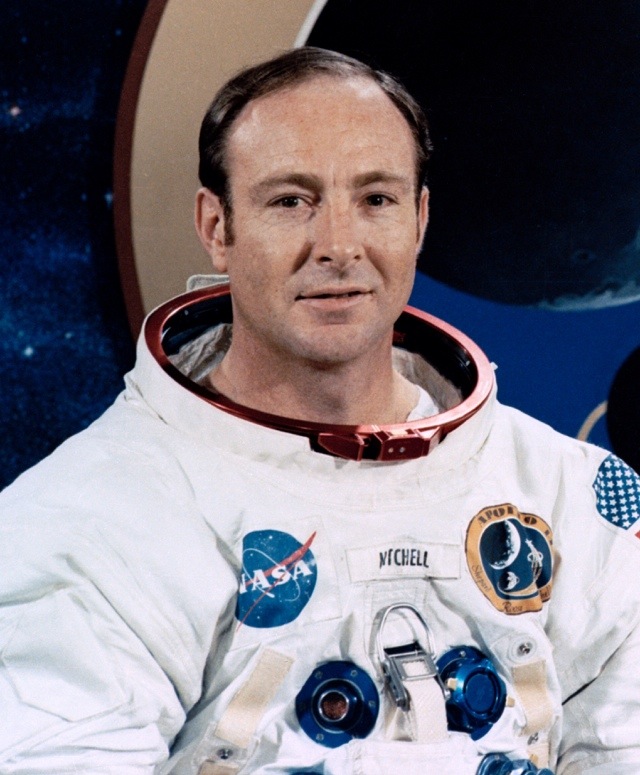
Edgar Mitchell: The Moonwalker Mystic
If Buzz Aldrin was the reluctant witness, Dr. Edgar Mitchell was the true believer. The sixth man to walk on the moon during the Apollo 14 mission in 1971, Mitchell was not your typical test pilot. He held a Doctorate in Aeronautics and Astronautics from MIT and later founded the Institute of Noetic Sciences, an organization dedicated to studying consciousness and the nature of reality.
This was a man who explored both outer space and inner space. And he was absolutely convinced we are not alone.

Unlike Aldrin, Mitchell didn’t just hint. He kicked the door down. In numerous interviews, he stated without hesitation that aliens are real, that they have visited Earth, and that a massive government cover-up has been in place for over 70 years. He claimed his sources were not crackpots on the internet, but high-level contacts he made within military and intelligence circles after his return from the moon.
“I don’t know how many or where or how they’re doing it, but they’ve been observing us and here for quite some time. We see these craft all the time,” he once told a reporter, as if he were discussing the weather. He was certain that the famous 1947 Roswell incident was real—the crash of an extraterrestrial vehicle. He insisted that insiders who were there had confided in him.
“I believe what I’m saying and I cite the evidence that I know,” Mitchell declared. NASA’s official response? A polite but firm statement: “NASA is not involved in any sort of cover-up about alien life on this planet or anywhere in the universe… Dr. Mitchell is a great American, but we do not share his opinions on this issue.”
An American hero. A man of science. A moonwalker. Calling the government’s biggest secret a lie. Who are you supposed to believe?
The Forbidden Transcript: Were They “Warned Off” the Moon?
This is where the story dives off the deep end. For decades, a document has circulated in the UFO community known as the “secret Apollo 11 transcript.” The official story is that there was a two-minute loss of signal during the moon landing. The unofficial story is that the blackout was intentional, to hide what Armstrong and Aldrin were really seeing.
The alleged transcript, supposedly leaked by a sympathetic NASA employee named Otto Binder, is pure dynamite. Binder was a real person, but he was a famous science fiction author, which critics say proves the transcript is a fake. Supporters argue he was the perfect cutout—a believable source who could also be easily discredited.
According to this explosive text, the conversation between the moon and Mission Control went something like this:
Apollo 11: “These babies are huge, sir! Enormous! Oh my God! You wouldn’t believe it! I’m telling you there are other spacecraft out there… lined up on the far side of the crater edge! They’re on the moon watching us!”
The transcript claims that Mission Control, and an unnamed professor, press the astronauts for details. What did they see? The answer, attributed to Neil Armstrong himself, is the stuff of nightmares.
When asked what happened, the transcript quotes Armstrong as saying, “We were warned off.”
Warned off? Warned off the MOON? By whom? The document continues, with Armstrong supposedly explaining later in a secure debriefing:
“I can’t go into details, except to say that their ships were far superior to ours both in size and technology—Boy, were they big … and menacing. … No, there is no question of a space station.”
Is it real? NASA, of course, denies it with every fiber of its being. A senior NASA scientist, David Morrison, has publicly stated, “There were no aliens on the moon. Armstrong and other Apollo astronauts saw no evidence of aliens either on the near-side or the far-side of the moon.”
It’s a hoax, they say. A fabrication. But the story won’t die. It taps into a deep-seated suspicion that the Apollo missions discovered something profound. Something that humanity was not ready for. Something that explains why, after a handful of missions in the late 60s and early 70s, we just… stopped going back.
Gordon Cooper: The Original Hero’s UFO Files
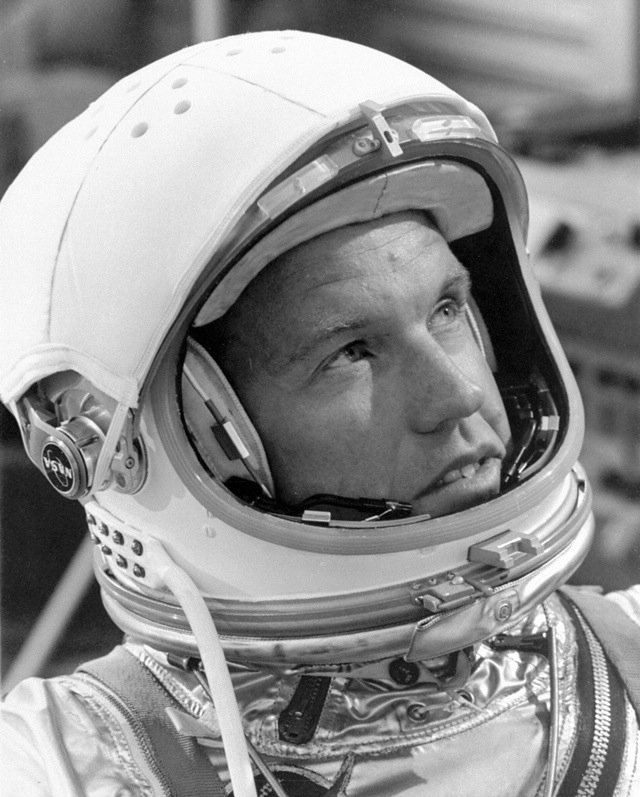
Long before Apollo, there were the Mercury Seven. The original astronauts. The icons. And among them was Leroy “Gordon” Cooper, a decorated test pilot and a bona fide American hero. And he saw UFOs. Not once, but twice. And he was not quiet about it.

Cooper’s first encounter happened way back in 1951. While flying for the Air Force in Germany, he and his fellow pilots witnessed a fleet of metallic, saucer-shaped objects flying in formation at an incredible altitude and speed. “We couldn’t get anywhere near their altitude,” he said in a 1996 interview.
They filed a detailed report. The official response that came back months later was so absurd it was insulting. His superiors told him they were “probably high-flying seed pods.”
The Saucer That Landed at Edwards Air Force Base
The seed pod story was laughable. But his second encounter was undeniable. In 1957, Cooper was a project manager at the legendary Edwards Air Force Base in California, the proving ground for America’s most advanced aircraft. A camera crew he managed was filming on a dry lake bed when something extraordinary happened.
A shining, silver, saucer-shaped craft descended from the sky and landed on three extended legs not far from the crew. They filmed the entire event. Cooper himself didn’t see the landing, but he was alerted immediately. He saw the developed film with his own eyes.
“It had three landing legs. They approached it and it took off,” he stated plainly. As the officer in charge, he followed protocol. He put the film in a secure pouch and sent it straight to the Pentagon. He expected a follow-up. An investigation. Something.
He got nothing. Silence. The film vanished into the bureaucratic black hole. No one ever spoke to him about it again. The event was erased from history.
Gordon Cooper went to his grave insisting that he saw that film and that the government buried it. He even testified before the United Nations, pleading for an end to the secrecy. He believed the cover-up was more dangerous than the truth itself.
What Does It All Mean?
One astronaut’s strange story can be dismissed. A misidentification. A trick of the light. But when you have a pattern, when you have multiple American heroes—the best pilots, the sharpest minds, the men we trusted to carry our dreams to the stars—all telling similar stories, you have to stop and wonder.
Aldrin’s L-shaped object. Mitchell’s insistence on a 70-year cover-up. Cooper’s confiscated film. The enduring legend of Armstrong’s “warning.”
These aren’t random people. They are the men who went there. They breathed the recycled air of the spacecraft, felt the rumble of the Saturn V rocket, and looked back at the “pale blue dot” of Earth from a place of profound silence and perspective.
Perhaps they saw space debris. Perhaps their minds, under incredible stress, played tricks on them. Or perhaps, just perhaps, in the vast, dark ocean between worlds, they discovered that we are not, and have never been, alone. The official story is written in history books. The real story might still be locked away in a classified vault, waiting.