Ice & Aliens: The Chilling Secret of the USS Trepang’s 1971 UFO Photos
The year is 1971. The Cold War is a frozen, silent stalemate. Deep beneath the Arctic ice, a predator stalks the crushing dark. She is the USS Trepang (SSN-674), a Sturgeon-class nuclear attack submarine, one of America’s deadliest hunter-killers. Her mission is simple: hunt Soviet boomers and gather intelligence in one of the most hostile environments on Earth. Silence is her shield. Secrecy is her sword.
But something else was in those waters.
Something not on any chart. Something that wasn’t Russian. Or American. Or anything from this world.
A set of grainy, mysterious photographs, allegedly snatched from the brink of oblivion, tell a story so bizarre it defies belief. They show… things. Unidentified craft maneuvering with impossible speed and grace between the sky and the sea. For decades, they were nothing more than a whisper, a legend shared in the shadowy corners of the internet. Now, we drag them into the light.
What did the crew of the USS Trepang witness in the icy void between Iceland and Jan Mayen Island? And why did someone go to such great lengths to make sure we never saw these pictures?
A Bombshell from the Blue
The story doesn’t start in an official government archive. Of course not. The good ones never do. It begins, as many of these tales do, with a plain brown envelope. Allegedly, an anonymous source sent a collection of photographs to the French paranormal magazine “Top Secret.” No note. No explanation. Just the images, pregnant with mystery.

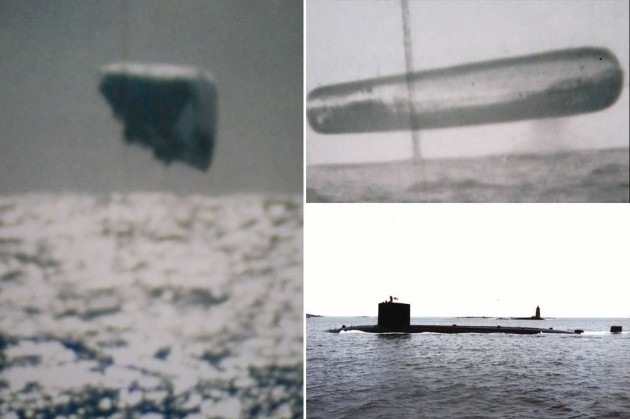
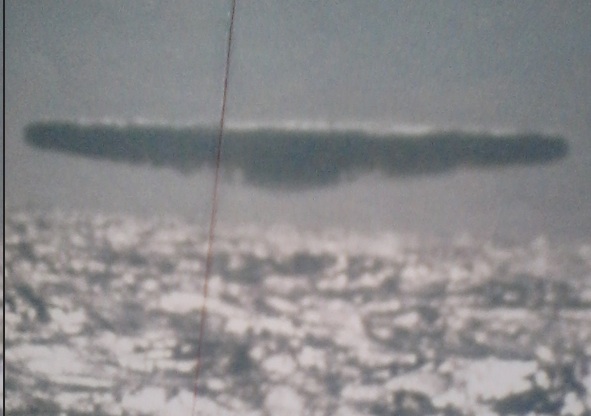
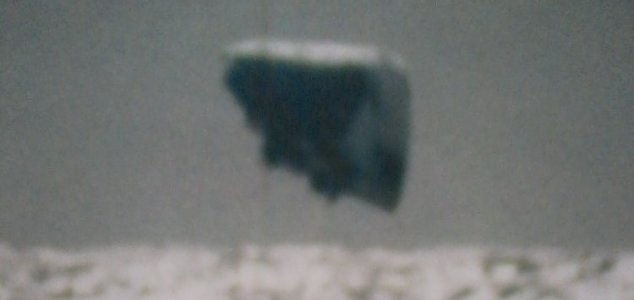
The images were a chaotic jumble. Some showed a massive, blimp-like object. A cigar, hovering silently over the frigid waves. Others captured a different craft entirely—a sharp, black, triangular shape that seemed to slice through the air. The quality was what you’d expect from a 1970s periscope camera in the middle of nowhere. Grainy. A little blurry. But undeniably real. And deeply unsettling.
Stamped on some of the photos were words that sent a chill down the spine of every researcher who saw them:
“Official Photograph. Not to be Released. CT.”
A direct warning. A government gag order printed right there in plain sight. This wasn’t just some sailor’s lucky snapshot. This was evidence. Evidence someone wanted buried. But what does “CT” stand for? The identity of the photographer? A department within Naval Intelligence? The theories run wild, but the truth remains locked away.
Deep Dive: The Hunter Becomes the Hunted
To understand the gravity of these photos, you have to understand the USS Trepang. This was no sightseeing vessel. Commissioned in 1970, she was the bleeding edge of naval technology. A nuclear-powered attack submarine designed for one purpose: to dominate the underwater battlefield. Her crew was elite, her missions were top secret, and her patrol grounds in the Arctic were the frontline of a clandestine war.
The Arctic Circle during the Cold War was a high-stakes chessboard. American and Soviet submarines played a deadly game of cat and mouse beneath the polar ice cap. It was a place of extreme isolation, constant danger, and absolute secrecy. For the crew of the Trepang to raise their periscope and start snapping pictures, the object in their sights had to be something extraordinary. A new Soviet weapon? A catastrophic malfunction? Or something so far outside their frame of reference they had no choice but to document it?
According to the sparse information accompanying the leaked photos, the Trepang was under the command of Admiral Dean Reynolds Sackett. The date was March 1971. The location, the strait between Iceland and Jan Mayen Island, was a strategic chokepoint for submarines. It was the perfect place for an ambush. But who was ambushing whom?
Analyzing the Arctic Anomalies
The collection of photos appears to document not one, but multiple distinct events, or perhaps a single object capable of changing its shape. Let’s break down what the periscope saw.
Exhibit A: The Cigar
Several shots show a large, cylindrical object. A perfect cigar shape. In one breathtaking photo, it hangs in the air, its metallic sheen stark against the grey Arctic sky. In another, its nose is pointed directly at the ocean’s surface, as if it’s either emerging from the depths or preparing to plunge into them. The most shocking image in this series shows the craft at a sharp angle, half-submerged in the churning, icy water, seemingly damaged and crashing. Or is it landing? With these things, you can never be sure.

The object has no visible seams, no wings, no engines, no markings. It’s unnervingly smooth. Perfect. It looks less like a machine built by human hands and more like something that was grown. The sheer size of it is staggering. Based on the perspective from the periscope, researchers have estimated it could be hundreds of feet long.
Exhibit B: The Black Triangle
Then there’s the other one. The darker one.
A single, haunting image shows a black, triangular object low over the water. It’s a completely different design. Sharp, angular, and menacing. This photograph has become legendary in UFO circles, as it predates the wave of “black triangle” sightings that swept through Belgium and the Hudson Valley in the 1980s. Could this be the first-ever photograph of the mythical TR-3B, the rumored top-secret anti-gravity spy plane? Or was the Trepang witnessing the patrol craft of the same intelligence behind the cigar-shaped mothership?
The existence of two radically different objects in the same set of photos raises mind-bending questions. Was the Trepang witness to a battle? An accident? A rendezvous between two different types of unknown craft? The silence from the Pentagon has been deafening.
The Official Story (Or Lack Thereof)
Naturally, the moment these images hit the public domain, the debunkers came out in full force. Their explanations are, as always, mundane, convenient, and utterly unsatisfying. They want you to believe what the sailors of a state-of-the-art nuclear submarine saw was nothing more than… a balloon.
The primary skeptical theory is that the “cigar” UFO is actually a type of target balloon used in naval exercises. Specifically, some point to the AEREON 26, a hybrid airship prototype from the era. They claim a weapons test went wrong, and the Trepang simply photographed the wreckage. It sounds plausible, right? Until you dig deeper.
Why would a top-secret hunter-killer submarine be taking pictures of a common target balloon? Why would those photos be classified and marked “Not to be Released”? And most importantly, the target balloon explanation completely fails to account for the *other* object—the black triangle. Were they testing two completely different, top-secret aerial vehicles in the same spot on the same day? The theory starts to fall apart under the slightest pressure.
Others dismiss the entire event as an elaborate hoax cooked up by the French magazine for publicity. A compelling argument, but it ignores the sheer specificity of the details: the precise submarine name (USS Trepang SSN-674), the admiral’s name, the general location, and the time frame. Hoaxes are usually vague. This story was filled with verifiable facts, wrapping the unbelievable core in a shell of truth.
Echoes from the Ice: A Century of Arctic Strangeness
The 1971 Trepang incident wasn’t an isolated event. Not by a long shot. The Arctic has *always* been a hotspot for the unexplained. The frozen wastes seem to attract these strange aerial visitors. To understand 1971, you have to look back even further.
Way back. All the way to 1908.
Explorer Benjamin F. Trueblood was on a polar expedition when he encountered local Inuit communities in Greenland. He expected to hear stories of seals and spirits. Instead, they were buzzing about something they’d seen in the sky. They described, with remarkable accuracy, a “cigar-shaped dirigible balloon” soaring silently over the ice. Some thought it belonged to the explorer Walter Wellman, who was famous for his attempts to fly to the North Pole in an airship. But the dates don’t line up. Wellman’s expeditions were in 1907 and 1909, not 1908. So what did they see?
This story connects to the “Great Airship Mystery” of the late 1890s, when thousands of people across America reported seeing mysterious, cigar-shaped airships decades before the technology was thought to exist. Was some hidden inventor testing their creation in secret? Or was it the same phenomenon that would later buzz the USS Trepang?
The rabbit hole goes deeper. Think about Admiral Byrd’s infamous “Operation Highjump” in 1947. A massive naval expedition to Antarctica that, according to rumor, ended in disaster when his forces were attacked by flying “saucers” emerging from the ice. Many researchers believe that Nazi Germany, with its known obsession with the occult and advanced technology, established secret bases in the polar regions. Could these “UFOs” be leftover Nazi super-weapons, still operating from hidden strongholds in the Arctic and Antarctic? It sounds like science fiction, but the historical breadcrumbs are there if you’re willing to follow them.
The Modern Investigation
In the age of the internet, these photos have been analyzed, deconstructed, and debated endlessly. Ufologist Alex Mistretta was one of the first to bring the case to a wider English-speaking audience, and his investigation turned up fascinating inconsistencies. He even claimed to have tracked down a source who identified the admiral in the photos as a different man, Otto C. “Oz” Kreisher, and the location as the Atlantic, not the Arctic.
This only deepens the mystery. Is this disinformation, designed to throw researchers off the scent? Or is the entire story a collage of different events, cobbled together to hide an even stranger truth?

Ultimately, digital analysis of the photographs has remained inconclusive. Some claim to see signs of tampering; others swear they are authentic. The original images, if they ever truly existed outside the pages of a French magazine, have never been produced. We are left with copies of copies, digital ghosts that hint at an incredible event.
Questions That Haunt the Deep
The USS Trepang incident leaves us adrift in a sea of unanswered questions. They linger, cold and sharp as the Arctic air itself.
Who was the anonymous source that leaked the photos? Was it a crew member, haunted by what they saw, risking a charge of treason to get the truth out? Or was it an intelligence agent, deliberately planting a story for reasons we can’t begin to fathom?
Why choose a French paranormal magazine? Why not a major newspaper? Was it to ensure the story would be dismissed by the mainstream, forever confined to the “fringe”?
What really happened in March of 1971? Did a US nuclear submarine stumble upon technology far beyond our own? Did they witness an accident, a battle, or a routine flight of craft that call the deep ocean and the high sky their home?
The Arctic holds its secrets close. The ice is thick, and the water is deep and dark. The official record is silent. But these photographs, whether they are hard proof or an elaborate fiction, tell a story that refuses to die. They suggest that while we were busy looking to the stars for visitors, they may have already been here, hiding in the last true wilderness on Earth, beneath the ice, in the crushing, silent dark.
And they’re still waiting.
Originally posted 2015-07-20 15:50:02. Republished by Blog Post Promoter