Home Weird World Strange Stories Gigantic sea spiders reported at the poles

Gigantic sea spiders reported at the poles

0
57

The Giants at the Bottom of the World: Are Antarctic Sea Spiders a Warning?

Down. Down in the crushing, silent dark of the polar abyss, where the weight of the ocean could pulverize a submarine like a soda can. It’s a place of eternal night, a landscape more alien than the surface of Mars. And something is happening there.

Something is growing.

For decades, researchers pulling nets from the frigid depths of the Antarctic Ocean have been hauling up nightmares. Creatures that look like they’ve crawled straight out of a sci-fi horror film. Spindly, leggy things that skitter across the seafloor, impossibly huge. They call them sea spiders.

But that name doesn’t do them justice. Not even close. Because in the freezing, isolated waters at the bottom of our planet, these things are reaching sizes that defy belief. This isn’t just a weird biological quirk. This is a profound mystery. A mystery that whispers of unknown forces at play in a part of the world we barely understand.

What is causing this monstrous growth? Is it a natural phenomenon? Or is it a sign of something else entirely?

Not Your Basement Spider: Meet the Pycnogonid

First, let’s get one thing straight. The creature we’re talking about isn’t a spider. Not really.

Sure, it has eight legs (sometimes more). It has that same creepy, crawly vibe that makes your skin prickle. But calling a pycnogonid a “sea spider” is like calling a bat a “sky mouse.” It’s a convenient label for something far, far stranger.

These are ancient beings, a class of marine arthropods that have been scuttling along the ocean floor since before the dinosaurs. They are a biological dead-end, a bizarre evolutionary experiment. They have no dedicated respiratory system; they literally breathe through their legs. In fact, most of their vital organs—from their digestive tract to their reproductive glands—are located inside those long, spindly limbs.

Think about that. An animal whose guts are in its legs.

They don’t bite or spin webs. Instead, they have a long proboscis, a straw-like appendage they use to suck the life-juices directly from soft-bodied prey like sea anemones and sponges. And in perhaps their most alien trait, it’s the males who carry the eggs, clutching the bright, berry-like clusters on specialized limbs until they hatch.

In most parts of the world, you’d never notice one. They’re tiny, often no bigger than your fingernail, hiding amongst seaweed. But at the poles, the rules change.

 spiders

Polar Gigantism: The South Pole’s Monster Factory

The Antarctic anomaly has a name: Polar Gigantism. It’s not just the sea spiders. The phenomenon affects multiple lines of deep-sea invertebrates. Isopods, normally the size of a pill bug, swell to the size of a football. Sea sponges and starfish reach incredible proportions. It’s as if the entire ecosystem is on steroids.

But the sea spiders are the most dramatic. The most unsettling.

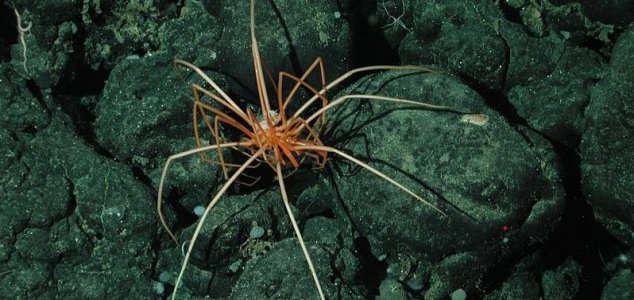
Scientists on ice-breaking research vessels drop their trawling nets into the deep, and what they bring back is breathtaking. Sea spiders with leg spans measuring over 30 inches. That’s two and a half feet. Imagine a creature with the diameter of a car tire, all knobby knees and spindly legs, crawling towards you. These aren’t just big spiders. They are monsters.

How Big Are We Really Talking?

Let’s put this in perspective. The common house spider has a leg span of maybe an inch. The largest terrestrial spider, the Goliath Birdeater, can reach a leg span of about 11 inches—terrifying, but manageable. The giants of the Antarctic dwarf it. They are dinner-plate-sized nightmares. They are so large that their slow, deliberate movements seem almost intelligent, a quality you don’t typically associate with a tiny arthropod.

Video footage from remotely operated vehicles (ROVs) paints an even starker picture. A small, submersible drone sweeps its lights across a barren field of silt on the Antarctic seabed. Then, a shadow moves. A leg, thicker than a man’s thumb and covered in bristles, steps slowly into the frame. The camera pans back to reveal the full creature, a pale, ghost-like behemoth, picking its way through the darkness with an eerie grace. It is a vision from another world.

Cracking the Code: The Hunt for an Explanation

So, what in the world is going on down there? How does a place so cold, dark, and seemingly devoid of resources become a factory for giants? Mainstream science has put forward a few “safe” theories. They’re neat, tidy, and fit within our current understanding of biology. But do they tell the whole story?

Theory 1: The Oxygen Hypothesis

The leading explanation revolves around oxygen. Simple chemistry dictates that cold water can hold far more dissolved gas than warm water. The water at the poles is saturated with oxygen, a super-rich cocktail for life.

For a creature like a sea spider, which lacks complex lungs or gills, this is a game-changer. With so much oxygen easily absorbed through its skin and leg membranes, its body isn’t limited by its ability to breathe. The abundance of O2 allows its tissues to grow larger and larger without outstripping the oxygen supply. It’s like giving an engine a constant supply of high-octane fuel; it can just keep getting bigger and more powerful without hitting a wall.

Theory 2: The Metabolic Deep Freeze

The other major theory points to the cold itself. The near-freezing temperatures of the Antarctic deep slow down every biological process to a crawl. This is called a reduced metabolic rate. The sea spiders’ “internal clocks” are ticking incredibly slowly.

They eat less. They move less. They age slower. They just… endure. While a sea spider in a temperate zone might live for a year or two, these polar giants could be living for decades, or even longer. They grow at a glacial pace, but over a much, much longer lifespan, allowing them to achieve sizes unthinkable for their warm-water cousins. They are the ancient redwoods of the arthropod world, slowly, patiently accumulating size over a vast stretch of time.

Are These Theories Enough?

Maybe. For some, these explanations are sufficient. But for others, they feel incomplete. They raise more questions than they answer. If high oxygen and low metabolism are the keys, why isn’t *every single creature* in the polar deep a giant? Why do some species balloon in size while others remain small? And why are the sea spiders, in particular, such extreme examples of this phenomenon?

The official explanations feel too simple for a mystery this profound. They describe the “how,” but they don’t touch the “why.” To do that, we have to look beyond the textbooks and into the shadows.

Beyond the Textbooks: What Else Could Be at Play?

This is where the story gets really interesting. When the easy answers don’t quite fit, you have to start asking harder questions. You have to consider possibilities that lie on the fringe. Antarctica is a continent of secrets, and its greatest mysteries may not be on the ice, but buried deep beneath it.

A Lost World Beneath the Ice?

We know for a fact that Antarctica is home to a vast network of subglacial lakes. The most famous, Lake Vostok, is a body of liquid water larger than Lake Ontario, buried under two and a half miles of solid ice. It has been sealed off from the outside world for at least 15 million years.

What kind of life has evolved in that isolated, pressurized darkness? Scientists speculate that these lakes could be warmed by geothermal vents, creating unique ecosystems that have followed a completely different evolutionary path. What if these giant sea spiders aren’t a product of the cold ocean, but are actually “escapees” from these hidden worlds? What if they are just the first hint of an entire, unknown biosphere of giants living right under our feet?

Ancient Signals and Unknown Energies

Antarctica is a strange place, magnetically speaking. It’s home to gravitational and magnetic anomalies that scientists still don’t fully understand. Could there be some unknown energy source, some form of natural radiation unique to the pole, that is acting as a mutagenic catalyst on the local fauna? It sounds like science fiction, but nature is often stranger than fiction.

For decades, theorists have whispered about strange goings-on at the South Pole, linking it to everything from crashed UFOs to secret Nazi bases. While those ideas are on the extreme end, the core question remains: is there a unique environmental factor in Antarctica, something beyond just cold and oxygen, that is fundamentally altering life itself? Could these giant creatures be living barometers of a force we have yet to discover?

The Abyss Stares Back: Modern Encounters & Online Whispers

This isn’t just an old sailor’s tale. The evidence keeps piling up with every new deep-sea expedition. Online communities, like Reddit’s r/TheDepthsBelow and r/thalassophobia, are filled with armchair oceanographers and amateur sleuths piecing together ROV footage and scientific papers. Every new clip of a giant pycnogonid fuels the debate.

The problem is the sheer difficulty of research. The Antarctic seafloor is arguably the most hostile and inaccessible environment on Earth. We have better maps of the Moon and Mars than we do of what lies beneath the Southern Ocean. For every one giant we manage to film or catch, how many thousands, or millions, are down there in the dark, completely unseen?

We are peeking through a keyhole into a vast, dark room, and the strange shapes we see moving around are just a fraction of what’s truly there. Every new discovery only deepens the sense that we know absolutely nothing about the bottom of our own world.

What if They’re Not Staying at the Poles?

Perhaps the most chilling thought of all isn’t what these creatures are, but what they might become. For eons, the extreme cold of the Antarctic has acted as a cage, keeping these giants confined to the polar abyss.

But that cage is beginning to rust.

Our planet is warming. The polar oceans are warming faster than anywhere else. The very conditions that may have created these giants—the stable, super-cold, oxygen-rich water—are now in flux. What happens when their ancient, stable environment begins to change?

Do they die off? Or do they adapt?

What happens if a creature perfectly evolved for a low-energy, slow-moving life in the freezer is suddenly introduced to warmer, more energy-rich waters? What happens if they begin to move, to migrate out of the deep polar regions and into the world’s other oceans? We simply don’t know. We have no precedent for this.

The mystery of the giant sea spider is more than just a biological curiosity. It’s a stark reminder that our planet is full of secrets, and that we are not the masters of this world. We are merely inhabitants, living on a thin, fragile crust. Beneath us, in the crushing dark, ancient things are stirring.

The ice at the bottom of the world holds its secrets close. But for how much longer? Down there, in the silent cold, something is growing. And we have no idea what it’s waiting for.

Originally posted 2016-01-16 14:52:23. Republished by Blog Post Promoter