
Home Alien Life Alien Message to Get Reply from Humanity

Alien Message to Get Reply from Humanity

0
56

The 72-Second Mystery: Was the “Wow!” Signal Humanity’s Only Missed Call From The Stars?

What if we’re not alone?

It’s the question that haunts our dreams and fuels our stories. We scan the heavens, building colossal metal ears to listen for the faintest whisper from the cosmic ocean. But what if the call already came? What if, for 72 fleeting seconds, an alien intelligence shouted across the void… and we weren’t quite ready to listen?

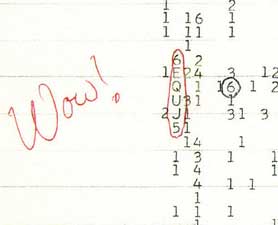
This isn’t science fiction. This is the story of the “Wow!” signal. A ghost in the machine. A single, powerful burst of radio energy from deep space that has defied every explanation for nearly half a century. It arrived without warning and vanished without a trace, leaving behind a single word scrawled in red ink on a dot-matrix printout.

Wow!

Was it a natural phenomenon? A secret military satellite? Or was it proof? The one piece of evidence that changes everything we know about our place in the universe. Let’s dive into the greatest cosmic mystery of all time.

The Night the Universe Spoke

Forget sleek control rooms and giant screens. The story begins in Delaware, Ohio, in the summer of 1977. At Ohio State University’s Perkins Observatory, a massive radio telescope nicknamed the “Big Ear” silently scanned the cosmos. It wasn’t glamorous work. The Big Ear was a behemoth, a fixed instrument the size of three football fields, using the Earth’s own rotation to sweep across the sky.

On the night of August 15, 1977, it was business as usual. The telescope listened, and its computer churned out endless reams of paper, covered in a monotonous cascade of numbers and letters.

Days later, a volunteer astronomer named Dr. Jerry Ehman sat down to do the mind-numbing work of reviewing the data. He was looking for anomalies, for anything that stood out from the background hum of the universe. For hours, it was the same old story. 1s and 2s. The cosmic static.

Then he saw it.

A sequence of characters that made the hair on his arms stand up. Buried in the data stream from the 15th was a signal so strong, so clear, so perfectly artificial-looking that his brain could barely process it. The sequence read: 6EQUJ5.

In the code of the Big Ear, low-power signals were represented by low numbers. Higher numbers meant a stronger signal. Once the scale hit 9, it started using letters. A was stronger than 9. B was stronger than A. U was the highest reading the telescope had ever registered, a blast of energy over 30 times more powerful than the background noise of deep space.

The signal flared up, peaked, and then faded away over the course of 72 seconds—the exact time it took for the Big Ear to drift past that point in the sky. It was a perfect bell curve. It looked exactly like what you’d expect to see if a fixed radio source from another star system was being observed.

Ehman grabbed a red pen. He circled the alphanumeric sequence. In the margin, he wrote the only word that came to mind. “Wow!” The name stuck, echoing through the decades.

01 Positive Alien - Extraterrestrial

Why This Signal Was So Unbelievably Weird

So, we got a strong radio blip. What’s the big deal? The universe is full of noise, right? Stars, quasars, black holes—they all spit out radio waves. But the “Wow!” signal was different. It was special.

Deep Dive: The Cosmic “Watering Hole”

To understand why, you need to know about the “watering hole.” Imagine the entire radio spectrum as a massive, noisy pub. Most of it is full of cosmic chatter. But there’s one quiet little spot, a frequency around 1420 megahertz. This frequency is produced by neutral hydrogen, the most common element in the universe. It’s a natural, universal constant.

Scientists in the 1950s theorized that if any intelligent species wanted to send a “Hello,” they’d choose this quiet, obvious channel. It’s the universal meeting place. The cosmic watering hole.

The “Wow!” signal was parked right in the middle of it. A perfect shot. The odds of a natural phenomenon producing such a strong, narrow-band signal on that exact frequency are astronomically low. It was like hearing a perfect symphony orchestra in the middle of a hurricane.

Pinpointing the Source

The signal came from the direction of the constellation Sagittarius, near a globular star cluster called M55. This patch of sky is teeming with sun-like stars. Billions of them. The perfect place for life to arise. But the Big Ear had two “feed horns,” two receivers that scanned slightly different patches of sky. The signal was only detected by one of them. This let astronomers narrow its location down, but it also deepened the mystery. If it was a continuous signal, the second feed horn should have picked it up a few minutes later as the Earth turned. It didn’t. The signal was gone.

Gone. As if a switch had been flipped somewhere out in the darkness.

The Great Silence: Frantic Searches Find Nothing

The discovery sent shockwaves through the small community of SETI (Search for Extra-Terrestrial Intelligence) researchers. This was it. The moment they had all been waiting for.

Immediately, astronomers pointed other, more powerful telescopes at that exact spot in the sky. They listened. And listened. For weeks. For months. For years.

They found nothing.

Absolute, deafening silence. The signal never repeated. Not once. Over 100 different studies have been conducted, all pointing their instruments at the source of “Wow!” and all have come up empty-handed.

This is perhaps the most unnerving part of the puzzle. What kind of message is only sent once? Was it a beacon from a spacecraft just passing by? A planetary radar sweeping across the galaxy that happened to catch Earth in its beam for 72 seconds? Or was it something more ominous… a warning that was never meant to be repeated?

The Skeptics Fire Back: Could It All Be a Mistake?

For every believer, there’s a skeptic. Science demands proof, and a one-off signal isn’t proof. Over the years, countless theories have been proposed to explain away the “Wow!” signal as something far more mundane.

The Controversial Comet Theory

In 2017, a new theory made headlines. An astronomer named Antonio Paris proposed that the signal wasn’t from aliens, but from a pair of comets (named 266P/Christensen and 335P/Gibbs) that were passing through that region of space at the time. The idea was that the huge hydrogen cloud surrounding a comet could, in theory, generate a radio signal at the 1420 MHz frequency.

It was a neat idea. Tidy. It closed the book on the mystery. For a moment, the internet seemed to accept it. Mystery solved, right?

Wrong.

The original team from the Big Ear observatory shot back. They pointed out several huge holes in the theory. First, the comets weren’t in the exact beam of the telescope on that night. Second, and more importantly, comets are “broadband” emitters. They might produce a hiss of radio noise across many frequencies, but the “Wow!” signal was “narrowband”—a sharp, precise spike on one specific frequency. A comet simply can’t do that. The comet theory was, to put it mildly, debunked by the very people who ran the original experiment.

Was It Just Human Interference?

Could it have been a signal from Earth? Maybe a high-altitude balloon, a secret military experiment, or even just a faulty microwave oven?

This is also incredibly unlikely. That 1420 MHz frequency is a internationally protected part of the spectrum. It’s forbidden for any terrestrial transmitter to broadcast on it for the exact reason that we’re using it to listen for aliens. Furthermore, a signal bouncing off a piece of space junk wouldn’t have the unique characteristics of the “Wow!” signal—the perfect bell curve shape that matched the Earth’s rotation. It looked like it came from a fixed point in deep space.

Every logical, terrestrial explanation has been thrown at the “Wow!” signal, and none of them stick. It remains an anomaly. A true unknown.

Humanity’s Audacious Reply

For 35 years, the signal remained a one-way street. A question without an answer. But then, in 2012, an ambitious project decided it was time to call back.

On the 35th anniversary of the signal’s detection, the National Geographic Channel, in collaboration with the legendary Arecibo Observatory in Puerto Rico, launched the “Wow! Reply” project. The idea was as modern as it was bold: crowdsource humanity’s first direct message to a potential alien intelligence.

Using Twitter, people from all over the world could contribute their own 140-character messages to the cosmic reply. Thousands of messages flooded in—messages of peace, scientific formulas, jokes, poetry, and simple greetings. All of it was collected, encoded into a complex binary signal, and prepared for transmission.

On August 15, 2012, the massive 1,000-foot dish of Arecibo tilted towards the same patch of sky in Sagittarius and blasted the collective voice of humanity into the cosmos.

But this raises a chilling question. Was that a good idea? The “Dark Forest” theory, popularized by science fiction, suggests that the universe might be a dangerous place. A silent, cosmic jungle where civilizations hide, because announcing your presence could attract predators. By shouting “Here we are!” into the void, are we inviting friends? Or are we ringing the dinner bell?

We don’t know. The message is now traveling through space at the speed of light. If anyone is out there, in the direction of the original “Wow!” signal, it will take thousands of years for our reply to reach them. And thousands more for any potential response to get back to us.

The Legacy of a Ghost Signal

Today, the Big Ear telescope is gone, dismantled in 1998 to make way for a golf course expansion. Jerry Ehman, the man who discovered the signal, has maintained that he believes it was of extraterrestrial origin. The original printout, with his iconic red scrawl, is a hallowed artifact in the history of astronomy.

The “Wow!” signal changed the game. It proved that strange, powerful, and unexplainable signals are out there, waiting to be found. It inspired a new generation of scientists and fueled projects like the Breakthrough Listen initiative, which is now scanning the heavens with technology that makes the Big Ear look like a child’s toy.

But the mystery remains. The 72-second ghost still lingers. It stands as a profound and tantalizing reminder that there are things happening in the universe that we do not understand. We live on a tiny, fragile world, adrift in an ocean of stars, and for one brief moment, it’s possible that someone, or something, waved from a distant shore.

We are still listening for them to wave again.

Originally posted 2016-02-29 16:28:10. Republished by Blog Post Promoter