
History is written by the victors. We know this. But what happens when the victors lie? Or worse—what if they simply had no idea what they were talking about? For seventy years, the school textbooks have told you the same dusty story. Adolf Hitler, the monster of the 20th century, bit down on a cyanide capsule and put a bullet in his brain as the Soviet Red Army pounded the streets of Berlin.
Case closed. Evil is dead.
But what if that isn’t true? What if the greatest magic trick in military history was pulled off right under the nose of the Allies? New evidence is tearing the official narrative to shreds.
We are talking about shockwaves. Massive, history-altering shockwaves. Declassified FBI files, modern forensics, and a team of elite man-hunters have cracked open a cold case that was supposed to be frozen solid. The theory? Hitler didn’t die in that bunker. He was ghosted out of a burning Berlin, smuggled across the ocean, and lived out his days plotting a Fourth Reich in the steamy jungles of South America.
Sounds crazy? Maybe. Until you look at the paperwork.
The FBI Files: The Smoking Gun You Weren’t Supposed to See
Imagine this. It’s 1945. The war is ending. The world is celebrating. But in the dark corridors of American intelligence, panic is setting in. They can’t find him. They can’t find the body.
Recently, the FBI cracked the vault. They declassified 700 pages of confidential documents that paint a chaotic, terrifying picture of the post-war manhunt. These aren’t conspiracy blogs. These are official memos from the highest levels of the United States government.
One memo stands out like a neon sign in a dark room. It’s from J. Edgar Hoover himself. The legendary, paranoid director of the FBI. He didn’t mince words. He stated bluntly: “American Army officials in Germany have not located Hitler’s body, nor is there any reliable source that will say definitely that Hitler is dead.”
Read that again.
No body. No proof. Just a burnt patch of dirt and a Soviet promise. And we all know how much the US trusted Joseph Stalin in 1945. The Soviets were playing a game. First, they said he was dead. Then, Stalin looked Winston Churchill in the eye and told him Hitler had escaped to Spain or Argentina. Marshall Zhukov, the head of the Soviet army, admitted, “We have found no corpse that could be Hitler.”
The files go deeper. Reports of sightings. Informants claiming to have seen the Führer stepping off U-boats in Argentina. Descriptions of a man without a mustache, aging, hiding in the foothills of the Andes. For decades, these were dismissed as noise. Now? They look like breadcrumbs.

The Berlin Escape: The “Missing Link” Found Underground
So, how do you get the most recognizable man on Earth out of a city that is being encircled by millions of angry Russian soldiers? You don’t go over the rubble. You go under it.
This is where the story shifts from “maybe” to “how.”
We know for a fact—this is documented history—that on April 21, 1945, a mass exodus took place. Nazi officials, sensitive documents, and personal belongings were frantically loaded onto planes at Tempelhof Airport. Eight planes. Loaded with the Führer’s personal effects. This isn’t speculation. It’s on the shipping manifests.
But the bunker was miles away. The streets were a kill zone. How did he get to the planes?
Enter the investigators. A powerhouse team including Bob Baer (a CIA veteran and the real-life inspiration for George Clooney’s character in Syriana) and Tim Kennedy (a literal giant in the US Special Forces who hunted terror leaders post-9/11). They teamed up with Sascha Keil, a historian who knows the Berlin underground better than anyone.
They treated this like a modern manhunt. No dusty books. Just cold, hard tactics.
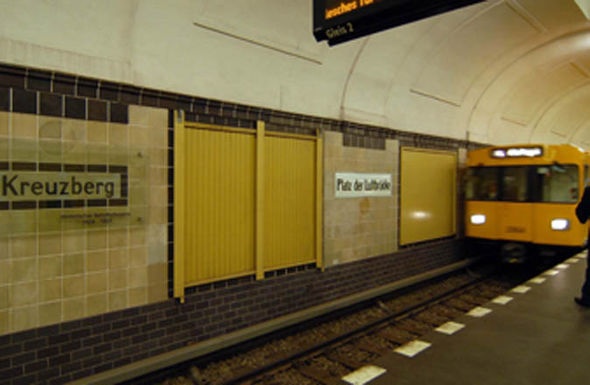
The team found the gap. There was a route from the Führerbunker that stayed underground almost the entire way to Tempelhof Airport. Except for one problem. A 200-yard gap between the subway station (formerly U6, now Luftbrücke) and the airport hangars.
200 yards is a death sentence in a war zone. Unless there was a tunnel nobody knew about.
Using military-grade sonar technology—the kind used to hunt terrorists in caves—the team pinged the subway walls. They were looking for anomalies. Hollow spots.
They found it.
Behind a false wall in the subway station, the sonar picked up a distinct hollow space. A tunnel. It lines up perfectly with the airport. This was the “missing link.” The secret artery that could have pumped the Nazi leadership from the safety of the bunker directly to the tarmac of Tempelhof without ever seeing the sky.
The Ghost Planes of April 21st
Let’s play this out. It’s the middle of the night. April 21st. The last sighting of Hitler was the day before. The tunnel is dark, damp, smelling of ozone and fear. He moves quickly with a small entourage. They pop up inside a hangar at Tempelhof. Engines are already running.
The planes take off. Not just any planes. Long-range Condors. Where do they go? The official history loses track of them. But the flight path to fascist-friendly Spain was open. Franco owed Hitler everything. It was the perfect pit stop before the long jump across the Atlantic.

Phase Two: The Ratlines and the U-Boat Convoy
If he made it to Spain, the next step was the ocean. You can’t fly a 1945 plane to South America easily. But you can take a submarine.
History has always had a weird footnote about the “Grey Wolves”—the Nazi U-boats. In the months after the war officially ended, German submarines were still popping up. Two of them, U-530 and U-977, didn’t surrender in Europe. They stayed submerged for months, ghosting through the Atlantic, only to surface and surrender in Mar del Plata, Argentina. incredibly late.
Why?
Why risk death in a tin can for months after the war is over? Unless the cargo was more valuable than the crew’s lives. The crews were tight-lipped. The logs were missing. But the timing fits the escape timeline perfectly. A flight to Spain in late April. A few weeks to organize. A submarine ride in early summer. Arrival in Argentina in the winter of 1945.
The Jungle Compound: A New Berchtesgaden?
Argentina wasn’t just a random choice. It was the plan. Juan Perón, the president, was an admirer of the axis. He welcomed the Nazis with open arms. Thousands of them flooded in using the “Ratlines” organized by sympathizers in Europe.
But Hitler wouldn’t live in a city. He needed isolation. Security.
Deep in the Argentine jungle, near the border with Paraguay, lies a ruin. It’s called Inalco. It’s not just a house. It’s a fortress. The architecture is bizarrely specific. It doesn’t look South American. It looks Bavarian. It looks like the Berghof—Hitler’s retreat in the Alps.
The investigators found strange things there. German power outlets. expensive, imported materials that shouldn’t be in the middle of a jungle. Security outposts. A water system designed for self-sufficiency. It was a compound built for someone who needed to run a war, or hide from the world, in total luxury.
Locals tell stories of a wealthy German who lived there. They talk about strict security. Trucks coming in at night. It was a state within a state. Was this the Fourth Reich’s headquarters? A place to nurse old wounds and dream of a comeback that never happened?
The DNA Bombshell: The Final Nail in the Coffin?
For years, the skeptics screamed, “But we have the skull! The Russians have the skull fragment from the bunker!”
This was the cornerstone of the suicide story. The Soviets held a piece of skull with a bullet hole in it. They said it was Hitler’s. Case closed.
Until 2009.
That year, an American archaeologist was finally allowed to test the DNA of the skull fragment held in the Russian state archives. The results were a catastrophe for the history books. The DNA didn’t belong to Adolf Hitler. It didn’t even belong to a man.
It was the skull of a woman under the age of 40.
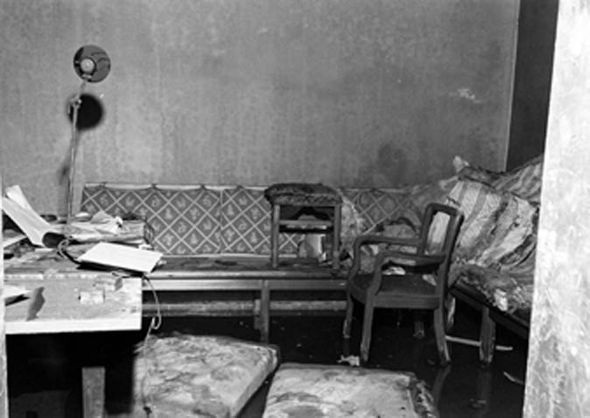
Everything we thought we knew about the physical evidence of Hitler’s death evaporated in a single lab test. The body in the bunker? Gone. The skull? A fake. The blood on the sofa? Who knows whose it was. The timeline? Wide open.
Why This Matters Now
We aren’t just talking about dusty history here. We are talking about the capability of intelligence agencies to shape reality. If the world’s most wanted man could slip away with an entourage and a fortune in stolen gold, what else have we missed?
The FBI files don’t say “he definitely escaped.” But they scream that “we never proved he died.”
Bob Baer, the CIA veteran leading the charge on this investigation, put it best. He looks at the tunnel, the planes, the U-boats, and the jungle compound, and he sees a pattern he recognizes from his own work in espionage. It’s a classic extraction operation. It has all the hallmarks of a professional disappearance.
The 20th century’s biggest villain may not have ended with a bang, but with a cocktail on a veranda in South America, watching the sun set over the jungle, laughing at the world he left behind.
The history books are still rewriting this chapter. And with every new document that gets declassified, the ink gets a little bit messier.